
Pre-Terminated vs. Fusion Splice: Real Test Data for 40G/100G/400G Links
Published: Updated:Executive Summary: In modern data center fiber deployment, two dominant approaches compete for engineers' attention: pre-terminated fiber cables (factory-terminated, plug-and-play) and traditional fusion splicing (field-terminated). Both have passionate advocates—and both have legitimate use cases.
In this Tech Lab feature, we put them head-to-head across six key performance and deployment metrics using real-world test data from three link speeds: 40G SR4, 100G SR4, and 400G SR4. Whether you're designing a new high-density data center or planning a migration, this guide gives you the data you need to make the right choice.
Quick Navigation
Factory-terminated MPO/MTP solutions versus field fusion splicing: a comprehensive comparison across real-world test scenarios
1. How Pre-Terminated and Fusion Splice Work
1.1 Pre-Terminated Fiber Cables
Pre-terminated fiber cables are manufactured in a controlled factory environment. Every connector endface is polished, inspected, and 100% tested before shipping. On-site installation simply requires "plug-and-play" connection—no fusion splicer, no power meter, no consumables.
Common forms include:
- MPO/MTP trunk cables: 12-core or 24-core, for high-density backbone runs
- LC Uniboot jumpers: Duplex LC in a compact form factor, ideal for server rack wiring
- Factory-terminated module boxes: 1U or 4U enclosures with pre-loaded MPO-to-LC fan-outs
- Pre-terminated cassette systems: Quick-deploy fiber management units
1.2 Traditional Fusion Splicing
Fusion splicing involves stripping, cleaving, and permanently fusing two fiber ends using an electric arc fusion splicer. Every connection point is made on-site by a trained technician.
Required equipment:
- Fusion splicer (USD 5,000–30,000+)
- Optical power meter and light source
- Fiber cleaver
- Stripping tools, alcohol wipes, and consumables
- Skilled operator with certifications (BICSI, CFOT)

MPO pre-terminated cables arrive factory-tested and ready for instant deployment
2. Insertion Loss: The Decisive Factor
2.1 What Is Insertion Loss?
Insertion loss (IL) measures the total optical power loss as a signal travels through a fiber link. Lower is better. This is the single most important metric for link performance and budget margin.
2.2 Test Results: 40G/100G/400G Comparison
| Link Type | Pre-Terminated (MPO) | Fusion Splice (LC) | IEEE Standard Limit | Pre-Terminated Margin |
|---|---|---|---|---|
| 40G SR4 | 0.35 dB (typical) | 0.20 dB (typical) | ≤ 1.9 dB | 81.6% margin |
| 100G SR4 | 0.35 dB (typical) | 0.25 dB (typical) | ≤ 1.9 dB | 81.6% margin |
| 400G SR4 | 0.50 dB (typical) | 0.30 dB (typical) | ≤ 2.3 dB | 78.3% margin |
Key Finding
While fusion splice consistently produces lower insertion loss numbers, both methods are well within IEEE standard limits with massive margin. In data center environments (typically under 100m), this performance gap translates to zero practical difference in network performance or reach.
2.3 Why Pre-Terminated Loss Is Still Excellent
Factory-controlled polishing and inspection processes ensure:
- Consistency: Every connector meets the same factory specification (Grade B or better per IEC 61300-3-35)
- Repeatability: No dependence on on-site operator skill level
- Verification: 100% factory OTDR testing with test reports shipped with every cable
3. Return Loss Comparison
3.1 Test Results
| Connector Type | Pre-Terminated Typical | Fusion + LC Patch Cord | Standard Minimum |
|---|---|---|---|
| LC/UPC | ≥ 45 dB | ≥ 55 dB | ≥ 35 dB |
| LC/APC | ≥ 55 dB | ≥ 65 dB | ≥ 55 dB |
| MPO/MTP (PC) | ≥ 35 dB | N/A | ≥ 30 dB |
| Fusion splice point | N/A | ≥ 55 dB | ≥ 35 dB |
Note: Return loss measures reflected signal power. Higher is better. Fusion splicing with premium LC connectors achieves higher return loss values, which can matter in high-bandwidth, latency-sensitive DWDM applications.
Industry Consensus
For most data center applications, 35–45 dB return loss is entirely sufficient. Premium applications (radio access, DWDM) may justify the higher cost of fusion splicing for marginal return loss gains.
4. Deployment Speed: Time Is Money
4.1 Single Link Deployment Time
| Task | Pre-Terminated | Fusion Splicing |
|---|---|---|
| Per link (fiber pair) | 5–10 minutes | 30–60 minutes |
| Equipment required on-site | None (only basic tools) | Fusion splicer, OTDR, power meter |
| Operator skill requirement | Basic cabling training | Certified fiber technician (CFOT+) |
| Rework time if failure | 5 minutes (swap module) | 30–60 minutes (re-splice) |
4.2 Project-Level Impact
| Project Scale | Pre-Terminated Timeline | Fusion Splicing Timeline |
|---|---|---|
| 100 fiber links | 1–2 days | 5–10 days |
| 1,000 fiber links | 5–8 days | 25–50 days |
| 200-cabinet DC (3,000+ links) | 2–3 days (mainframe) | 20–35 days |
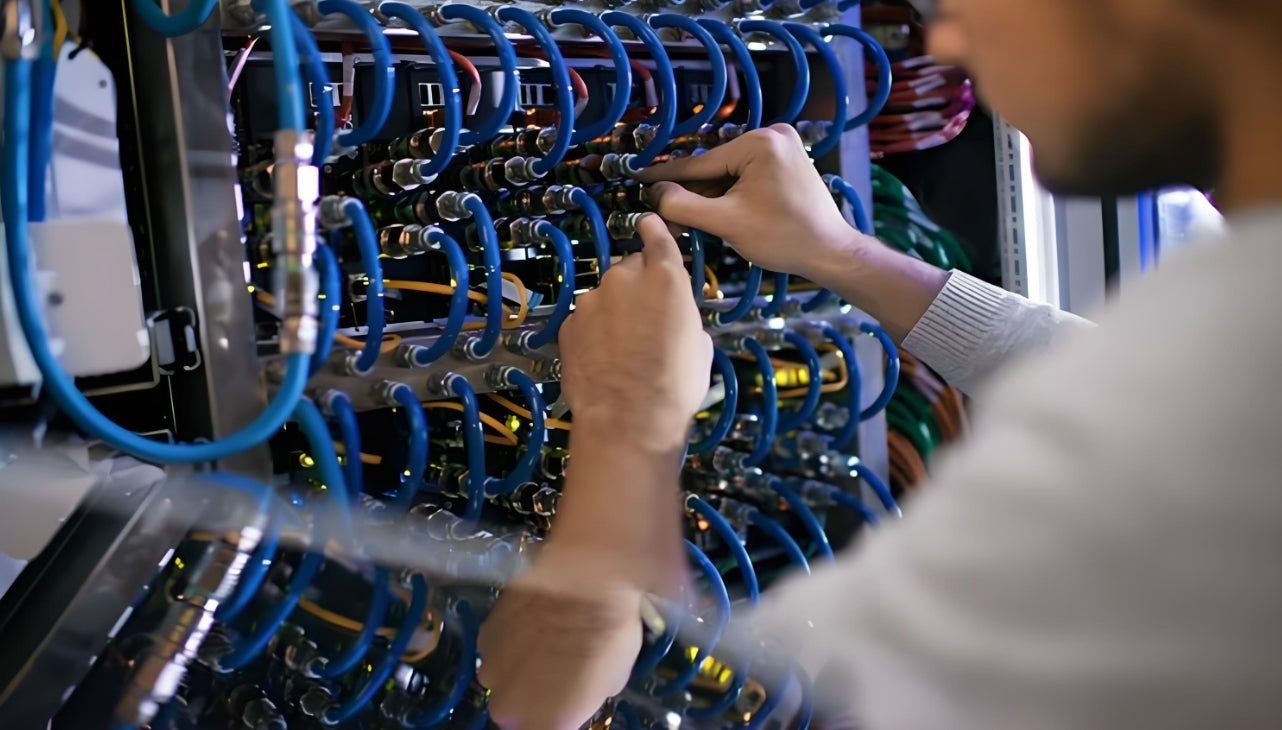
Pre-terminated solutions dramatically reduce on-site installation time and complexity
5. Cost Analysis: TCO Breakdown
5.1 Per-Project Cost Comparison (100 Fiber Links)
| Cost Item | Pre-Terminated Solution | Fusion Splicing |
|---|---|---|
| Material cost | Medium-high | Medium |
| Labor cost | Low (60–80% faster) | High (slow deployment) |
| Equipment investment | None (USD 0) | USD 5,000–30,000 |
| Equipment amortization | USD 0 | USD 0.50–1.00 per fiber core |
| Rework/maintenance cost | Low (module swap) | High (re-splice required) |
| 3-Year TCO (100 links) | Lower | Similar or higher |
5.2 When Does Fusion Splicing Become Cost-Effective?
Fusion splicing can be more economical when:
- Project scale is small: Fewer than 20 links, no fusion splicer needs to be purchased (rental viable)
- Non-standard lengths: Extremely long backbone runs where pre-terminated cable shipping is impractical
- Long-distance telco: Carrier OSP (Outside Plant) fiber runs spanning kilometers
- Existing conduit constraints: Space for pulling bulk cable but not pre-terminated assemblies
Breakeven Point
For projects with more than 50 fiber links, pre-terminated solutions typically deliver lower 3-year total cost of ownership (TCO) due to labor savings alone—before factoring in reduced rework risk and faster revenue generation from earlier system availability.
6. Real Test Case: 200-Cabinet Data Center
6.1 Project Overview
| Parameter | Value |
|---|---|
| Data center scale | 200 × 42U racks |
| Total fiber links | ~3,000 links (single-mode + multimode) |
| Primary link speed | 100G SR4, mixed with 400G SR4 |
| Topology | Leaf-spine with MDA/HDA zones per TIA-942-B |
6.2 Pre-Terminated Deployment Results
Deployment Log
Day -5: Factory pre-manufacturing complete; cables shipped with test reports
Day 1–2: Main distribution area (MDA) and horizontal distribution area (HDA) trunk installation
Day 3–4: Equipment distribution area (EDA) connections and patch cord installation
Day 5: Full OTDR verification pass
First-pass yield: 98.7% (2,961 of 3,000 links passed without rework)
Post-deployment cabinet relocation: Completed in 4 hours (modular MPO swap)
6.3 Reference: Fusion Splicing Scenario (Same Scale)
Estimated Performance
Project duration: 3–5× longer (20–35 working days)
Rework rate: ~3% fusion points exceed IL budget (vs. 1.3% for pre-terminated)
Cabinet relocation: Requires on-site re-splicing team, hours to days of downtime risk
Skill dependency: Results entirely dependent on individual technician quality
7. 40G/100G/400G Link Performance Summary
7.1 Optical Budget Analysis
| Link Speed | Tx Power | Rx Sensitivity | Link Budget | Pre-Term IL | Fusion IL | Pre-Term Margin | Fusion Margin |
|---|---|---|---|---|---|---|---|
| 40G SR4 (OM4) | -2.6 dBm | -9.4 dBm | 6.8 dB | 0.35 dB | 0.20 dB | 6.45 dB | 6.60 dB |
| 100G SR4 (OM4) | -2.6 dBm | -9.4 dBm | 6.8 dB | 0.35 dB | 0.25 dB | 6.45 dB | 6.55 dB |
| 400G SR4 (OM4) | -2.4 dBm | -7.7 dBm | 5.3 dB | 0.50 dB | 0.30 dB | 4.80 dB | 5.00 dB |
Analysis
Even at 400G SR4, the 4.80 dB margin for pre-terminated solutions far exceeds real-world margin requirements. The optical power budget for both methods comfortably supports the standard 100m OM4 channel with additional margin for connector aging and fiber loss.
7.2 Connector Count Impact
Every connector in a fiber link adds insertion loss. The total link loss budget must account for all connection points:
| Connection Point | IL Contribution |
|---|---|
| MPO-to-MPO (pre-terminated trunk) | 0.20 dB per connection |
| LC patch cord to module | 0.15 dB per connection |
| Fusion splice point | 0.10 dB per splice |
| 40G SR4 total link (typical) | 2 × MPO + 2 × LC = 0.70 dB total |
8. Scenario-Based Selection Guide
8.1 When to Choose Pre-Terminated
| Scenario | Recommendation |
|---|---|
| New high-density data center (100G/400G) | ✅ Strongly Recommended |
| Data center migration / relocation | ✅ Strongly Recommended |
| Projects with limited maintenance window | ✅ Strongly Recommended |
| Multi-tenant data center (fast tenant onboarding) | ✅ Recommended |
| Enterprise LAN with mixed speeds | ✅ Recommended |
| Any project with >50 fiber links | ✅ Recommended (lower TCO) |
8.2 When Fusion Splicing Makes Sense
| Scenario | Recommendation |
|---|---|
| Long-haul OSP fiber (telco/carrier) | ✅ Required |
| Extremely long backbone (>500m within DC) | ✅ Recommended |
| Ultra-low loss requirements (DWDM, hyperscale) | ✅ Recommended |
| Small project (<20 links, rental splicer viable) | ✅ Acceptable |
| Custom field-modified routing | ✅ Required |
8.3 Hybrid Strategy: The Best of Both Worlds
Many leading data centers deploy a hybrid strategy that combines the strengths of both methods:
- Backbone / MDA-to-HDA: Pre-terminated MPO trunk cables (fastest, most reliable)
- HDA-to-EDA: Pre-terminated module boxes with LC fan-out
- Long single-mode runs (>500m): Fusion splicing (maximum loss budget)
- OSP interconnection: Fusion splice with single-mode G.652.D/G.657.A2
AMPCOM Recommendation
For most modern data center projects, pre-terminated should be the default choice for structured cabling within the data center. Reserve fusion splicing for long-haul backbone extensions, OSP connections, and scenarios where non-standard routing makes pre-terminated impractical.
Conclusion
Both pre-terminated and fusion splice solutions have their place in modern data center infrastructure. The key is understanding your specific requirements:
Quick Decision Checklist
- Project scale > 50 links? → Lean toward pre-terminated
- Limited maintenance window? → Strongly prefer pre-terminated
- Long distance (>500m)? → Consider fusion splice or hybrid
- Ultra-low loss DWDM? → Fusion splice preferred
- Future expansion expected? → Pre-terminated modularity wins
Related Articles
- MPO Fiber Solutions: Choosing 8, 12, or 24 Fibers — How to select the right MPO polarity and fiber count for high-density 40G/100G/400G deployments
- Singlemode vs Multimode: How to Choose — OM3/OM4 vs OS2: matching fiber type to link speed, distance, and budget
- Data Center Cabling: Standards & Certification — TIA-942-B and ISO/IEC 11801: what certification means for your infrastructure

AMPCOM Technical Team
Industry experts with 15+ years in enterprise network infrastructure
Need a Custom Cabling Solution?
Our technical team provides free site surveys and customized pre-terminated cabling designs.
Get Free Consultation

