
From Data Center to Outdoor Plant: How AMPCOM Delivers Engineer-Verified Reliability for Next-Generation Networks
Published:Executive Summary: The architecture of enterprise networks, hyperscale data centers, and telecommunications infrastructure is evolving at an unprecedented pace. As AI-driven intelligence clusters surge and fiber extends deeper into the edge and communities, network engineers face multidimensional challenges: they must drastically increase optical layer density while rigorously controlling optical power budgets, physical durability, and total cost of ownership (TCO). At AMPCOM, we approach fiber optic manufacturing not from the perspective of traditional brand premiums, but from the standpoint of precision materials science and rigorous metrology. From ultra-low-loss MTP® interconnect components designed for 800G clusters to high-strength All-Dielectric Self-Supporting (ADSS) aerial cables built for harsh environments, AMPCOM delivers telco-grade components that fully comply with the stringent deployment standards of global enterprises and mission-critical networks.
Quick Navigation
- 1 High-Density Optical Interconnect: Precision Matching of Architecture and Media
- 2 Structural Density: Deep Comparison of MPO vs Genuine MTP® Connection Technology
- 3 Precision Metrology: Fully Quantified Physical Layer Verification
- 4 Steel Defense: Heavy-Duty Outdoor Plant (OSP) Cable Engineering
- 5 Industrial-Grade and Special Project Reliability
- 6 Conclusion: Data-Driven Infrastructure Scalability
- 7 Contact AMPCOM Network Technology Experts
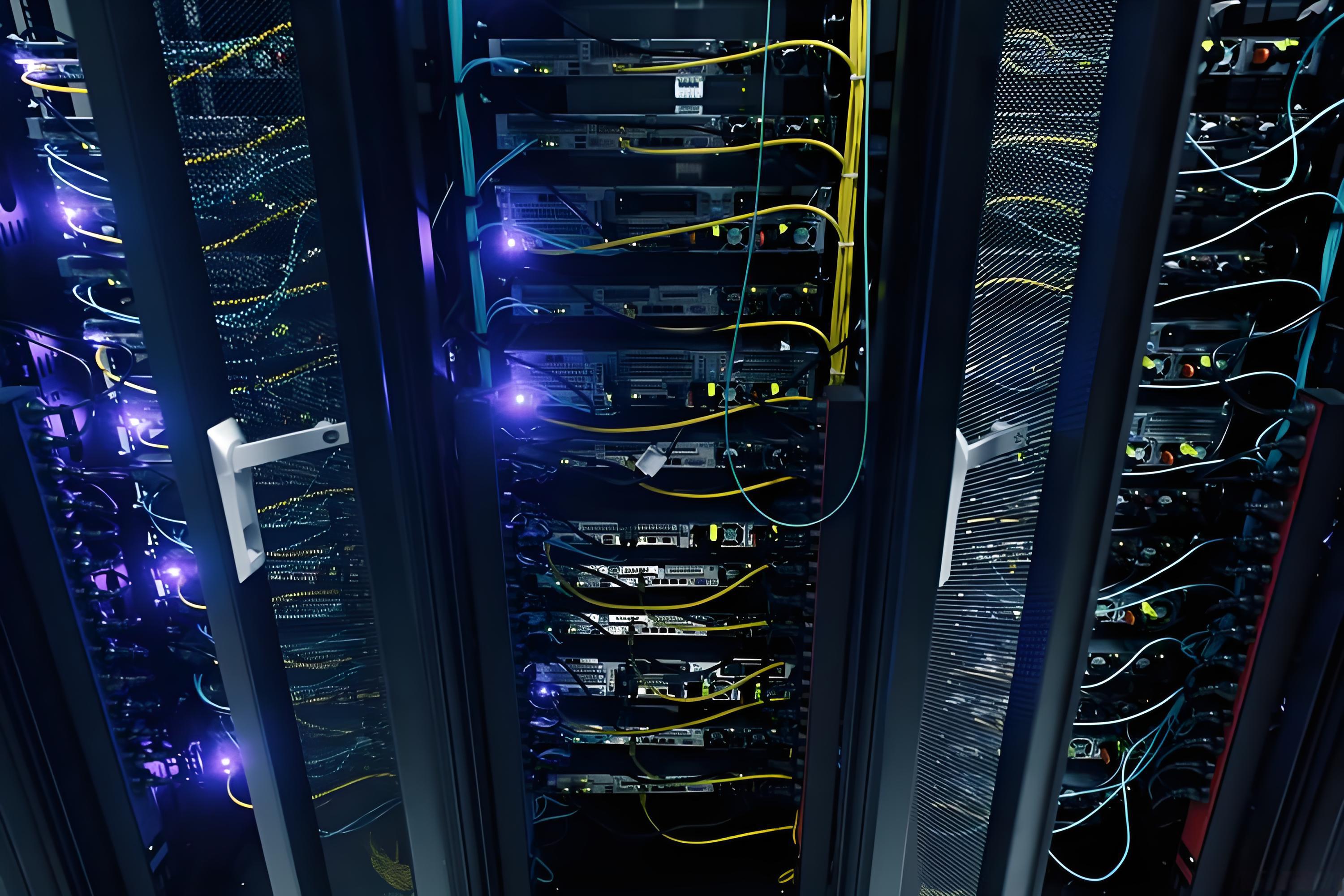
AMPCOM's precision-manufactured fiber optic components deliver engineer-verified reliability for 800G data center and outdoor plant deployments
Chapter 1: High-Density Optical Interconnect — Precision Matching of Architecture and Media
Modern data center networks do not rely on a single transmission medium. Instead, bandwidth demands are precisely partitioned into different physical boundaries based on distance, optical module cost, and port density. AMPCOM manufactures a comprehensive, optimized product portfolio tailored to these clearly defined boundaries.
Short-Reach Interconnect Solutions: DAC or AOC?
For intra-cabinet routing, power efficiency and latency determine component selection.
Direct Attach Copper (DAC): For links from Top-of-Rack (ToR) switches to server NICs within a cabinet (typically 0.5 m to 2 m), AMPCOM's passive DAC assemblies provide near-zero latency and power consumption. In 400G/800G architectures, when traditional copper cables reach their physical attenuation limits, we offer active copper solutions (AEC/ACC) to maintain high-frequency signal integrity across local cabinet rows.
Active Optical Cables (AOC): When links span cabinet rows (3 m to 30 m) and copper cables become too bulky or suffer from severe high-frequency loss, AMPCOM's AOCs provide an integrated, pre-tested alternative. By permanently bonding optical transceivers directly to both ends of the fiber at the factory, we eliminate the risk of fiber end-face contamination for field installers, thereby accelerating network commissioning speed.
High-Speed Structured Cabling: OM4, OM5, and Single-Mode Fiber (SMF)
Beyond cabinet rows, backbone structured cabling requires precise selection of the glass core based on multi-wavelength engineering techniques.
OM4 and OM5 Multimode Optimization: For short-reach multimode networks using MPO/MTP parallel optics technology, AMPCOM uses laser-optimized, bend-insensitive fiber. Our OM4 assemblies support transmission up to the physical distance limit of multimode fiber in multi-lane configurations (such as 400G/800G SR8); our OM5 (Wideband Multimode) solution is specifically designed for multi-wavelength division multiplexing (such as SWDM4). This enables up to 400% capacity increase per fiber pair within the 850 nm–950 nm spectral band, significantly reducing the physical cable count of structured cabling.
Single-Mode Infrastructure: For long-haul backbones, metropolitan area networks, and distributed leaf-spine data center topologies that exceed multimode boundaries, AMPCOM delivers ultra-low-loss single-mode (OS2) fiber channels, designed to maximize transmission distance for high-power silicon photonics and EML optical modules.
Q: Since single-mode fiber transmits over long distances, why use DAC, AOC, or multimode OM5 for short-reach interconnects?
A: This is entirely determined by the network-level "power consumption and module cost budget." While single-mode fiber itself is inexpensive and high-performing, the optical modules paired with it have complex internal structures and high prices. Within 2 m inside a cabinet, using DAC pure-copper direct connection achieves near-zero power consumption and extremely low procurement cost; between cabinet rows, AOC eliminates complex on-site cleaning and commissioning in the data center; and the OM5 multimode solution, combined with Short Wave Division Multiplexing (SWDM4) technology, can carry massive bandwidth with a minimal number of fiber cores, significantly optimizing the Total Cost of Ownership (TCO) of hyperscale data centers.
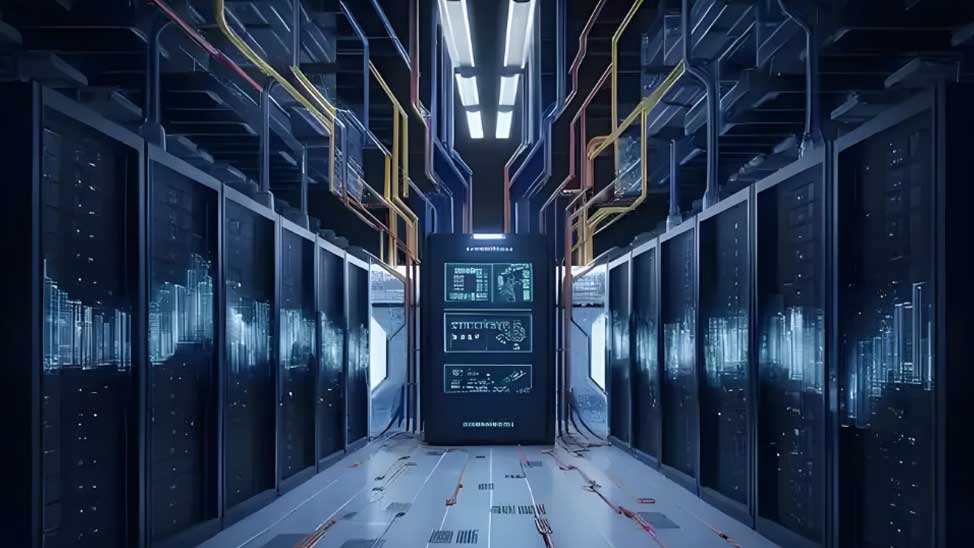
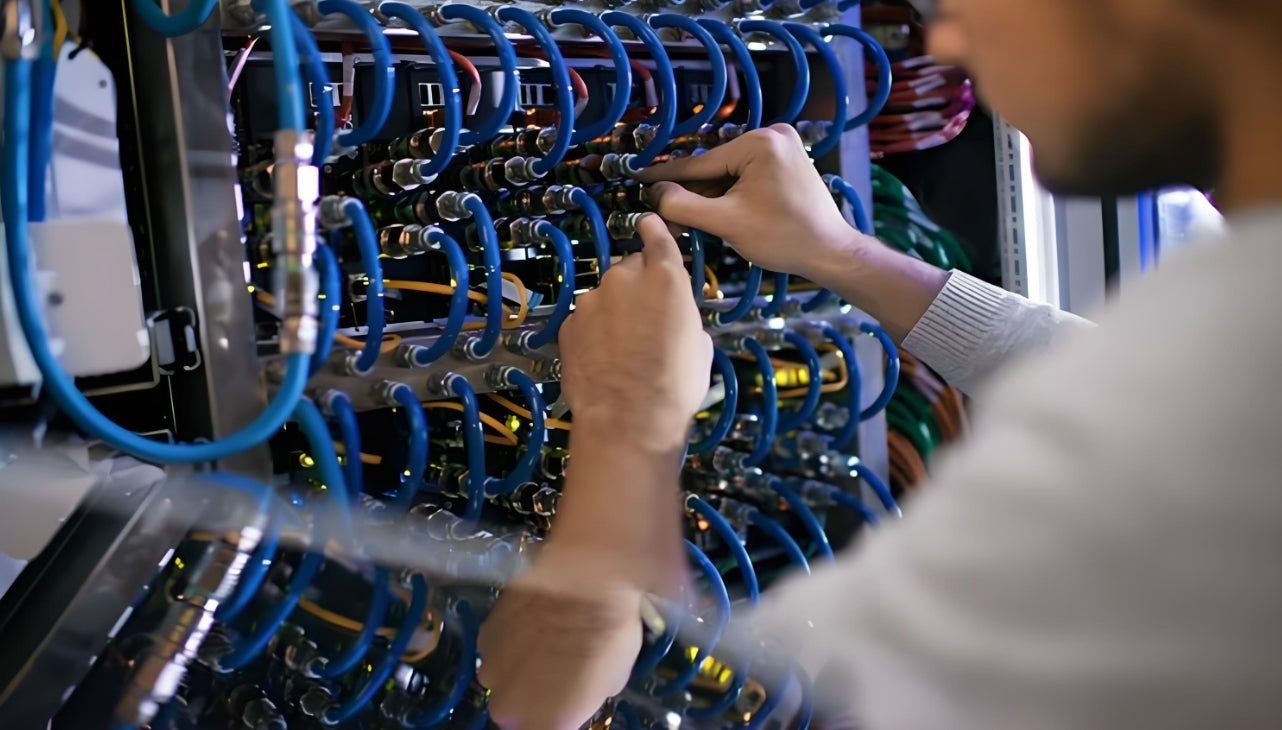
High-speed fiber optic cabling in modern data centers: OM4/OM5 multimode and MTP interconnects form the backbone of 400G/800G AI clusters
Chapter 2: Structural Density — Deep Comparison of MPO vs Genuine MTP® Connection Technology
The transition to 400G and 800G high-speed networks heavily depends on multi-fiber parallel optics technology. However, due to microscopic mechanical misalignment, multi-fiber connectors exponentially amplify the risk of Insertion Loss (IL) and Return Loss (RL).
To ensure extreme network stability, AMPCOM's high-density backbone trunk cables offer premium customization options using genuine US Conec MTP® connectors.
Mechanical Tolerance Control
Unlike ordinary MPO assemblies, MTP® ferrules incorporate a floating ceramic guide pin design that maintains perfect physical contact at the end-face even when the cable is under tensile load. Meanwhile, its highly precision-machined oval guide pin design substantially reduces mechanical wear during repeated mating cycles.
Ultra-Low-Loss (ULL) Calibration
AMPCOM's high-end ultra-low-loss MTP® assemblies strictly control insertion loss indicators at ≤0.35 dB (standard Elite grade) to ≤0.25 dB (select-grade custom). This exceptional performance perfectly matches the demanding optical loss budget requirements of modern high-density leaf-spine routing matrices and modular distribution boxes.
Q: What is the essential technical difference between MPO and MTP® cables? What does AMPCOM offering MTP® mean?
A: MPO is the international generic industry term for multi-fiber optical connectors, while MTP® is a registered trademark of US Conec (USA), representing the "luxury high-end configuration" of MPO connectors. MTP® internally integrates precision mechanical improvements such as floating ferrules and oval guide pins, resulting in minimal mating wear and extremely precise alignment. AMPCOM's ability to deliver genuine MTP® backbone trunk cables means our production line has introduced precision grinding and assembly processes that comply with original factory specifications, capable of suppressing multi-fiber connector insertion loss to an ultimate ≤0.25 dB level, thereby satisfying the minimal attenuation requirements of high-compute networks such as 800G.
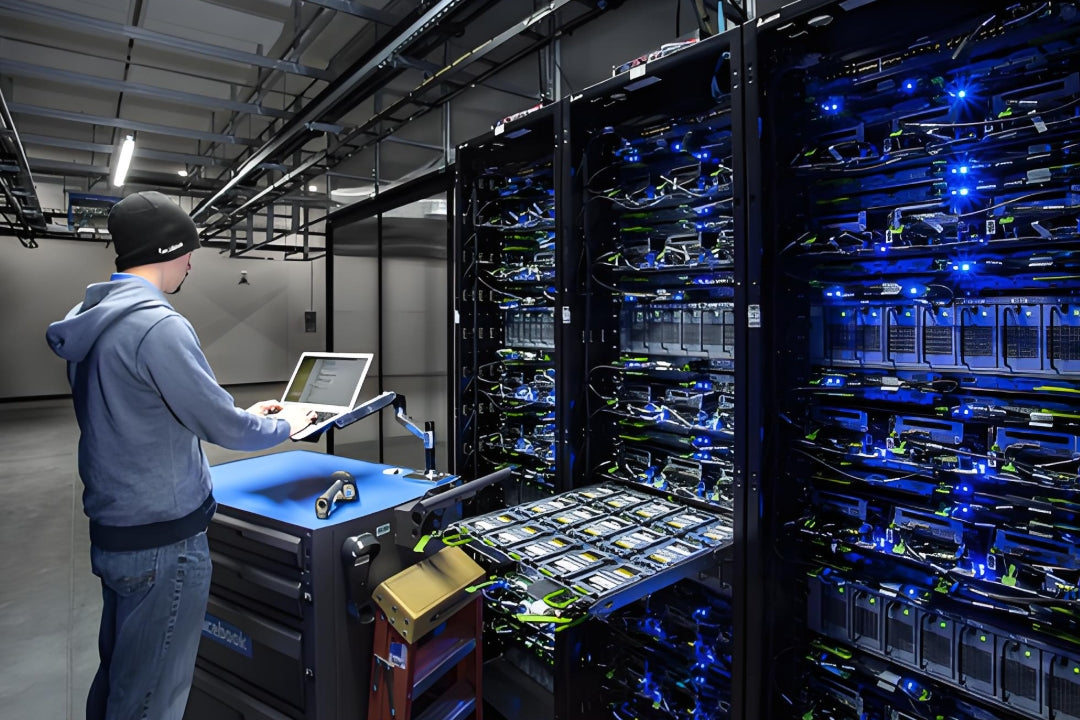
Genuine MTP® connectors with floating ferrule design deliver ultra-low-loss performance (≤0.25 dB) required for 800G AI data center interconnects
Chapter 3: Precision Metrology — Fully Quantified Physical Layer Verification
In ultra-high-speed data communication environments, "guessing by experience" is a major taboo in engineering deployment. AMPCOM thoroughly eliminates quality fluctuations in mass production by building a standards-aligned, data-driven quality verification system based on objective data.
100% Full-Volume Automated 3D Interferometer Verification
Every enterprise-grade and data-center-grade pre-terminated patch cord assembly manufactured by AMPCOM must pass full-volume 3D interferometer geometric calibration before leaving the factory. We precisely quantify and record the physical geometry of the polished ceramic ferrule end-face, ensuring full compliance with strict geometric window indicators:
3D Interferometer Scan Parameters
Radius of Curvature: Ensures the end-face curvature is within the optimal physical contact pressure range, preventing material fatigue or air gaps caused by excessive or insufficient pressure.
Apex Offset: Strictly limits the physical deviation between the highest point of the polished spherical surface and the optical fiber center point to the nanometer level, preventing micro-air gaps from forming during physical contact.
Fiber Undercut / Protrusion: Precisely adjusts the indentation or protrusion height of the fiber core relative to the ferrule end-face, avoiding surface abrasion or mating degradation during field insertion/removal.
Strict Adherence to IEC 61300-3-35 International End-Face Standards
Under prolonged exposure to high-power 800G intelligent computing lasers, even a tiny particle as small as 0.5 µm on the fiber end-face can instantly become a massive light-absorbing "black hole," leading to local fiber burn or severe signal attenuation. AMPCOM performs fully automated digital microscope visual scanning on all optical areas of our products, strictly enforcing IEC 61300-3-35 standards.
We include original factory Fluke® test link reports and independent 3D metrology parameter sheets with every batch of custom orders, ensuring the delivery of a completely traceable and auditable healthy physical layer.
Q: Why does AMPCOM emphasize that factory products must 100% pass 3D interferometer and end-face full inspection?
A: Because in 400G/800G ultra-high-speed data networks, the fault tolerance rate is nearly zero. Even nanometer-level geometric deviations (such as apex offset) on a fiber mating end-face, or micron-level scratches and contamination, can cause devastating optical signal return loss or connector burnout when facing high-power lasers. AMPCOM abandons sampling inspection and insists on 100% telco-grade full inspection, with Fluke® link reports and 3D data sheets included with each shipment, in order to guarantee to engineers worldwide with quantifiable scientific data: every cable shipped is physically zero-defect.
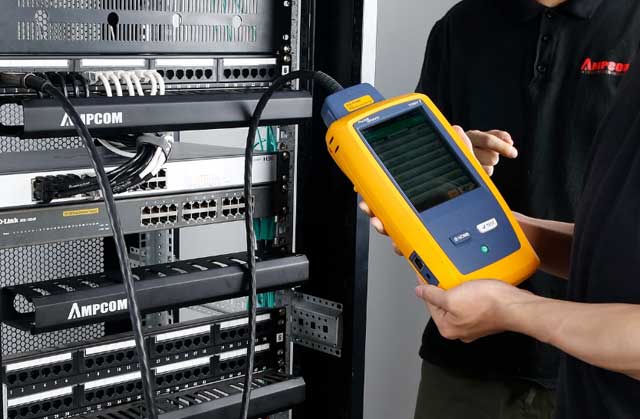
AMPCOM 100% full-inspection workflow: every cable is verified by 3D interferometer and automated end-face microscopy before shipment
Chapter 4: Steel Defense — Heavy-Duty Outdoor Plant (OSP) Cable Engineering
After exiting the climate-controlled data center, long-haul outdoor cables must endure extremely harsh natural environments year-round, including moisture hydrogen loss, drastic temperature swings, typhoon gravity stress, and physical gnawing by rodents. AMPCOM's outdoor cable system, through multi-layer physical defense design, ensures excellent transmission performance over a long life cycle.
Advanced Water-Blocking and Hydrogen Loss Comprehensive Protection
If moisture and humidity penetrate into the interior of the cable, they not only squeeze the fiber due to ice expansion in cold regions, but also decompose to generate hydrogen, causing a "hydrogen aging" phenomenon that permanently increases the fiber's attenuation coefficient. AMPCOM's outdoor cables are fully filled with high-purity thixotropic water-blocking gel inside the loose tubes, perfectly encasing the fiber cores. Simultaneously, the cable core voids are supplemented with longitudinally wrapped water-swellable tapes. Once the outer jacket suffers accidental damage, the water-blocking material rapidly expands within seconds to form a solid internal water dam, preventing moisture from spreading longitudinally inside the cable.
Double-Side Plastic-Coated Corrugated Steel Tape Armor (GYTS / GYTA)
For direct-burial, trenching, and underground pipeline duct laying scenarios, AMPCOM provides outer jacket cables with double-side plastic-coated corrugated steel tape (CST) armor. This robust continuous metal barrier layer gives the cable extremely high mechanical crush resistance and impact strength, effectively preventing damage from excavation settlement and rodent destruction, ensuring absolute physical security of remote terrestrial backbone network assets.
All-Dielectric Self-Supporting (ADSS) Aerial Cable System
When performing long-span aerial laying across mountainous canyon areas, or when directly hung near high-voltage power transmission lines ("fiber along the way" cabling), metallic material cables introduce extremely high lightning strike and induced electrical breakdown risks.
ADSS Technical Advantages
100% Non-Metallic Electrical Safety: AMPCOM ADSS cables adopt a completely metal-free all-dielectric architecture, utilizing high-modulus fiberglass reinforced plastic (FRP) as the central strength member, thoroughly eliminating the risks of strong electromagnetic interference, lightning induction, and tracking-induced corrosion near high-voltage power grids.
High-Strength Aramid Yarn Tension Bearing: All structural tension of the cable when suspended in the air is fully borne by the internally high-density braided premium aramid yarn (Kevlar-class material). AMPCOM scientifically calculates and customizes the braiding density of the aramid yarn based on the gust wind speed, ice coating thickness, temperature variations, and precise span distance requirements of different deployment regions. This ensures that in long-span suspensions of hundreds of meters, the fragile internal glass fiber cores do not share even a fraction of the external tensile force, guaranteeing their long-term attenuation stability.
Q: When aerially laying communication cables on strong-EMF high-voltage power towers, how should safety and reliability be ensured?
A: This scenario requires the use of AMPCOM's ADSS all-dielectric self-supporting aerial cables. First, it removes all metal materials (using FRP fiberglass central strength members), thoroughly avoiding the risks of electrical induction and lightning breakdown; second, all wind loads, ice loads, and the cable's own gravity during aerial installation are fully absorbed and borne by the internally braided high-elasticity, high-modulus aramid yarn layer. AMPCOM adjusts the aramid quantity elastically based on the extreme meteorological history of the project location, ensuring the internal precision fiber cores maintain a "zero-stress state" during long-span aerial suspension over the long term.
AMPCOM outdoor plant cables feature Corrugated Steel Tape (CST) armor and ADSS all-dielectric designs for harsh environmental deployments
Chapter 5: Industrial-Grade and Special Project Reliability
AMPCOM's production processes and delivery standards have been widely deployed and validated in numerous long-cycle special engineering projects, field mobile communications, complex utilities, and national infrastructure projects with high security requirements.
Ruggedized Specifications
Extended Wide-Temperature Weather Resistance: Our special heavy-duty outdoor cables are given an extremely wide temperature adaptation range, capable of maintaining normal transmission characteristics in extreme freezing and scorching heat environments from -40°C to +70°C (-40°F to 158°F), with the jacket remaining non-brittle in extreme cold and internal gel not migrating or leaching under high heat.
Tactical Ruggedization: For scenarios requiring high-frequency insertion/removal and coiling/uncoiling in mobile emergency communications or field temporary cabling, we manufacture special field cables encapsulated with heavy-duty Thermoplastic Polyurethane (TPU) elastomer outer jackets. Internally reinforced with high-density aramid layers, these cables possess extremely strong memory elasticity and tensile resistance, and can rapidly recover their original shape even after being repeatedly run over and trampled by heavy industrial vehicles.
High-Transparency Supply Chain: AMPCOM maintains vertical control of the entire process from raw material procurement, cabling, grinding processes, to end-point optical inspection. This not only eliminates the delivery schedule and quality black-box risks brought by multi-layer subcontractors, but also provides solid supply guarantees for sensitive enterprise and public institution projects with extremely high compliance requirements for security continuity and component traceability.
Q: Facing harsh applications with frequent heavy vehicle rolling and repeated field deployment/recovery, ordinary cables easily break internally. What engineering solution does AMPCOM offer?
A: Such extreme scenarios are suitable for AMPCOM's TPU special tactical field cables. We discard ordinary PVC/PE plastics and adopt Thermoplastic Polyurethane (TPU) jackets that combine rubber elasticity and plastic strength, with a large amount of bulletproof-grade aramid fiber protection mesh filled inside. This high-elasticity, damage-resistant structure enables the outer jacket to recover to its original shape within seconds after suffering heavy rolling by industrial vehicles or high-tension pulling in the field, thereby perfectly protecting the internal fiber physical path from even the slightest mechanical damage.
Chapter 6: Conclusion — Data-Driven Infrastructure Scalability
Planning a network with a robust life cycle is essentially about finding the golden balance between technical indicators, environmental tolerance, and capital utilization efficiency.
With clear, transparent metrology and high-standard precision manufacturing, AMPCOM provides a set of hard-core solutions with greater engineering value and certainty for global network construction:
AMPCOM Solution Matrix
For High-Density Computing Centers: We deliver 100% verified, ultra-low-loss MTP® and single-mode fiber systems, perfectly integrating into 400G/800G demanding optical loss budgets.
For Campus and Metropolitan Backbones: We provide full-scenario options in DAC, AOC, and multi-fiber backbone trunk cables to match your specific topology distance and cost budget.
For Outdoor Plant Networks: Our armored CST metallic cables and non-metallic ADSS aerial cables deliver reliable physical defense lines for complex field all-weather environments.
Use clear, objective technical verification to activate the new leap of your next-generation network infrastructure.
Chapter 7: Contact AMPCOM Network Technology Experts
Accelerate your next-generation network construction immediately. To help you select the most suitable products, what is your project's current expected transmission bandwidth, and does it involve specific physical distance limitations or special outdoor climate environments? Welcome to contact our optical communication engineering team — we can provide customized ADSS span tension force calculation schemes, 3D interferometer test raw log sheets, or flexible customized sampling of high-density MTP® module assemblies according to your actual network topology specifications in the first instance.
Related Articles
- MPO Fiber Solutions for Data Center and High-Density Cabling — Choosing 8, 12, or 24 fibers for your MPO deployments
- Strategic Fiber Selection: Engineering High-Performance Networks — How to choose the right fiber type for your application
- Structured Cabling for AI Data Centers: What Is Changing — How AI workloads are reshaping physical layer requirements
- Best Practices for Data Center Cabling Standards and Certification — Fluke testing and international standards compliance
- Indoor vs Outdoor Patch Cords: UV, Moisture & IP-Rated Connectors — Choosing the right cable for outdoor plant deployments

AMPCOM Technical Team
Industry experts with 15+ years in enterprise network infrastructure
Ready to upgrade your network with engineer-verified reliability?
AMPCOM delivers precision-manufactured fiber optic solutions — from 800G-ready MTP® interconnects and OM4/OM5 multimode systems to ADSS aerial cables and CST-armored outdoor plants. Every cable is 100% verified by 3D interferometer and end-face inspection before shipment.
Contact Our Engineering Team![AMPCOM Blog-Fiber Optic Cable Market Size, Share, and Forecast [2026–2035]](http://www.ampcom.com/cdn/shop/articles/AMPCOM_fiber_patch_cable_16_70131270-8c09-4395-a295-c8fce9efa87b.jpg?v=1792059310&width=533)

