
1.6T Era Fiber Selection: Singlemode vs Multimode — The Decision Matrix That Actually Matters
Published:Executive Summary: The 1.6T era is forcing data center teams to revisit one of the oldest questions in networking: singlemode or multimode fiber? For a decade, the answer was simple — "multimode for under 300m, singlemode beyond." That rule no longer holds. At 800G and 1.6T, singlemode optics have dropped to commodity pricing, AI factory distances are getting shorter, link budgets are getting tighter, and the total cost of ownership calculus has flipped. This article delivers a practical three-dimensional decision matrix — distance × speed × cost — that tells you which fiber to use in every real-world scenario, from a hyperscale AI campus to a standard enterprise data center.
Quick Navigation
- 1 Why the Old Rules Are Breaking Down in 2026
- 2 Fiber 101: What You Actually Need to Know About OS2, G.657, OM3, OM4, and OM5
- 3 The 1.6T Optical Landscape: Which Wavelengths and Interfaces Win
- 4 The Three-Dimensional Decision Matrix: Distance × Speed × Cost
- 5 Scenario Playbooks: Six Real-World Use Cases
- 6 AI Factory Specifics: Why Singlemode Is Winning Inside the Rack Room
- 7 Migration Strategy: How to Upgrade Without Forklift Changes
- 8 The Bottom Line: Your Fiber Decision Checklist

The 1.6T era is rewriting the singlemode vs multimode decision — here is the matrix that replaces the old rules
Chapter 1: Why the Old Rules Are Breaking Down in 2026
The Decade-Old Rule That No Longer Works
For years, the fiber decision was almost formulaic: multimode for <300m, singlemode for >300m. The logic was straightforward — multimode transceivers were dramatically cheaper (DOM: $150–$300 for 100G-SR4 vs $400–$800 for 100G-LR4), and the 300m reach of OM4 covered almost all intra-data-center links. The premium for singlemode only made sense when you were building DWDM long-haul or crossing campus distances.
Three forces have demolished that logic in 2026:
Force 1: Singlemode Optics Hit Commodity Pricing
800G-DR4 and 800G-DR8 singlemode QSFP-DD and OSFP modules have fallen to $180–$350 in volume, driven by 7nm DSP improvements and hyperscale deployment scale. The price gap that once made multimode mandatory for cost-sensitive intra-DC links has shrunk to a factor of 1.5–2× — not the 4–6× gap that defined the 100G/400G era. When a $200 singlemode transceiver competes with a $150 multimode one, the old cost-first logic evaporates.
Force 2: OM4 Runs Out of Road at 1.6T
At 1.6T, the industry is converging on 8×200G lane rates using 1310nm DWDM or CWDM wavelengths. At those wavelengths, standard OM4 and OM5 multimode fiber hit hard distance limits. OM4 delivers only ~50m at 1.6T-SR4 — down from 350m at 400G-SR8. That means any link your enterprise data center thought was "short enough for multimode" at 100G is likely singlemode territory at 1.6T. The distance ceiling dropped faster than anyone planned for.
Force 3: AI Factories Are Redrawing the Distance Map
Inside an AI factory, distances are remarkably short: GPU racks to top-of-rack switches are often <30m. But the intra-cluster fabric — leaf-to-spine and spine-to-superspine — routinely spans 100–500m, with campus-level AI superclusters stretching to several kilometers. The AI infrastructure era therefore uses singlemode across a far broader portion of the campus than any previous generation, simply because the aggregate fabric spans are wider.
❓ Is multimode fiber dead for new data center builds?
Not dead — but significantly narrowed in scope. Multimode remains economically rational for new enterprise data centers below 200m and under 800G aggregate bandwidth, where 400G-SR4.2 (dual-wavelength OM4) remains cost-effective. For AI infrastructure, hyperscale, or any 1.6T-capable build, singlemode is the default; multimode requires a specific, documented justification.
❓ Does this apply to existing installations with OM4?
Existing OM4 plant is not obsolete. 100G and 400G links on OM4 still work fine and will for years. The decision is forward-looking: new deployments, capacity upgrades, and 1.6T planning should assume singlemode. Preserving OM4 for brownfield upgrades within 200m is still valid, but the window is closing as 1.6T optics proliferate.
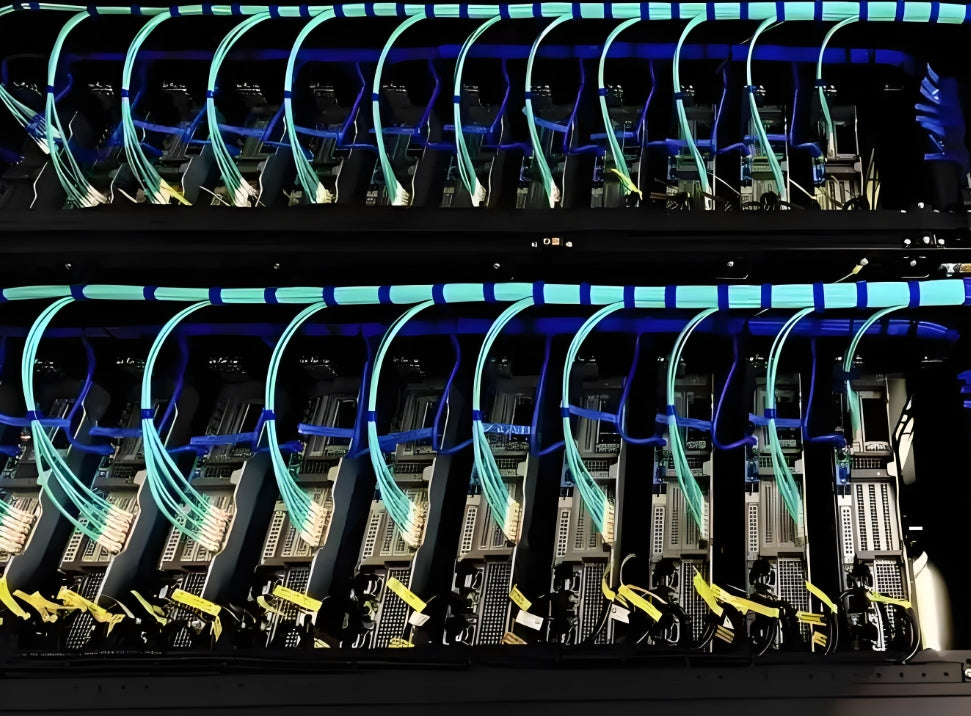
Singlemode optics at commodity pricing and OM4's 1.6T reach collapse are rewriting the distance × cost equation
Chapter 2: Fiber 101 — What You Actually Need to Know About OS2, G.657, OM3, OM4, and OM5
Singlemode Fiber Families
Singlemode fiber carries light in a single optical mode (the fundamental HE₁₁ propagation mode), eliminating modal dispersion and enabling distances from 10km to thousands of kilometers. For data center applications, three subtypes matter:
| Type | Standard | Key Characteristics | Best For |
|---|---|---|---|
| OS2 Standard SMF | ITU-T G.652.D | Legacy standard, 1310/1550nm, zero-dispersion at ~1310nm, high loss at 1550nm bend | Long links, campus backbone, legacy DWDM |
| Bend-Optimized SMF | ITU-T G.657.A2 / B2 | 7.5mm (A2) or 5mm (B2) minimum bend radius; backward compatible with G.652.D; low水和 loss at 1550nm | Data center rack-level, tight routing, AI factory environments |
| Large-Area SMF / Cutoff-Shifted | ITU-T G.654.E | Larger effective area (110–130 µm²), lower nonlinear effects at 1550nm; higher MFD | Long-haul data center interconnect, DCI, submarine segments |
G.657.A2 is the default singlemode choice for modern data centers. It is fully backward-compatible with G.652.D infrastructure (the same splicing, connector, and testing tools), carries the full set of 1310/1550nm DWDM/CWDM wavelengths, and its tight-bend tolerance makes it far more reliable in high-density rack environments. The "premium" over standard OS2 is typically 5–15% per meter — negligible against the reliability and longevity gains.
Multimode Fiber Families
Multimode fiber carries multiple propagation modes simultaneously, which limits bandwidth and reach but enables use of lower-cost VCSEL-based optics (the source of multimode's historical cost advantage). Four types are currently deployed in data centers:
| Type | Core Diameter / NA | Bandwidth @ 850nm | 1.6T Reach (est.) | Status |
|---|---|---|---|---|
| OM3 | 50µm / 0.20 NA | 2000 MHz·km | ~30m (SR4.2) | Legacy; not recommended for new 800G+ builds |
| OM4 | 50µm / 0.20 NA | 4700 MHz·km | ~50m (SR4.2) | Viable for 800G at <200m; 1.6T use cases shrinking fast |
| OM4+ / Enhanced OM4 | 50µm / 0.20 NA | 6000+ MHz·km | ~70m (SR4.2) | Narrow window of viability at 800G for short links |
| OM5 | 50µm / 0.20 NA | 4700 MHz·km (SWDM: 4 lanes) | ~70m (SWDM4) | Viable at 400G; limited 800G+ role outside specific SWDM applications |
The OM3/OM4/OM5 family shares the same physical connector infrastructure (LC, SC, MPO-12/16/24), but their different bandwidth-distance products mean the "right" multimode type depends on both current speed and planned upgrade horizon. As we discuss in our deep-dive on strategic fiber selection for high-performance networks, the fiber you spec at install shapes the upgrade path for the next 15–20 years.
The Wavelength Dimension
Modern optics use three distinct wavelength windows:
- 850nm — traditional VCSEL multimode window; cost-effective at low speeds; distance-limited
- 1310nm — the singlemode sweet spot; low chromatic dispersion; used by most DR/FR/LR 800G/1.6T optics
- 1550nm — DWDM/C-band window; maximum fiber capacity; lowest attenuation (0.18dB/km vs 0.35dB/km at 1310nm); requires G.657.A2/B2 for tight bends
For 800G/1.6T deployments, G.657.A2 singlemode is the infrastructure default. OM4 is a narrow exception for proven short-link (<150m) legacy plant. OM3 and OM5 are effectively legacy-only in new builds.
❓ Can G.657.A2 be spliced to standard G.652.D fiber?
Yes. G.657.A2 is fully backward-compatible with G.652.D — same mode field diameter (~9.2µm at 1310nm), same coating and cladding dimensions (125µm). Fusion splicing, mechanical splicing, and connector termination all work identically. The difference is only in the glass geometry near the core, which controls bend performance, not propagation characteristics.
❓ Is G.654.E relevant for data centers?
For typical data centers, no — G.654.E's large effective area and 1550nm optimization serve data center interconnect (DCI) and metro links (40–100km). Inside a data center (<10km), G.657.A2 is the right singlemode choice. For campus-scale AI superclusters where you're crossing 5–20km between buildings, G.654.E starts to earn its keep by reducing nonlinear effects at high channel counts.
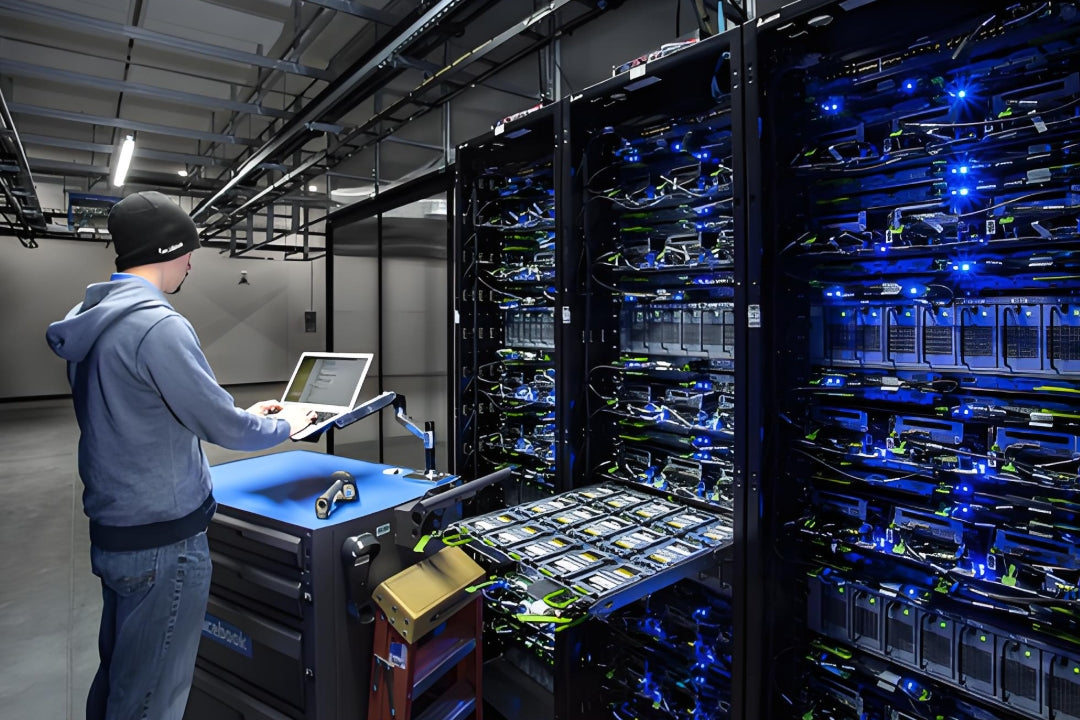
G.657.A2 singlemode is the default for 800G/1.6T — backward compatible with G.652.D and far more tolerant of AI factory routing density
Chapter 3: The 1.6T Optical Landscape — Which Interfaces and Wavelengths Win
The 8×200G Building Block
The 1.6T era is built on 8×200G lane rates — a departure from the 4×100G and 8×100G configurations of 400G/800G. This architectural shift has direct implications for fiber selection:
- MPO-16 becomes the primary trunk connector (16-fiber: 8 transmit + 8 receive lanes)
- Dual MPO-16 or quad MPO-12 serve as fallback breakout architectures
- VSFF connectors (SN, CS, MDC) emerge for ultra-high-density switch faceplates, enabling duplex 200G per fiber pair
- 1310nm CWDM/DWDM dominates: most 800G-DR8 and 1.6T-LR8 optics operate in the 1310nm O-band (1304–1310nm region), where G.657.A2 has low dispersion and G.654.E is optimized for high-power long-haul
The Multimode Optics That Survive at 800G
Despite the singlemode tide, there are still viable multimode optics at 800G for specific applications:
| Optics Type | Fiber Required | Reach | Use Case | Viable at 1.6T? |
|---|---|---|---|---|
| 800G-SR4.2 | OM4 / OM5 | 100–150m | Short intra-rack, intra-row links at 800G | Limited (50m reach) |
| 800G-SR8 | OM4 | 50–100m | Proven short-haul 800G MMF links | No (1.6T-SR8 reach ≈20m) |
| 800G-DR4 / DR8 | OS2 / G.657.A2 | 500m / 2km | Standard AI DC, intra-fabric, campus | Yes (base for 1.6T-DR8) |
| 800G-FR4 / LR4 / LR8 | OS2 / G.657.A2 | 2–10km | Campus interconnect, building-to-building | Yes (1.6T-LR8) |
| 800G-ZR / ZR+ | G.657.A2 / G.654.E | 120km+ | DCI, metro, campus WAN | Yes (1.6T-ZR+) |
CPO and LPO: The Architecture Wildcards
Co-packaged optics (CPO) and linear pluggable optics (LPO) are both gaining traction in the 1.6T era, and both affect fiber selection:
- CPO (Co-Packaged Optics): Optics moved inside the switch ASIC package; current implementations use multimode fiber (typically OM4/OM5 with VCSEL or edge-emitting lasers) for intra-rack links, and singlemode for any interconnect going beyond the rack row. CPO shortens the electrical trace between ASIC and fiber, enabling higher lane rates, but locks the fiber type to whatever the CPO module ships with.
- LPO (Linear Pluggable Optics): Removable modules that eliminate DSP in the optics path (DSP function moved to the switch ASIC). LPO is primarily a power and latency play. Fiber selection follows the same rules as conventional pluggable optics — singlemode G.657.A2 for DR/FR/LR applications, with multimode viable only for proven short runs.
❓ Will CPO kill singlemode fiber in data centers?
No — CPO reduces the number of external fiber links (fewer switch-to-rack connections), but it does not eliminate fiber between racks, rows, and buildings. For any link that leaves the immediate rack group, singlemode remains the only viable choice at 800G/1.6T. CPO is therefore a complement to singlemode infrastructure, not a replacement for it.
❓ What about OM5's SWDM (Short Wavelength Division Multiplexing)?
OM5 SWDM was designed to transmit 4 wavelengths (850/880/910/940nm) over a single fiber pair, effectively quadrupling the capacity of OM4 at the same reach. At 400G, SWDM4 on OM5 was a legitimate option. At 800G/1.6T, the lane rates and wavelength spacing make SWDM more complex and less cost-effective than simply deploying singlemode. OM5 is effectively a 400G-era solution that did not carry forward.

8×200G lane rates and 1310nm DWDM/CWDM optics are making singlemode the universal fabric medium across AI data center distances
Chapter 4: The Three-Dimensional Decision Matrix — Distance × Speed × Cost
Here is the decision framework that replaces the old "300m rule." Evaluate your project on all three dimensions; the dominant constraint (usually distance at the highest planned speed) determines the fiber type.
The Matrix
| Link Distance | Planned Top Speed | Recommended Fiber | Recommended Optics | Rationale |
|---|---|---|---|---|
|
<30m (intra-rack GPU-to-TOR) |
800G / 1.6T | G.657.A2 SMF (preferred) OM4 (acceptable for proven 800G-only) |
800G-DR4/DR8 (SM) 800G-SR4.2 (MM — 800G only) |
Shortest links; SMF eliminates any distance risk; MM viable only at 800G |
|
30–100m (intra-row, same rack group) |
800G / 1.6T | G.657.A2 SMF | 800G-DR4/DR8 / 1.6T-DR8 | OM4 reach at 1.6T is ≤50m; SMF is the only future-proof choice |
|
100–300m (inter-row, intra-building) |
400G / 800G | G.657.A2 SMF (preferred) OM4 (legacy plant only) |
800G-DR4/DR8 / 400G-DR4 | Singlemode is the practical standard at 800G regardless of distance |
|
300m–2km (building-to-building, campus) |
800G / 1.6T | G.657.A2 SMF | 800G-DR8 (500m) 800G-FR4/LR4 (2km) 1.6T-LR8 (10km) |
Singlemode only; OM4 not viable at any 800G+ speed at these distances |
|
2–20km (campus, metro DCI) |
800G / 1.6T | G.657.A2 SMF (≤10km) G.654.E SMF (>10km, high-count) |
800G-LR4/LR8 800G-ZR/ZR+ |
G.654.E for >10km high-power DWDM; G.657.A2 for <10km standard links |
|
>20km (long-haul DCI) |
800G / 1.6T | G.654.E SMF | 800G-ZR+ / 1.6T-ZR+ C-band DWDM mux |
Large effective area reduces nonlinearities at 1550nm C-band; critical for 80+km |
The Cost Dimension: TCO, Not Unit Price
The fiber-vs-fiber cost comparison often stops at the cable price per meter. The real decision is total cost of ownership (TCO), which includes:
A 10-year TCO model almost always favors singlemode for anything above 100m and above 400G aggregate — even with the historical 3× optics premium. At 2026 pricing, that premium is effectively gone. The only scenarios where multimode retains a cost advantage are proven legacy OM4 plant at <150m and targeting only 400G.
❓ Should I spec different fiber for different parts of my data center?
For greenfield builds, no — standardize on G.657.A2 everywhere. The cost differential is marginal and the operational simplicity of one fiber type across the entire campus is significant. For brownfield expansions where you are connecting into existing OM4 backbone infrastructure, use G.657.A2 for new builds and manage the hybrid junction point carefully with proper testing and documentation.
❓ Is there ever a scenario where OM3 makes sense for a new build in 2026?
Only for highly cost-constrained, short-distance (<100m), 100G-only links where no future upgrade is planned — essentially a "cap the cost today" decision. The moment 400G, 800G, or any distance above 100m enters the scope, OM3 becomes a liability. OM4 is the minimum viable multimode for any modern build, and even OM4's window is closing fast for 800G+.

Standardize on G.657.A2 singlemode for greenfield builds — the marginal cost premium buys a 15–25 year upgrade runway
Chapter 5: Scenario Playbooks — Six Real-World Use Cases
Scenario 1: Hyperscale AI Factory (100MW+ Campus)
Context: Greenfield AI campus with 50,000+ GPU racks, GPU-to-TOR <30m, intra-cluster fabric 100–500m, campus interconnect 5–20km
G.657.A2 for all intra-facility fiber (up to 10km). G.654.E for inter-building campus backbone (>10km). OM4/MM has no role in an AI factory fabric at any speed above 400G. Every rack drop, trunk, and patch cord is singlemode. The fabric is planned around singlemode DWDM from day one.
Optics: 800G-DR8 (500m) for intra-cluster, 800G-FR4/LR4 (2–10km) for building-to-building, 800G-ZR+ for campus WAN. The entire campus fabric runs on a single fiber type — G.657.A2 — which dramatically simplifies MPO-16 trunking, sparing, and testing. As covered in our analysis of how AI infrastructure is reshaping data center cabling requirements, this uniformity is a deliberate operational choice, not a technical constraint.
Scenario 2: Enterprise Data Center (Tier II, 5,000–20,000 sq ft)
Context: Mixed legacy (OM4 backbone, Cat6A horizontal) + new 800G capacity expansion, maximum link 300m
G.657.A2 for all new 800G+ deployments. OM4 backbone remains for existing 100G/400G links. Manage the OM4/SM hybrid junction: do not mix fiber types within the same link segment. New 800G+ links from leaf switches upward use singlemode; legacy 100G-SR4 links on OM4 can coexist on the same MPO infrastructure until upgraded.
Scenario 3: Colocation Data Center (Wholesale / Retail)
Context: Tenant diversity means unknown future speeds; customer cages at varying distances from meet-me rooms; multi-tenant fiber paths
G.657.A2 as the building standard for all backbone and interconnect. Singlemode is the only fiber that covers the full range of tenant speeds (100G to 800G+) and distances (10m to 10km). Offering multimode to tenants locks them into a speed and distance ceiling; singlemode future-proofs every handed-over fiber path.
Scenario 4: High-Performance Computing (HPC) Cluster
Context: In-rack GPU/accelerator interconnects at <30m, InfiniBand or high-speed Ethernet, intra-row at <100m
G.657.A2 singlemode for all active fabric links. At 400G HDR InfiniBand and 800G Ethernet, the intra-rack distance (<30m) technically allows multimode, but singlemode eliminates any risk of OM4 reach uncertainty and enables direct extension to the HPC cluster spine without fiber change. The HPC cluster's upgrade cadence (every 2–3 years) makes singlemode the lowest-friction choice across generations.
Scenario 5: Enterprise Campus (Multi-Building Corporate Network)
Context: Building-to-building links 500m–3km, intra-building horizontal runs <100m, mixed 10G/40G/100G legacy, planning for 800G upgrade in 3–5 years
G.657.A2 for all new building-to-building fiber. The campus backbone is the highest-leverage singlemode investment: it carries every building's traffic and determines how far the 800G upgrade can extend. Horizontal copper (Cat6A/Cat8) remains viable for <90m at 10G/25G; any new structured cabling inside buildings should plan for fiber-to-the-desktop for high-bandwidth zones.
Scenario 6: Edge / Telco Data Center (Small Footprint, Harsh Environment)
Context: Micro data centers at cell towers, factories, or urban edge locations; short links <100m; limited maintenance access; extreme temperature ranges
G.657.A2 singlemode — with armored or outdoor-rated cable where environmental exposure is a factor. Singlemode fiber tolerates wider temperature ranges than multimode and is more resistant to vibration and mechanical stress. In harsh edge environments where fiber may be exposed to moisture, rodents, or temperature extremes, armored singlemode with gel-filled buffer tubes is the right choice, regardless of the short link distance.
❓ Should a colocation provider offer both OM4 and singlemode to tenants?
Yes — as two distinct product tiers. Singlemode as the premium tier (all speeds, all distances up to 10km); OM4 as an economy tier (100G/400G only, <150m). This lets cost-sensitive tenants on legacy OM4 paths coexist with tenants who need 800G at any distance. Just ensure cross-connects clearly label fiber type and test records are fiber-specific.
❓ What about fiber-to-the-desktop (FTTD) for enterprise?
FTTD on singlemode is growing for enterprise campus networks where 10G+ desktop speeds are needed (CAD workstations, video production, medical imaging). The connector question (LC duplex vs. MPO-to-duplex conversion) and the economics (SMF electronics remain slightly more expensive than copper for <10G desktop links) mean FTTD is still a targeted deployment, not a universal standard. Plan it for high-bandwidth zones; Cat6A remains cost-effective for general office 1G/2.5G/5G.

Enterprise campus and HPC clusters converge on singlemode for any 800G+ deployment — the upgrade runway justifies the marginal unit cost premium
Chapter 6: AI Factory Specifics — Why Singlemode Is Winning Inside the Rack Room
The AI Factory Fiber Topology
AI factory networks have a distinctive three-tier topology that shapes fiber selection at each layer:
- Layer 1 — GPU-to-TOR (<30m): 500+ fiber strands per rack; MPO-16 trunking; highest density and thermal stress
- Layer 2 — TOR-to-Leaf (<100m): Switch-to-switch within the same row; 800G-DR4/DR8 on G.657.A2
- Layer 3 — Leaf-to-Spine (<500m): Row-to-row; 800G-FR4/LR4 on G.657.A2; the backbone of the AI cluster
- Layer 4 — Spine-to-Superspine / DCI (>1km): Campus-level; G.654.E or G.657.A2; 800G-ZR/ZR+ optics
At every layer above the intra-rack jumpers, singlemode is not just preferred — it is required. The reach of OM4 at 800G-SR8 (50–100m) covers Layer 1 and barely touches Layer 2. OM4 cannot span Layer 3 at any speed above 400G. Building an AI factory fabric on a mix of OM4 and singlemode means the AI cluster's core spine fabric is singlemode anyway — and maintaining two fiber types across the campus adds operational complexity that the AI infrastructure team cannot afford.
OM4's Narrow Window in AI Environments
Where does OM4 still make sense in an AI factory context?
OM4 Viability Zones in AI Factories
- Storage area networks (SANs) using NVMe-over-Fabrics at 400G-NRDZ over distances <100m
- Management network out-of-band Ethernet for BMC/IPMI at 10G/25G (<100m)
- In-rack InfiniBand HDR100 at 100G per lane (<30m) — but teams typically standardize SMF here for consistency
- Any link planned for 800G+ in the next 3 years — OM4 is not viable, regardless of distance
The 1.6T Transition Inside the AI Factory
When AI factories begin migrating from 800G to 1.6T, the optical lane rate doubles (8×200G vs 8×100G), and OM4's reach drops again. G.657.A2 singlemode is the only fiber type that carries a guaranteed upgrade path from 800G to 1.6T without a physical-layer change. MPO-16 trunking on G.657.A2 is the standard that survives both generations — the fiber does not change; only the optics at each end are upgraded.
This is why AI infrastructure operators are standardizing on G.657.A2 singlemode at every tier, even for the <30m GPU-to-TOR links where OM4 technically suffices. The fiber plant is a 20-year decision; the GPU generation cycles every 18–36 months.
Case Study: One AI Campus, Two Fiber Strategies
Two hyperscale AI campuses built in the same year made opposite fiber choices. Campus A standardized G.657.A2 singlemode across all fabric tiers. Campus B used OM4 for GPU-to-TOR (<30m) and singlemode for leaf-to-spine and above. When both campuses began 1.6T capacity planning, Campus A needed only optics changes — no fiber re-pull. Campus B faced 40% of its in-rack and intra-row fiber needing replacement, at a cost and outage risk that delayed the 1.6T rollout by 6 months. The marginal OM4 "savings" in year one became a significant unplanned cost in year three.
❓ Does AI factory intra-rack fiber really need singlemode if it's only 20–30m?
Technically, 800G-SR4.2 on OM4 works at 20–30m. But consider: (1) the rack will be re-cabled every 18–36 months when GPU generations change; (2) every re-cable event is a contamination and bend-risk event; (3) G.657.A2 is more tolerant of those repeated events. The operational reliability advantage of G.657.A2 in a high-churn environment outweighs the OM4 technical sufficiency at very short distances.
❓ What about copper (DAC/AOC) for intra-rack AI links?
Active copper cables (ACC/AOC) and direct attach copper (DAC) remain cost-effective for <3m intra-rack GPU-to-switch links at 800G. Above 3m and at 1.6T, fiber takes over due to signal integrity limits of copper at these lane rates and the heat load copper adds in a 100–200kW rack. For a comprehensive view of when to use fiber vs copper in AI environments, see our analysis of AI data center cabling challenges.

AI factory fabric at every tier above the intra-rack jumper runs on G.657.A2 singlemode — the fiber plant must outlast multiple GPU generations
Chapter 7: Migration Strategy — How to Upgrade Without Forklift Changes
The Brownfield Reality
Most data centers today have OM4 installed. A complete forklift replacement of fiber plant is rarely feasible. The practical question is: how do I plan an upgrade to 800G/1.6T on an OM4 foundation?
Upgrade Pathway by Starting Point
| Current State | 800G Upgrade Action | 1.6T Upgrade Action | Fiber Change Required? |
|---|---|---|---|
| OM4 backbone (<150m), 100G-SR4 | Upgrade to 400G-SR4.2 on OM4 (still viable) | Fiber must be replaced: install G.657.A2 singlemode for new 1.6T links | Partial — new 1.6T paths only |
| OM4 backbone (>150m), 100G-LR4 | Already singlemode for long links; replace with 800G-DR4/FR4 | Replace remaining OM4 segments >100m with G.657.A2; extend SMF to cover all fabric | Systematic — full plant audit |
| Mixed OM4 + SMF backbone | Isolate OM4 segments; migrate to SMF for 800G+ capacity | Standardize SMF for all new and upgraded links; retire OM4 from active fabric | Phased — OM4 segments over time |
| Greenfield or G.657.A2 backbone | Install 800G-DR4/DR8 on existing singlemode — no fiber change needed | Install 1.6T-DR8/LR8 on existing singlemode — no fiber change needed | None for many years |
The Phased Migration Playbook
For brownfield OM4 data centers targeting 800G/1.6T, a phased approach minimizes disruption:
- Audit the existing plant — document every fiber segment: type (OM3/4/5/SM), length, termination, and current link speed. This determines which paths can stay OM4 and which must migrate.
- Segment by criticality — separate the spine/aggregation fabric (which must go singlemode) from access-layer links where OM4 may survive one more generation.
- Install G.657.A2 in parallel — new 800G/1.6T links use singlemode; old OM4 links are kept live until cutover. Never mix fiber types within a single link segment.
- Plan the cutover window — whenever a link is down for maintenance, re-terminate or splice in a singlemode segment. The goal is to retire OM4 from the active fabric within 2–3 hardware refresh cycles.
- Stock the right fibers — MPO-16 singlemode trunk, LC duplex singlemode patch cords (G.657.A2, high-temperature-rated for AI zones), and LC/SC MPO conversion cassettes for hybrid panels.
❓ Can I use OM4 patch cords with singlemode trunk cables?
Yes — as a hybrid transition patch, not as an active link segment. A common brownfield configuration: G.657.A2 backbone trunks → MPO-to-LC singlemode cassettes → LC duplex singlemode patch cords to switch. OM4 patch cords might coexist in a mixed tenant environment but should never be in the same physical link path as singlemode fiber — the modes and wavelengths are incompatible.
❓ How do I test mixed OM4/single-mode segments?
Test each fiber type with the appropriate reference-grade launch cable for that fiber type. Never use an OM4 launch cable to test a singlemode link — the mode field diameter mismatch (50µm vs 9µm) causes significant measurement error. Tier 1 OLTS and Tier 2 OTDR both require matching reference cables per fiber type. Budget two test kits (or two OTDR modules) if you are certifying both fiber types simultaneously.

Phased migration from OM4 to singlemode: install G.657.A2 for every new 800G/1.6T link, retire OM4 from active fabric within 2–3 hardware refresh cycles
Chapter 8: The Bottom Line — Your Fiber Decision Checklist
Fiber selection at 800G/1.6T is not a one-time procurement decision — it is an infrastructure commitment that shapes the next 15–25 years of your data center's upgrade capability. Here is the decision checklist:
| Decision Point | Recommendation | When to Reconsider |
|---|---|---|
| Greenfield data center | G.657.A2 singlemode everywhere — backbone, intra-row, intra-rack | Never; this is the universal standard |
| 800G links <100m | G.657.A2 singlemode (OM4 only for proven legacy plant) | Only if upgrading to 1.6T within 18 months and budget is severely constrained |
| 800G links 100m–2km | G.657.A2 singlemode mandatory; 800G-DR8 (500m) or FR4/LR4 (2km) | Never; singlemode is required at these distances for 800G+ |
| Building-to-building campus (>2km) | G.657.A2 up to 10km; G.654.E for >10km high-capacity DWDM | When 80+km DWDM channel count exceeds G.657.A2 nonlinearity limits |
| Brownfield OM4 <150m, 400G target | OM4 viable for 400G-SR4.2; plan G.657.A2 for 800G+ migration | At 800G migration; OM4 no longer viable above 100m |
| AI factory / HPC cluster | G.657.A2 singlemode at every fabric tier | Never; the upgrade cadence demands fiber that survives multiple GPU generations |
| Colocation / multi-tenant | G.657.A2 as standard offering; OM4 as economy tier (100G/400G, <150m only) | When tenants require 800G+ at any distance |
| Edge / harsh environment | G.657.A2 with armored outdoor-rated jacket | When distance exceeds 10km and G.654.E becomes cost-effective |
🎯 What is the single most important fiber decision in 2026?
Choosing singlemode for any link above 100m or above 400G aggregate speed. The economics have shifted: singlemode optics at 800G are no longer a premium product, OM4's reach at 1.6T collapses to 50m, and AI factory upgrade cycles demand fiber that survives multiple generations. If you take one action from this article, make it this: specify G.657.A2 singlemode for every new fiber installation above 100m or targeting 800G+.
🚀 Where should a team starting a new data center build begin?
Specify G.657.A2 singlemode as the universal standard in the infrastructure design document — before the RFP, before the vendor selection, before the first cable is pulled. This single decision eliminates the fiber type question for the life of the building. All optics, cassettes, patch cords, and testing equipment follow from that foundation. Our guide to 800G and 1.6T data center cabling trends in 2026 covers the broader context for getting this right from the start.

AMPCOM Technical Team
Industry experts with 17+ years in structured cabling, data center infrastructure, and fiber optic network design
Planning an 800G or 1.6T data center? Your fiber choice today determines your upgrade path for decades.
AMPCOM provides G.657.A2 singlemode fiber solutions, MPO-16 trunking systems, high-temperature-rated patch cords, and structured cabling products engineered for the 1.6T era — from greenfield builds to phased brownfield migrations.
Talk to Our Cabling Infrastructure Experts

