
Data Center Cooling: Types, Benefits, and Best Practices
Published:Executive Summary: The math stopped working in 2024. NVIDIA's Blackwell B200 draws 1,000W per chip — up from 700W for the H100 — and the GB200 NVL72 rack pushes 2,700W per chip and 132 kW per rack. Air cooling hits a physical wall around 700W per chip and 20–25 kW per rack. If your facility cannot cool these densities, it cannot host the AI workloads driving industry revenue growth.
This guide examines every major cooling approach — from traditional CRAC/CRAH air systems to direct-to-chip liquid cooling, immersion, and rear-door heat exchangers — with verified performance data, cost analysis, and deployment best practices. By the end, you'll know exactly which cooling strategy fits your rack density, budget, and roadmap.
Quick Navigation
- 1 Why Data Center Cooling Matters More Than Ever
- 2 Air Cooling Systems: CRAC, CRAH, and Containment
- 3 Liquid Cooling Technologies: D2C, Immersion, and RDHx
- 4 Hybrid Cooling: The Pragmatic Middle Ground
- 5 Key Metrics: PUE, WUE, and TCO Analysis
- 6 Best Practices for Deployment and Operations
- 7 Regulatory Landscape and Sustainability
- 8 Decision Framework: Matching Cooling to Workload
- 9 Key Questions (FAQ)
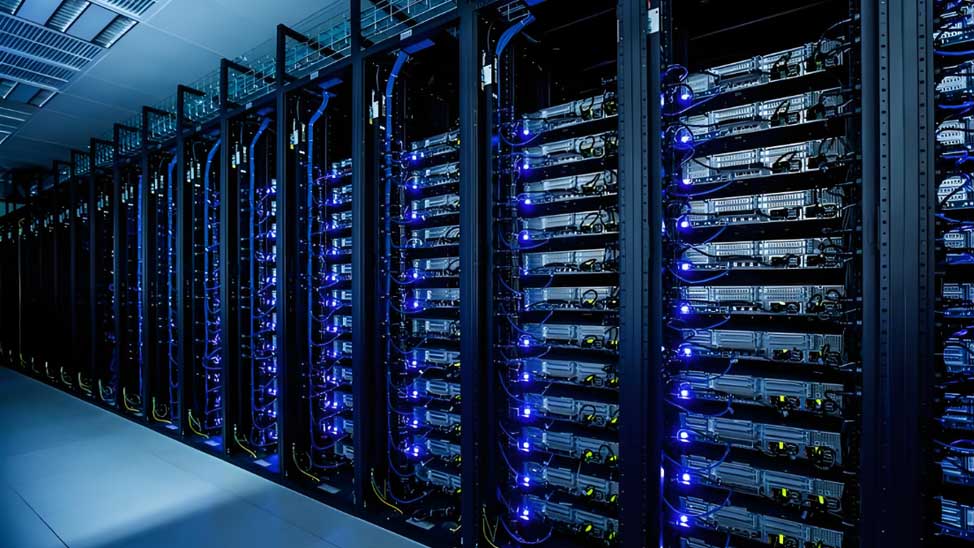
Modern data centers increasingly blend air and liquid cooling to handle AI-driven rack densities exceeding 100 kW
1. Why Data Center Cooling Matters More Than Ever
Cooling has shifted from a supporting function to the primary constraint on data center capacity. The Uptime Institute's 2025 Global Data Center Survey found that PUE improvements have stalled for the sixth consecutive year, with legacy air-cooled facilities stuck at PUE 1.55–1.67, wasting 30–40% of their total electricity on cooling alone.
The driver is unmistakable: AI. GPU power consumption has escalated beyond what air cooling can handle for dense deployments. Average data center rack power density increased 38% from 2022 to 2024, with AI clusters now pushing 80–120 kW per rack. NVIDIA's roadmap is even more aggressive:
| GPU Generation | Release Year | Power per Chip | Rack Density | Air Cooling Viable? |
|---|---|---|---|---|
| A100 | 2020 | 400W | ~25 kW | Yes (borderline) |
| H100 | 2022 | 700W | ~40 kW | Marginal |
| B200 (Blackwell) | 2024 | 1,000W | 132 kW | No |
| GB200 NVL72 | 2025 | 2,700W | 132 kW+ | No |
| Rubin (projected) | 2026–2027 | 3,000W+ | 250–600 kW | No |
The physics are unforgiving. Convective heat transfer through air limits cooling effectiveness regardless of fan speed or air handler capacity. Liquid offers approximately 3,000 times the heat capacity of air, enabling fundamentally superior thermal management at high densities. For a deeper look at how these power demands reshape cabling infrastructure, see AI Infrastructure: How Machine Learning Is Reshaping Data Center Cabling Requirements.
2. Air Cooling Systems: CRAC, CRAH, and Containment
Air cooling remains the most widely deployed method, leveraging mature technology and familiar operational models. Three primary architectures dominate:
2.1 CRAC Units (Computer Room Air Conditioning)
Traditional CRAC units compress refrigerant to cool air, circulating it through raised-floor plenums or overhead ducts. They provide reliable, centralized cooling for moderate heat loads but struggle with hotspots in high-density deployments. CRAC units are cost-effective for facilities under 15 kW per rack.
2.2 CRAH Units (Computer Room Air Handlers)
CRAH units use chilled water from central plant systems, passing return air over cooling coils. They handle larger thermal loads more efficiently than CRAC units and are standard in hyperscale facilities. CRAH systems scale well but depend on chiller plant capacity and water infrastructure.
2.3 In-Row Cooling and Containment
In-row cooling places precision air handlers directly between server cabinets, shortening the airflow path and improving efficiency. Combined with hot-aisle or cold-aisle containment, these systems can support 15–25 kW per rack. Containment prevents hot and cold air mixing, reducing fan energy by 15–20% compared to uncontained layouts.
| Air Cooling Type | Max Rack Density | Best For | PUE Range | Key Limitation |
|---|---|---|---|---|
| CRAC (raised floor) | ~10 kW | Legacy enterprise, small facilities | 1.6–1.9 | Hotspots at high density |
| CRAH (chilled water) | ~15 kW | Large enterprise, colocation | 1.5–1.7 | Chiller plant dependency |
| In-row + containment | ~25 kW | High-density enterprise, edge | 1.4–1.6 | Diminishing returns above 25 kW |
Air cooling's fundamental limitation is thermodynamic: as rack density increases, the volume of air required for adequate heat removal grows exponentially. Fan power scales cubically with airflow, meaning doubling airflow requires eight times the fan energy. Above 25 kW per rack, this becomes economically unsustainable. Facilities managing high-density cable infrastructure should also review material compatibility and routing design for 30kW–120kW racks to ensure cabling withstands elevated operating temperatures.
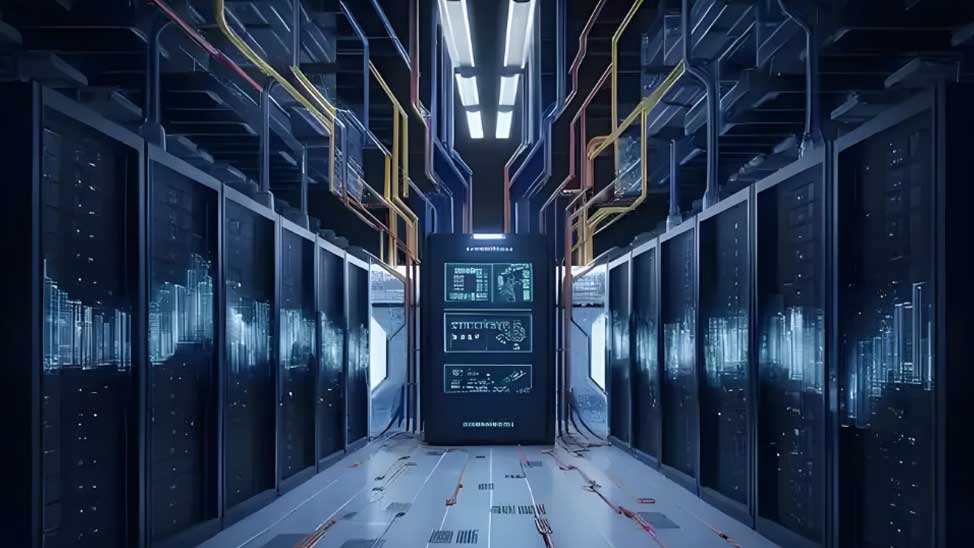
Hot-aisle containment captures exhaust heat before it mixes with supply air, improving CRAC/CRAH efficiency by 15–20%
3. Liquid Cooling Technologies: D2C, Immersion, and RDHx
Liquid cooling is no longer experimental — it is the baseline specification for AI-era data centers. Three primary technologies address different density tiers and deployment contexts:
3.1 Direct-to-Chip (D2C) Liquid Cooling
D2C circulates coolant through cold plates mounted directly on CPUs, GPUs, and other high-power components. Heat is captured at the source — the most thermally efficient approach available. ASME-validated studies show D2C boosts GPU performance by 2.7% in Gflops per second while cutting overall power consumption by 12% and dropping chip operating temperatures by 20°C compared to air cooling.
D2C systems use Coolant Distribution Units (CDUs) to regulate flow, temperature, and pressure between facility and IT loops. Supermicro released NVIDIA Blackwell rack-scale solutions with 250 kW CDUs — double previous capacity — reflecting the escalating power demands of next-generation GPUs.
Two D2C variants exist:
- Single-phase: Coolant remains liquid throughout the cycle. Simpler to operate, widely deployed, lower risk.
- Two-phase: Coolant boils on hot chip surfaces and condenses back, achieving superior heat transfer. ZutaCore's HyperCool system uses a non-toxic dielectric fluid with ultra-low global warming potential (GWP) that safely evaporates if leaked.
Case Study: University of Chicago — ZutaCore + CPI ZetaFrame
The University of Chicago deployed CPI ZetaFrame cabinets integrated with ZutaCore HyperCool two-phase D2C cooling. Results: 50°F reduction in cabinet temperature and 37% reduction in power consumption. The ZetaFrame cabinet's 5,000 lb static load rating accommodated the weight of liquid cooling infrastructure without modification.
3.2 Immersion Cooling
Immersion cooling submerges entire servers in dielectric fluid, eliminating fans and airflow management entirely. Every heat-producing component — not just CPUs and GPUs — contacts the cooling fluid directly. This approach achieves the highest thermal performance available:
- Single-phase immersion: Fluid remains liquid, circulating through external heat exchangers. Submer's SmartPod achieves 140 kW per rack with PUE between 1.03 and 1.1.
- Two-phase immersion: Fluid boils on hot surfaces and condenses back. Microsoft tested two-phase immersion for AI training clusters, reporting a 30% energy efficiency gain and improved hardware reliability.
The immersion cooling market reached $4.87 billion in 2025 and is forecast to hit $11.10 billion by 2030 (17.91% CAGR). However, immersion requires specialized hardware compatibility, dedicated tank infrastructure, and rethinking maintenance procedures — servers must be lifted from fluid for servicing.
3.3 Rear-Door Heat Exchangers (RDHx)
RDHx replaces standard cabinet rear doors with liquid-cooled coils. Hot server exhaust passes through the coil before entering the room, transferring heat to the liquid loop. The liquid never touches IT equipment — making RDHx the lowest-risk liquid cooling option and an ideal retrofit for existing facilities.
RDHx handles 20–40 kW per rack and serves as a bridge between air and full liquid cooling. Legrand's CL20 ProActive and CL23 High Performance Capacity models integrate with existing chilled water systems and monitoring infrastructure, enabling capacity expansion without comprehensive redesign.
| Technology | Max Density (kW/rack) | PUE Range | Retrofit Difficulty | Best For |
|---|---|---|---|---|
| Traditional air | <20 | 1.6–1.9 | N/A | Legacy workloads |
| Rear-door HX | 20–40 | 1.3–1.5 | Low | Transitional, retrofit |
| Direct-to-chip (D2C) | 50–250 | 1.1–1.3 | Moderate | GPU/AI clusters |
| Single-phase immersion | 100–140 | 1.03–1.1 | High | Max efficiency |
| Two-phase immersion | 100–200+ | 1.02–1.07 | High | Highest density |
For facilities planning the cabling infrastructure that accompanies these cooling technologies, in-rack cooling and rack cable architecture must be designed concurrently to avoid thermal interference between cable bundles and cooling loops.
4. Hybrid Cooling: The Pragmatic Middle Ground
Most data centers are not built for today's high-density workloads and cannot be taken offline for a complete rebuild. Hybrid cooling — combining air and liquid in the same facility — has become the dominant deployment strategy:
- Standard server racks (10–20 kW): Continue using air cooling with containment
- AI and HPC racks (60–150+ kW): Deploy direct-to-chip liquid cooling
- Transitional racks (25–40 kW): Use rear-door heat exchangers to augment air cooling
D2C is particularly well-suited for hybrid deployment because it cools only the hottest components (GPUs, CPUs) while relying on existing air infrastructure for lower-power elements (memory, storage, network cards). This additive approach — rather than wholesale replacement — limits retrofit scope and enables operational teams to gain liquid cooling experience incrementally.
Nautilus Data Technologies brings over 500,000 unit-hours of fully liquid-cooled AI facility operation, with its EcoCore FCD delivering 3.2 MW of cooling capacity — the highest among liquid-to-liquid systems in NVIDIA's DSX infrastructure catalog. Their patented vacuum-sealed closed-loop design eliminates leakage risk, addressing one of the most common operator concerns. For organizations planning phased transitions, AI retrofit projects for existing data centers provides a structured framework.
5. Key Metrics: PUE, WUE, and TCO Analysis
5.1 Power Usage Effectiveness (PUE)
PUE measures total facility power divided by IT equipment power. Lower is better. The industry is moving beyond PUE as the sole efficiency metric, but it remains the most widely understood benchmark:
| Cooling Approach | Typical PUE | Cooling Energy Share | Implication |
|---|---|---|---|
| Legacy air-cooled | 1.55–1.67 | 30–40% | Stalled improvement (Uptime Institute 2025) |
| Air + containment | 1.4–1.5 | 25–30% | Best case for air-only designs |
| D2C liquid cooling | 1.10–1.20 | 10–15% | 30–40% improvement over air |
| Single-phase immersion | 1.03–1.10 | 5–8% | Near-optimal efficiency |
| Two-phase immersion | 1.02–1.07 | 3–5% | Theoretical near-limit |
For a 50 MW data center, moving from PUE 1.60 to PUE 1.10 saves 15.6 MW of cooling load — enough to power 15,000 additional servers without expanding the facility footprint. Dell's comparative testing measured a chip-to-coolant temperature difference of 17–20°C with single-phase liquid cooling at 500W processor loads, versus 60°C or higher with air cooling under identical conditions.
5.2 Total Cost of Ownership (TCO)
Liquid cooling systems require 15–30% higher upfront capital investment — including CDUs, cold plates, manifolds, piping, and leak detection. However, the operational savings are substantial:
- Energy cost reduction: 30–50% lower cooling energy compared to air
- Deferred facility expansion: Higher rack density avoids new white-space construction
- Hardware lifespan extension: Lower operating temperatures reduce thermal stress and failure rates
- Free cooling enablement: Higher supply temperatures allow year-round economizer operation in many climates
- Waste heat reuse: Liquid loops deliver higher-grade heat suitable for district heating (operational in Finland and Sweden)
ROI typically materializes within 2–3 years through energy savings alone, before accounting for the revenue enabled by supporting AI workloads that air cooling physically cannot host. For broader infrastructure cost optimization, see power flexibility strategies for AI data centers.
6. Best Practices for Deployment and Operations
6.1 Pre-Deployment Assessment
Infrastructure Readiness Checklist
- Audit current density: Measure actual vs. potential rack power consumption to establish baseline
- Project GPU roadmap: Plan for 2–3x current density within 3 years (NVIDIA Rubin: 250–600 kW by 2026–2027)
- Assess floor loading: Liquid-filled racks and tanks add significant weight (ZetaFrame: 5,000 lb static rating)
- Evaluate piping routes: Ensure space for coolant manifolds, supply/return lines, and CDU placement
- Verify electrical capacity: PDUs must handle higher density plus CDU power draw
- Confirm drainage: Plan for condensate and emergency leak containment
- Check monitoring systems: DCIM must integrate temperature, flow, and pressure sensors
6.2 Airflow Management First
Even with liquid cooling deployed, airflow management remains critical. Seal all unused rack U-spaces with blanking panels, install grommets and brush strips in cable cutouts, and use vertical exhaust ducts to prevent hot-air recirculation. Facilities without complete hot-aisle containment should prioritize this before any liquid cooling deployment — it's the highest ROI improvement available.
6.3 Leak Detection and Safety Protocols
Modern liquid cooling systems incorporate multiple safety layers: quick-disconnect fittings that minimize fluid loss during maintenance, pressure sensors that detect anomalies in real time, and automatic shutoff valves. Nautilus's vacuum-sealed closed-loop design represents the gold standard — negative pressure means any breach draws air inward rather than leaking fluid outward. Train operations teams on coolant handling, emergency procedures, and routine inspection protocols before deployment.
6.4 Phased Migration Strategy
4-Phase Migration Roadmap
Phase 1 — Optimize Air Cooling: Implement containment, seal leaks, optimize CRAH setpoints. Target: PUE 1.4–1.5.
Phase 2 — Deploy RDHx for Hotspots: Install rear-door heat exchangers on racks approaching 25–30 kW. No server modifications required. Target: support 30–40 kW racks.
Phase 3 — Pilot D2C for AI Clusters: Install CDU infrastructure and cold plates on new GPU racks. Train operations team. Target: 50–120 kW per AI rack.
Phase 4 — Scale and Evaluate Immersion: Expand D2C to additional racks. Pilot immersion for extreme-density workloads (>100 kW). Target: PUE below 1.15 facility-wide.
Proper cable management becomes even more critical in liquid-cooled environments where space is constrained by cooling infrastructure. Review patch panel cable management best practices for data centers and cabling strategies for high-density data centers to ensure thermal and cable pathways don't conflict.
7. Regulatory Landscape and Sustainability
Governments and regulators across Europe and Asia are drafting increasingly rigorous cooling efficiency requirements. New and high-density data centers face mandates to implement liquid cooling and publicly report PUE, WUE (Water Usage Effectiveness), and other ESG indicators:
- EU Energy Efficiency Directive: Requires data centers over 500 kW to report PUE, WUE, and REF (renewable energy factor) annually
- Germany: Amended Energy Industry Act mandates liquid cooling readiness for new facilities above 100 kW IT load
- Singapore: Green Data Centre Roadmap sets PUE targets of 1.3 for new tropical facilities
- China: East Data West Computing project requires PUE below 1.25 for new hyperscale facilities in western zones
Beyond compliance, sustainability drives operational decisions. Liquid cooling enables waste heat reuse — transferring captured heat to district heating networks. Facilities in Finland and Sweden already deliver server waste heat to municipal heating systems, reducing both carbon footprint and heating costs for surrounding communities. Thermal energy storage using ice batteries can time-shift cooling loads to off-peak hours, reducing demand charges.
The industry is also moving beyond PUE as the sole efficiency metric. System-level energy recovery, carbon intensity per compute unit, and water consumption per transaction are emerging as more holistic measures of data center sustainability. For facilities navigating European compliance requirements, Europe's AI data center infrastructure priorities provides regional guidance. Operators should also ensure cable jacket materials meet fire safety codes in these regulated environments — see PVC vs LSZH cable jacket comparison for compliance details.
8. Decision Framework: Matching Cooling to Workload
There is no one-size-fits-all solution. The optimal cooling strategy aligns technology with business goals, workload requirements, and facility constraints:
| Rack Density | Recommended Cooling | Investment Level | Timeline |
|---|---|---|---|
| <15 kW | Air cooling + containment | Low (optimize existing) | Immediate |
| 15–25 kW | In-row cooling + containment | Moderate | 1–3 months |
| 25–40 kW | Rear-door heat exchangers | Moderate (retrofit-friendly) | 3–6 months |
| 40–100 kW | Direct-to-chip liquid cooling | High (CDU + piping + training) | 6–12 months |
| 100–200 kW | D2C + immersion evaluation | Very high (purpose-built) | 12–18 months |
| >200 kW | Full immersion cooling | Highest (facility redesign) | 18–24 months |
Actionable Next Steps
- Step 1: Audit current rack power consumption — measure, don't estimate
- Step 2: Project your GPU roadmap for the next 3 years (plan for 2–3x density growth)
- Step 3: Evaluate facility constraints — floor loading, piping routes, electrical capacity
- Step 4: Build operational expertise — train teams on liquid cooling before deployment, not during
- Step 5: Start with a pilot deployment on one AI rack cluster before facility-wide rollout
- Step 6: Align cooling strategy with TIA-942-C compliance standards and sustainability reporting requirements

Cooling technology selection follows rack density: air (below 20 kW) transitions through RDHx (20–40 kW) to D2C (50–250 kW) and immersion (100 kW+)
The choice is rarely binary. Most modern deployments balance multiple cooling technologies within a single facility — air for legacy workloads, RDHx for transitional racks, D2C for AI clusters, and potentially immersion for extreme-density research computing. Organizations planning AI infrastructure without liquid cooling capability risk deployment limitations as GPU power continues its inexorable climb. For comprehensive infrastructure planning, review how structured cabling is changing for AI data centers and common data center cabling pitfalls to avoid.
Key Questions (FAQ)
Q1: At what rack power density should I switch from air cooling to liquid cooling?
Air cooling becomes impractical above 20–25 kW per rack. Between 25–40 kW, rear-door heat exchangers can extend air-based designs. Above 40 kW, direct-to-chip liquid cooling is strongly recommended, and above 100 kW, immersion cooling should be evaluated. NVIDIA Blackwell rack designs already push 132 kW, making liquid cooling mandatory rather than optional.
Q2: What is the difference between single-phase and two-phase immersion cooling?
Single-phase immersion submerges servers in dielectric fluid that remains liquid, circulating through external heat exchangers to reject heat. Two-phase immersion uses a fluid that boils on hot chip surfaces, with vapor condensing back to liquid. Two-phase achieves higher heat transfer rates but involves more complex fluid management and pressure control. Single-phase is simpler to operate and more widely deployed in production.
Q3: How much does liquid cooling reduce PUE compared to air cooling?
Traditional air-cooled data centers typically operate at PUE 1.55–1.67, wasting 30–40% of electricity on cooling. Direct-to-chip liquid cooling achieves PUE 1.10–1.20, a 30–40% improvement. Single-phase immersion reaches PUE 1.03–1.1, and two-phase immersion can approach PUE 1.02–1.07. For a 50 MW facility, moving from PUE 1.60 to 1.10 saves 15.6 MW of cooling load.
Q4: Can I retrofit liquid cooling into an existing data center?
Yes, but with caveats. Rear-door heat exchangers are the easiest retrofit, replacing standard cabinet doors without major infrastructure changes. Direct-to-chip requires adding coolant distribution units, piping routes, and leak detection. Floor loading, drainage, and electrical capacity must be assessed. Hybrid approaches — liquid for new AI racks, air for legacy workloads — minimize disruption while enabling high-density workloads.
Q5: What is a CDU and why is it critical for liquid cooling?
A Coolant Distribution Unit (CDU) is the interface between facility cooling water and IT equipment coolant loops. It regulates flow rate, temperature, and pressure, isolating the primary facility loop from the secondary IT loop. CDUs prevent contamination, provide redundancy, and enable precise per-rack thermal management. Supermicro's 250 kW CDU for NVIDIA Blackwell systems exemplifies the scaling needed for next-generation AI racks.
Q6: Is liquid cooling safe for IT equipment?
When properly designed, yes. Direct-to-chip systems use non-conductive dielectric fluids or treated water in sealed, leak-tested loops with quick-disconnect fittings. Modern CDUs include leak detection, pressure monitoring, and automatic shutoff. ZutaCore's two-phase system uses fluid that safely evaporates if leaked. Nautilus employs vacuum-sealed closed-loop designs that eliminate leak risk entirely. Training and protocols are essential.
Q7: How do I choose between direct-to-chip and rear-door heat exchangers?
Rear-door heat exchangers (RDHx) suit facilities transitioning from air to liquid, handling 20–40 kW racks without server-level modifications. Direct-to-chip (D2C) is necessary for 50 kW+ AI racks, as it captures heat at the source via cold plates on GPUs and CPUs. RDHx is lower cost and complexity; D2C delivers superior thermal performance and supports the highest densities. Many facilities deploy both: RDHx for moderate racks, D2C for AI clusters.
Q8: What are the main cost considerations when transitioning to liquid cooling?
Upfront costs include CDUs, cold plates, manifolds, piping, leak detection, and facility modifications — typically 15–30% higher than air-only designs. However, liquid cooling reduces energy costs by 30–50%, enables higher rack density (avoiding facility expansion), and extends hardware lifespan. ROI typically materializes within 2–3 years through energy savings and deferred capital expenditure on new white space.
About AMPCOM Data Center Infrastructure Solutions
AMPCOM supplies a complete range of network infrastructure products engineered for high-density, liquid-cooled, and hybrid data center environments:
- High-Density Fiber Solutions: MPO/MTP trunk cables, LC cassette modules, and pre-terminated assemblies optimized for space-constrained liquid-cooled racks
- Copper Cabling for AI Racks: Cat6A and Cat8 patch cords rated for elevated operating temperatures in high-density environments
- Cable Management Systems: Vertical and horizontal cable managers designed to coexist with CDU piping and cooling manifold routing
- Patch Panels and ODFs: High-port-density panels that maximize airflow in thermally constrained cabinets
- Custom Solutions: Tailored cabling architectures for direct-to-chip and immersion-cooled deployments
Related Articles
- AI Infrastructure: How Machine Learning Is Reshaping Data Center Cabling Requirements — Why AI workloads demand higher fiber counts, bandwidth, and lower latency than traditional computing
- Structured Cabling for AI Data Centers: What Is Changing — Key differences between traditional and AI-optimized structured cabling architectures
- Material Compatibility and Routing Design for 30kW–120kW Racks — Cabling solutions engineered for extreme-density rack environments
- In-Rack Cooling and Rack Cable Architecture — Designing cable pathways that complement liquid cooling infrastructure

AMPCOM Technical Team
Industry experts with 17+ years in enterprise network infrastructure and structured cabling systems
Planning a data center cooling upgrade?
Our technical team provides free consultation on cabling infrastructure for liquid-cooled, hybrid, and high-density AI data center environments worldwide.
Get Free Expert Consultation

