
TIA-942-C New Standard Explained: Key Fiber Cabling Compliance Changes Every Data Center Professional Must Know
Published:Executive Summary: The ANSI/TIA-942 standard is the world's most widely referenced data center infrastructure framework — adopted in some form by over 60 countries and required by most major colocation and enterprise certification programs. TIA-942-C represents the most consequential revision since the 2017 B-update, with significant implications for fiber connectivity architecture in AI infrastructure, multi-fiber connector selection (MPO-16/24/32), and updated cabinet sizing requirements. This guide walks through every major compliance change — from MPO polarity defaults to G.657.A1 singlemode guidance and cabinet width updates — so you can plan your next data center design or upgrade with confidence.
Quick Navigation
- 1 The Evolution of TIA-942: From 2005 to Today
- 2 MPO Multi-Fiber Connector Architecture — Expanded for the AI Era
- 3 MPO Polarity, Singlemode & Multimode Fiber Updates
- 4 Cabinet Dimensions & Structured Cabling Topology
- 5 TIA-942-B vs. TIA-942-C: Side-by-Side Comparison
- 6 Practical Procurement & Compliance Checklist
- 7 Key Takeaways & Conclusion

Modern hyperscale data center interior — TIA-942-C compliance requires updated fiber architecture planning from the earliest design stages
Chapter 1: The Evolution of TIA-942 — From 2005 to Today
The TIA-942 standard was first published in 2005 as the world's first comprehensive data center telecommunications infrastructure standard. It introduced the now-universal Tier classification framework (Tier I through IV) and established the structured cabling systems architecture that most modern data centers still follow today. Since then, the standard has undergone three major revisions, each driven by the evolution of data center technology:
| Version | Year | Major Focus | Key Fiber Additions |
|---|---|---|---|
| TIA-942 | 2005 | Foundational standard; introduced Tier classification | OM1–OM3 multimode; singlemode |
| TIA-942-A | 2012 | International alignment; energy efficiency; eliminated OM1/OM2 for horizontal | OM4 added; MPO multi-fiber connectors standardized |
| TIA-942-B | 2017 | 400G/800G readiness; higher-density fiber; AI/HPC support | MPO-16 and MPO-32 added; OM5 (SWDM) added; Cat8 copper recognized |
| TIA-942-C | 2023 | 1.6T and beyond; AI cluster fiber architecture; cabinet/form factor updates | MPO polarity Type B emphasized; expanded singlemode guidance; cabinet width updates |

TIA-942 has evolved with each data center generation — TIA-942-C is the first version designed specifically for the AI cluster era
Chapter 2: MPO Multi-Fiber Connector Architecture — Expanded for the AI Era
Why MPO Architecture Matters More Than Ever
Perhaps the most impactful update in TIA-942-C relates to multi-fiber connector architecture. The explosive growth of AI GPU clusters — many now running 800G and planning for 1.6T — has made MPO-based parallel optics the dominant interconnection technology inside the data center. TIA-942-C addresses this reality with expanded guidance across connector types.
The standard now formally recognizes and provides application guidance for the full range of parallel fiber MPO connector types used in modern AI data centers:
| MPO Type | Fiber Count | Primary Application | TIA-942-C Status |
|---|---|---|---|
| MPO-12 | 12 fibers | 40G SR4, early 400G QSFP28 | Legacy — still permitted |
| MPO-16 | 16 fibers | 800G DR8/FR8 (QSFP-DD, OSFP) | ✅ Primary standard for 800G |
| MPO-24 | 24 fibers | 1.6T trunking, high-density backbone | ✅ Recommended for 1.6T readiness |
| MPO-32 | 32 fibers | Future 1.6T+ applications | ✅ Newly recognized in TIA-942-C |
💡 AMPCOM Engineer's Note
With MPO-32 now formally recognized in TIA-942-C, data center architects planning new builds or major upgrades should consider trunk cable infrastructure that supports MPO-32 from day one. Specifying MPO-24 or MPO-32 compatible infrastructure today avoids costly recabling when 1.6T deployments become mainstream (expected 2027–2028). AMPCOM's MPO-16, MPO-24, and MPO-32 assemblies are all available with verified Type B polarity and full factory test reports.

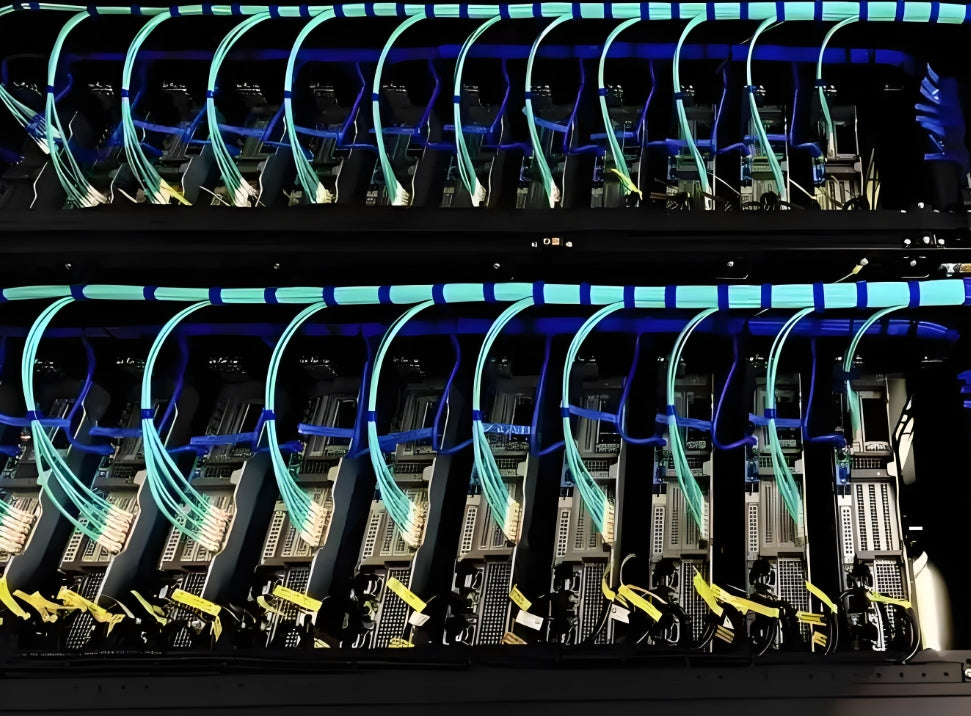
MPO-16 Type B polarity deployment in an AI GPU cluster — TIA-942-C makes Type B the recommended default for all new parallel optics installations
Chapter 3: MPO Polarity, Singlemode & Multimode Fiber Updates
MPO Polarity — Type B Now the Default Recommendation
Polarity management in multi-fiber MPO links has always been a critical — and frequently misunderstood — topic. TIA-942-C provides the clearest guidance yet, establishing Type B (Method B) polarity as the recommended default for all new MPO-based parallel optic deployments.
Type B polarity uses a straight-through fiber mapping with Key-up orientation at one end and Key-down at the other — the connector orientation itself handles the TX/RX flip without requiring gender-flipped patch cords. This eliminates a major source of installation error that has plagued 400G and 800G deployments.
| Polarity Type | Mechanism | TIA-942-C Recommendation | Best For |
|---|---|---|---|
| Type A | Straight-through fiber; requires gender-flipped connector at one end | ⚠️ Permitted — less preferred | Legacy MPO-12 deployments |
| Type B | Key-up to Key-down flip; straight-through fiber mapping | ✅ Recommended default | 800G DR8/FR8, 1.6T, all new MPO-16/24/32 builds |
| Type C | Adjacent-pair flip (1↔2, 3↔4...); duplex conversion only | ❌ Not applicable for parallel optics | SC duplex conversion (not MPO) |
Singlemode Fiber — Expanded Guidance for AI and Long-Reach Applications
TIA-942-C significantly expands guidance around singlemode fiber (SMF) specifications, driven by the surge in AI cluster interconnects requiring 500m–2km singlemode runs between racks and across campuses. The standard now addresses:
- OS2 (ITU-T G.652.D): Standard singlemode — still the baseline for most AI cluster interconnects
- G.657.A1/A2 bend-insensitive singlemode: Now explicitly recommended for data center environments where tight routing radii are common inside racks and cabinets
- Maximum distance limits removed: TIA-942-C follows the approach introduced in -942-A of specifying maximum distances based on application requirements rather than fixed horizontal distance limits, providing more design flexibility
Multimode Fiber — OM3/OM4 Still Valid, OM5 SWDM Recognized
For short-reach inside-rack and intra-row applications, TIA-942-C maintains OM3 and OM4 multimode fiber as valid options while formally recognizing OM5 for Short-Wavelength Division Multiplexing (SWDM) applications. This is relevant for 100G SR4 and emerging short-reach 400G/800G multimode links within 50–100m distances.
| Fiber Type | Wavelength | Max Reach (at rate) | TIA-942-C Status |
|---|---|---|---|
| OM3 | 850 nm | 100m at 10G; 70m at 100G-SR4 | Valid — minimum for new horizontal fiber |
| OM4 | 850 nm | 110m at 10G; 100m at 100G-SR4 | ✅ Recommended multimode |
| OM5 (SWDM) | 850–953 nm | 200m+ at 10G SWDM; emerging at 40G/100G | ✅ Recognized for SWDM applications |
| OM1/OM2 | 850/1300 nm | Legacy only | ❌ No longer supported for new horizontal fiber |
❓ Q: Does TIA-942-C require me to replace existing OM3 infrastructure?
A: No — existing installations remain valid. Standards typically apply to new installations or major upgrades. If your existing OM3 horizontal fiber links are performing within specification, there is no mandatory replacement requirement. However, for new horizontal fiber deployments, OM3 is the minimum acceptable grade (OM4 is recommended), and OM1/OM2 should not be used.
❓ Q: Should I specify OM5 for new multimode deployments?
A: OM5 makes sense for SWDM-based applications — specifically when you need to transmit multiple wavelengths over each fiber pair, effectively doubling or quadrupling capacity on existing fiber plant. For straightforward single-wavelength 40G/100G SR4 links within 100m, OM4 remains the more cost-effective choice. OM5 is a future-proofing consideration, not a general-purpose upgrade.
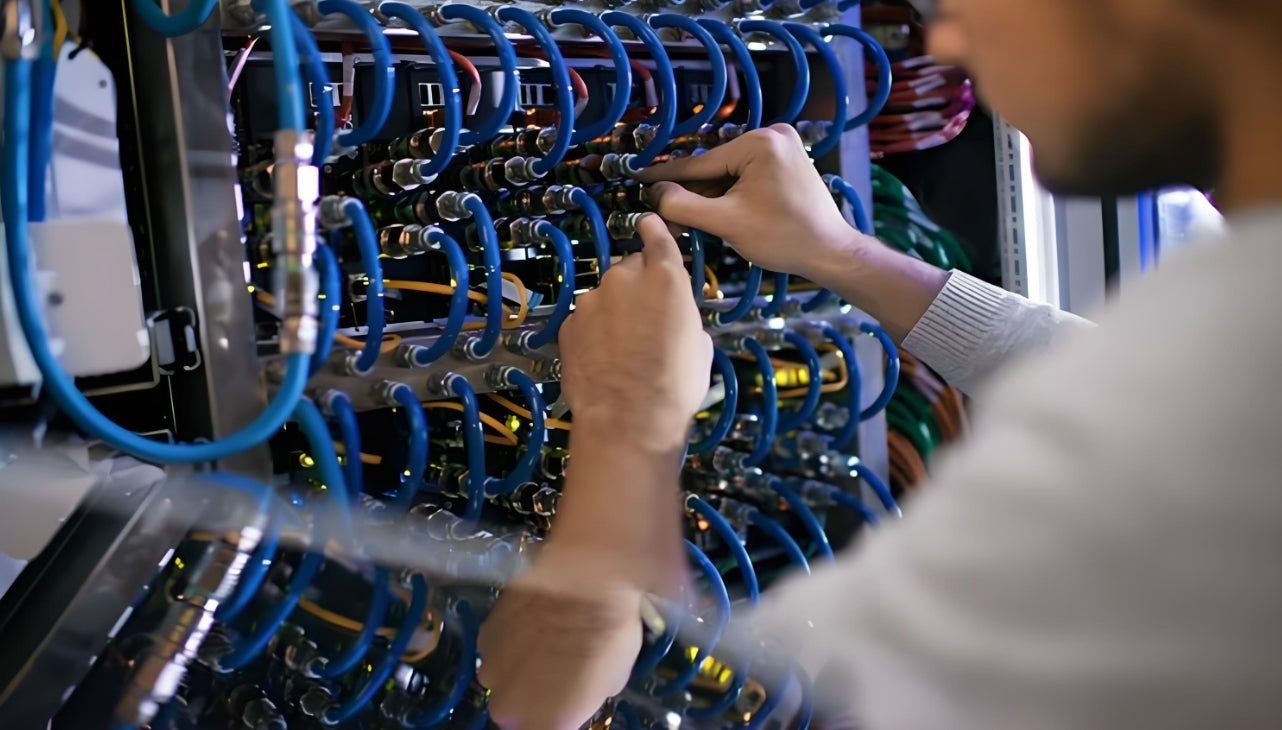
Choosing between singlemode and multimode fiber has direct implications for your TIA-942-C compliance — G.657.A1 bend-insensitive singlemode is now explicitly recommended for dense in-rack routing
Chapter 4: Cabinet Dimensions & Structured Cabling Topology
Cabinet Form Factor and Spacing — Updated for AI Density
TIA-942-C introduces updated guidance on cabinet dimensions and spacing, reflecting the reality of modern high-density AI server deployments. The standard now provides more explicit requirements for:
- Cabinet width: Expanded guidance distinguishing standard 600mm cabinets from wider 800mm cabinets often needed for high-density AI server configurations with back-to-back power distribution units (PDUs) and cable management
- Cabinet depth: Updated minimum depth requirements to accommodate the deeper form factors of modern GPU servers (some AI accelerators exceed 800mm depth)
- Aisle spacing: Revised hot/cold aisle dimensions to account for higher power densities — some AI racks now exceed 40kW per cabinet, well beyond traditional 10–15kW designs
- Floor loading: Updated floor load calculations reflecting the weight of liquid-cooled and GPU-dense cabinets
📋 TIA-942-C Cabinet Compliance Quick Reference
If you are designing a new data center or major expansion under TIA-942-C, verify these physical infrastructure specifications:
- Cabinet width: Standard 600mm is minimum; 800mm recommended for AI/high-density zones with PDU and cable management requirements
- Cabinet depth: Minimum 1200mm for traditional IT; verify AI server depth (many GPU systems require 800mm+ depth)
- Aisle width: Minimum 1,000mm for cold aisle access; expanded to 1,200mm+ for high-density zones with active cooling infrastructure
- Floor loading: Calculate per cabinet weight including server, PDU, and cooling distribution units — some AI cabinets exceed 1,500 kg/m²
- Cable management: Dedicated vertical and horizontal routing space required; TIA-942-C emphasizes structured pathways separate from cooling airflow
Structured Cabling Topology — Key Spaces and Zones
TIA-942-C maintains the fundamental telecommunications space hierarchy introduced in earlier versions, but with updated guidance on the role and sizing of each zone in modern structured cabling for AI data centers:
| Space / Zone | Function | TIA-942-C Update |
|---|---|---|
| ER (Equipment Room) | Core network and core switching | Expanded guidance for hyperscale switching platforms |
| MDA (Main Distribution Area) | Primary cross-connect; main fiber distribution frames | MPO-24/32 trunking now standard for new builds |
| HDA (Horizontal Distribution Area) | Row-level switching and fiber patching | End-of-row (EOR) topology still dominant for AI clusters |
| EDA (Equipment Distribution Area) | Server cabinets and in-rack patching | Higher port counts per cabinet; in-rack MPO patching expanded |
| IDA (Intermediate Distribution Area) | Intermediate cross-connect for large modular campuses | New TIA-942-A addition; retained in -C for multi-building campuses |

High-density in-rack cabling requires careful planning under TIA-942-C — dedicated cable management space is now explicitly required, separate from cooling airflow pathways
Chapter 5: TIA-942-B vs. TIA-942-C — Side-by-Side Comparison
The table below summarizes the most important changes from TIA-942-B (2017) to TIA-942-C (2023), so you can quickly identify what needs attention in your planning:
| Area | TIA-942-B (2017) | TIA-942-C (2023) | Impact |
|---|---|---|---|
| MPO connector types | MPO-12, MPO-16, MPO-24, MPO-32 listed | MPO-32 explicitly validated; MPO-16 emphasized for 800G | Higher fiber count MPO now standard for AI |
| MPO polarity | All three methods permitted | Type B recommended as default | Simpler procurement; fewer installation errors |
| Singlemode guidance | G.652.D OS2 specified | G.657.A1/A2 bend-insensitive SMF explicitly recommended | Less bend loss risk in dense rack environments |
| OM5 fiber | Added as permitted type | SWDM applications clarified and expanded guidance | More flexibility for multimode SWDM deployments |
| Cabinet dimensions | 600mm standard cabinet width | 800mm cabinet explicitly addressed for high-density AI | Critical for liquid-cooled and GPU-dense deployments |
| Power density | Up to ~15kW per cabinet addressed | Up to 40kW+ per cabinet addressed; liquid cooling integration | Redesign of cooling and floor infrastructure for AI zones |
| OM1/OM2 multimode | Not permitted for new horizontal fiber | Still not permitted; OM3 minimum | No change — existing guidance retained |
| Data rate scope | Up to 400G primarily addressed | 800G addressed; 1.6T projected and infrastructure guidance added | Future-proofing language for next-generation AI clusters |
📋 Case Study: TIA-942-C Compliance Upgrade — From 400G Legacy Facility to 800G-Ready AI Cluster
Challenge: A 40MW colocation facility built to TIA-942-B specifications in 2018 needed to support new 800G AI cluster tenants. The existing structured cabling used MPO-12 trunk infrastructure designed for 40G/100G QSFP28 deployments. Initial planning assumed the existing fiber plant could be reused.
Assessment Findings:
- MPO-12 vs. MPO-16 incompatibility: The 800G DR8 QSFP-DD modules used MPO-16 connectors — physically incompatible with existing MPO-12 patch panels and trunks
- Polarity method confusion: The legacy facility used mixed Type A and Type B MPO polarity — no documentation existed to identify which was which, requiring 100% field verification
- Bend radius violations: In-rack OS2 routing used standard bend radius (15× cable OD) — G.657.A1 specification would have provided more margin in the tight rack environment
- Cabinet width insufficient: 600mm-wide cabinets with 42U height could not accommodate the power density and cable management needs of 30kW AI server configurations
AMPCOM Intervention:
- Designed new MPO-16/24 structured cabling infrastructure for the AI cluster zone using TIA-942-C Type B polarity as the standard
- Specified G.657.A1 singlemode for all in-rack OS2 runs to handle tight routing
- Provided upgraded 800mm-wide cabinets with integrated cable management and PDU mounting for the AI zone
- Documented all new infrastructure with TIA-606-C labeling aligned to TIA-942-C spatial requirements
Investment: $2.4M in new MPO-16/24 infrastructure and cabinet upgrades across 12 rows
Result: 800G-ready AI cluster zone certified to TIA-942-C standards. The lesson: planning infrastructure to the latest TIA standard version from day one — rather than adapting legacy infrastructure — is significantly more cost-effective in hyperscale AI deployments.
End-of-row MPO trunking in a structured cabling deployment — TIA-942-C makes MPO-24 or MPO-32 the recommended backbone choice for 1.6T-ready new builds
Chapter 6: Practical Procurement & Compliance Checklist
Fiber Cable Specifications Under TIA-942-C
If you are procuring fiber cabling for a new data center or major AI cluster expansion, align your specifications with TIA-942-C:
| Cable Type | TIA-942-C Recommended Specification | Application |
|---|---|---|
| In-rack / single-mode | G.657.A1 LSZH or OFNR, MPO-16 APC | 800G DR8/FR8 intra-rack |
| Inter-row trunk / single-mode | OS2 G.652.D or G.657.A1, MPO-24 or MPO-32 APC | 800G/1.6T row-to-row backbone |
| Short-reach multimode | OM4 50/125μm, LSZH, MPO-12 PC (legacy) or MPO-16 PC | 100G SR4 within 100m |
| SWDM multimode | OM5 50/125μm, MPO-12 or MPO-16 | 40G/100G SWDM over extended reach |
| Patch cords (SMF) | Type B polarity MPO-16 APC, labeled with polarity type and key orientation | All 800G DR8/FR8 MPO connections |
❓ Q: Is TIA-942-C certification mandatory?
A: TIA-942 certification is voluntary — but it is increasingly required by enterprise clients, colocation customers, and insurance underwriters as evidence of infrastructure quality. Major financial institutions, government agencies, and hyperscale cloud providers routinely specify TIA-942 compliance in their data center RFPs. If you are building a new facility intended for enterprise or government tenancy, TIA-942 certification — now based on TIA-942-C — is effectively a market requirement.
❓ Q: Can an existing TIA-942-B certified facility remain certified after TIA-942-C is published?
A: Yes — existing certifications remain valid. TIA-942 certification is tied to the version of the standard current at the time of certification. A facility certified under TIA-942-B does not need to automatically recertify to -C. However, if significant changes or expansions are made to the facility, those additions would typically need to meet the current standard version.

High-speed computing centers demand TIA-942-C compliant fiber infrastructure from the earliest planning stages — retrofitting later is significantly more expensive
Chapter 7: Key Takeaways & Conclusion
TIA-942-C is not a revolutionary departure from its predecessors — it is a targeted update that brings the standard's architecture and guidance in line with the reality of 800G and 1.6T data rate trends in the AI data center era. The three themes that define -C are: higher fiber density (MPO-16/24/32), better singlemode guidance (G.657.A1 for bend-sensitive environments), and updated physical infrastructure (cabinet sizing, aisle spacing, and power density for 40kW+ cabinets).
For data center designers, operators, and procurement professionals, the practical implication is clear: if you are planning infrastructure for 800G or 1.6T deployments — whether in a new build or an expansion of an existing facility — specify to TIA-942-C from the start rather than adapting legacy infrastructure designed for earlier standards.
Key Takeaways Checklist
| Decision Point | TIA-942-C Recommendation | Common Mistake to Avoid |
|---|---|---|
| MPO connector type (800G) | MPO-16 APC Type B polarity | Ordering MPO-12 or mixing polarity methods — leads to link failures |
| Backbone trunk (1.6T-ready) | MPO-24 or MPO-32 Type B from day one | Installing MPO-12 and hoping 1.6T uses the same connectors |
| Singlemode specification | G.657.A1 bend-insensitive for in-rack; OS2 for inter-row | Specifying OS2 without considering bend radius in dense rack routing |
| Multimode grade | OM4 minimum; OM5 for SWDM applications | Specifying OM3 or OM1/OM2 — not permitted for new horizontal fiber |
| Cabinet sizing (AI zones) | 800mm wide for high-density GPU configurations | Using 600mm standard cabinets for 30kW+ AI deployments |
| Polarity specification | Type B (Method B) — Key-up to Key-down, straight-through fiber | Specifying Type A without gender-flipped connectors — installation errors |
| Certification version | TIA-942-C for new projects; TIA-942-B still valid for existing certifications | Waiting for -C to plan infrastructure for 800G — the technology is already here |

AMPCOM Technical Team
Industry experts with 17+ years in structured cabling, data center infrastructure, and fiber optic network design
Need help sourcing TIA-942-C compliant fiber infrastructure?
AMPCOM provides a full range of MPO-16, MPO-24, and MPO-32 assemblies with verified Type B polarity, OS2/G.657.A1 singlemode trunks, and G.657.A1 bend-insensitive patch cords — all with factory test reports. Contact our engineering team for a project consultation.
Talk to Our Infrastructure Experts

