
How to Choose a Network Cabling Supplier (B2B Guide)
Published:Executive Summary: The global structured cabling market—valued at $12.58 billion in 2025 and projected to reach $20.69 billion by 2035—brings an increasingly diverse supplier landscape. For enterprise procurement teams, distinguishing infrastructure-grade manufacturers from commodity resellers requires a systematic qualification process grounded in objective criteria. Copper-clad aluminum (CCA) substitution, unverifiable certifications, and trading companies presenting as factories are challenges that a structured evaluation framework catches before they become deployment issues.
This guide delivers a 10-point B2B supplier evaluation framework covering certification verification, factory audit protocols, red-flag detection, procurement decision modeling, and supplier negotiation best practices. Whether you are sourcing 500 boxes of Cat6A for a campus retrofit or 50 kilometers of OS2 fiber for a hyperscale data center, the framework provides a repeatable, auditable process for qualifying suppliers against objective criteria.
Quick Navigation
- 1 Why Supplier Selection Fails Most B2B Buyers
- 2 What Makes a Quality Network Cable: The Spec Sheet Decoder
- 3 The 10-Point B2B Supplier Evaluation Framework
- 4 Certifications That Actually Matter (and How to Verify Them)
- 5 Red Flags: 7 Signals to Walk Away Immediately
- 6 Factory Audit Checklist for Bulk Orders Over $50K
- 7 Understanding Pricing Structure & Procurement Value
- 8 Lead Times, MOQ & Production Capacity
- 9 Post-Sale: Warranty, Support & Documentation
- 10 Key Questions About Choosing a Cabling Supplier

Supplier selection determines whether a structured cabling deployment passes certification on Day 1—or triggers a $30K+ rework project six months later
Why Supplier Selection Fails Most B2B Buyers
Why a Structured Qualification Process Matters
Structured cabling procurement sits at the intersection of electrical engineering, materials science, and supply chain management. The supplier you choose determines not just the price on the PO, but the certification pass rate, the installation team's productivity, and the cable plant's 15-year operational reliability. A systematic evaluation framework ensures each criterion is assessed objectively rather than relying on sales presentations and sample kits alone.
Fluke Networks field data indicates that a meaningful percentage of new structured cabling installations require remediation before passing first-pass certification—often because cable or termination quality did not meet the specifications on the box, not because the design was incorrect. The Uptime Institute's 2025 survey found that 53% of data center operators experienced at least one outage in the preceding three-year period, with IT and networking configuration issues among the frequently cited root causes. A properly vetted supplier addresses the material quality layer of this reliability equation before installation begins.
Meanwhile, the global structured cabling market—valued at $12.58 billion in 2025—is projected to reach $20.69 billion by 2035 at a 5.1% compound annual growth rate. Data centers alone now account for more than 41% of all structured cabling installed globally according to BSRIA's 2026 report, almost double the 21% share from 2015-2018. This means more buyers are entering the market, more projects are competing for production capacity, and more low-quality suppliers are rushing to capture demand.
| Quality Metric | Industry Benchmark | Source |
|---|---|---|
| First-pass certification rate (certified supplier) | 96%+ pass rate | AMPCOM project data |
| CCA detection in unverified supply chain | 10-15% of samples | Shanghai Unicorn Cable procurement research |
| Cat6A adoption (new enterprise installs) | Overtaken Cat6 in global volume | BSRIA 2026 structured cabling report |
| Data center share of cabling market | 41% of global structured cabling installed | BSRIA 2026 |
| Supplier audit refusal as quality predictor | Strongest single predictor | B2B procurement research |
| Expected cable plant operational life | 15 years (certified, properly installed) | Industry standard |
The Three Failure Modes
Every major supplier-related cabling failure falls into one of three categories. Understanding them prevents you from building your evaluation around the wrong problem:
Failure Mode 1 — Specification Fraud: The cable meets the printed category on the box but fails Fluke certification because the manufacturer used under-gauge conductors, recycled PVC with degraded dielectric properties, or copper-clad aluminum (CCA) labeled as solid bare copper. This is the most common failure mode and the hardest to detect before installation. According to Shanghai Unicorn Cable's procurement research, conductor weight testing reveals under-gauge material in approximately 10-15% of samples from unverified suppliers.
Failure Mode 2 — Certification Theater: The supplier shows impressive certificates—UL logos, ISO badges, "CE marked" stamps. But the UL file number does not exist on iq.ul.com, the ISO certificate was issued by an unknown body with no IAF accreditation, and the CE mark is self-declared without a Notified Body assessment. The cable itself may be acceptable, but when the auditor arrives for a TIA-942 compliance review, those fake certifications trigger immediate rejection.
Failure Mode 3 — Capacity Collapse: The supplier passes all quality checks, delivers great samples, and quotes competitive pricing. But when your 2,000-box order enters production, their single extrusion line is already running at 110% capacity for another customer. Lead times slide from 3 weeks to 12 weeks. Your project stalls, your installation team sits idle, and the general contractor starts issuing liquidated damages notices. Verifying production capacity is not optional for B2B buyers.
How the Framework Works: A Campus Network Deployment
A university campus network upgrade with 800 drops across 6 buildings illustrates the 10-point framework in practice:
Evaluation process: Five suppliers were shortlisted. Three were eliminated at the certification verification stage—one had an unverifiable UL listing, and two could not provide batch-level test reports for their production orders. Of the two remaining candidates, a factory audit revealed inconsistent conductor gauge on one production floor during the on-site weight check, leaving one qualified supplier.
Outcome: The qualified supplier delivered 800 drops of Cat6A cable with batch-level Fluke DSX test reports, UL Listing Notice, and ISO 9001 certification from an IAF-accredited body. First-pass certification rate: 96%. The structured evaluation process—not price comparison—identified the supplier capable of delivering to specification before installation began.
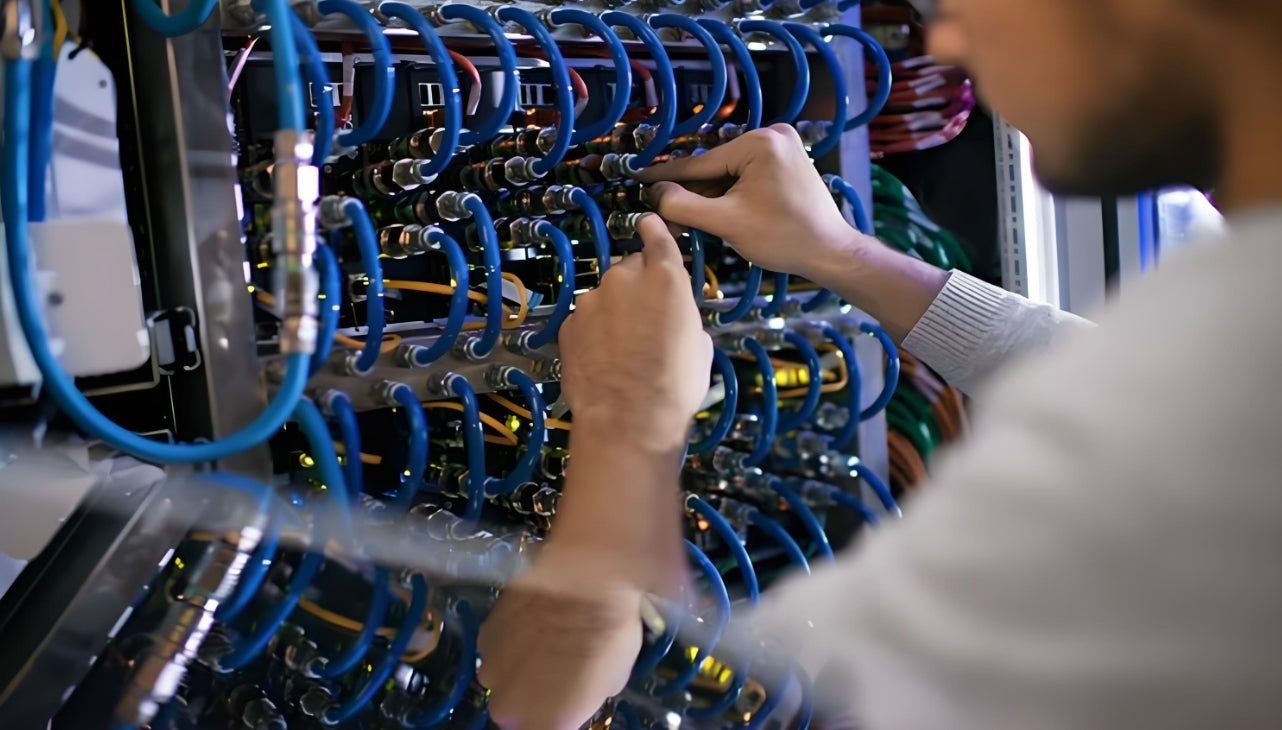
Fluke DSX certification testing exposes specification fraud that visual inspection cannot detect
What Makes a Quality Network Cable: The Spec Sheet Decoder
Conductor Material: Bare Copper vs. CCA — The Non-Negotiable
The single most important specification in any network cable procurement is the conductor material. Solid bare copper is the only conductor type recognized by ANSI/TIA-568 and ISO/IEC 11801 for permanent link installations. Copper-clad aluminum (CCA) exists, moves data, and costs 30-40% less—and introduces three failure vectors that disqualify it from any enterprise-grade procurement.
| Property | Solid Bare Copper | CCA (Copper-Clad Aluminum) |
|---|---|---|
| Conductivity (IACS) | 100% (reference standard) | ~60-65% |
| DC resistance (24 AWG) | ~9.4 Ohms/100m | ~14.5 Ohms/100m (+54%) |
| PoE++ (90W) performance | Stable temperature, full power delivery | Overheating at connector, voltage sag beyond 30m |
| Tensile strength | ~35,000 psi | ~12,000-15,000 psi (brittle) |
| TIA-568 / ISO/IEC 11801 compliant | Yes | No — not recognized by either standard |
| Termination reliability | Consistent IDC contact, minimal oxide formation | Brittle fracture during punch-down; aluminum oxide forms insulating layer |
| Fire safety (PoE bundles) | Predictable temperature rise under load | Higher resistance = more heat in bundles; documented fire hazard |
The CCA detection method is straightforward and costs nothing beyond a precision scale. Cut exactly 1 meter of a single conductor from a sample, weigh it on a scale accurate to ±0.01 grams, and compare to the nominal values: 12 AWG copper = 13.49 g/m; 14 AWG copper = 8.52 g/m; 23 AWG copper = 1.59 g/m. A weight variance exceeding 5% from nominal indicates either CCA material or under-gauge copper—both are disqualifying.
Category, Bandwidth, and What the Numbers Actually Mean
Every network cable category defines two things: the maximum frequency at which the cable is tested, and the data rate it can support over what distance. But procurement teams routinely misunderstand what they are buying:
| Category | Bandwidth (MHz) | Max Data Rate | Max Channel Length | B2B Procurement Context |
|---|---|---|---|---|
| Cat5e | 100 | 1 Gbps | 100 m | Legacy only; not for new enterprise projects |
| Cat6 | 250 | 1 Gbps (standard), 10 Gbps limited | 100 m (1G), 55 m (10G) | Minimum for new office LAN; 10G limited to 55m |
| Cat6A | 500 | 10 Gbps | 100 m | Recommended baseline for enterprise and PoE++ |
| Cat8 | 2,000 | 25/40 Gbps | 30 m | Data center top-of-rack only; not for horizontal runs |
Why Cat6A is now the enterprise baseline: ANSI/TIA-568.2-E (revised October 2024) formally recommends Category 6A or higher for all new installations, particularly for PoE deployments. BSRIA's 2026 report confirms Cat6A has now overtaken Cat6 in global sales volume. More critically, the IEEE 802.3bt PoE++ standard (Type 4, 90W) uses all four cable pairs simultaneously—higher-resistance Cat5e or CCA Cat6 cables generate dangerous heat levels in bundled deployments that Cat6A's larger-gauge conductors (typically 23 AWG vs. 24 AWG in Cat6) dissipate safely.
Shielding: UTP vs. F/UTP vs. S/FTP — Environment Decides
Shielding selection is not a quality decision—it is an environmental decision. Using the wrong shielding type for the installed environment is as damaging as using the wrong category:
| Shielding Type | Construction | EMI Protection | Best Environment | Cost Premium |
|---|---|---|---|---|
| UTP (Unshielded) | No shield; twist pairs only | Relies on pair balance | Standard offices, low-EMI commercial spaces | Baseline |
| F/UTP (Foil Shielded) | Overall foil wrap around all four pairs | Moderate; blocks external RFI | Light industrial, near fluorescent ballasts or motor controllers | +15-20% |
| S/FTP (Braid + Foil) | Overall braid + individual foil per pair | High; blocks both RFI and low-frequency EMI | Factories, welding facilities, MRI suites, power substations | +30-40% |
The critical procurement mistake is ordering S/FTP for a standard office environment. The additional cost provides zero benefit because there is no EMI to suppress. Conversely, ordering UTP for a manufacturing floor with VFD motor drives guarantees intermittent link flaps from electromagnetic interference. A competent supplier asks about the deployment environment before quoting a shielding type—this alone filters out box-moving trading companies from engineering-led manufacturers.
Jacket Materials: PVC vs. LSZH vs. PE
Cable jacket selection carries life-safety and code-compliance implications that purchasing teams frequently overlook:
- PVC (CM/CMR/CMP rated): Standard for commercial indoor environments. CMR (Riser-rated) for vertical runs between floors; CMP (Plenum-rated) for air-handling spaces where smoke toxicity is regulated by NFPA 262. Never deploy standard CM-rated cable in a plenum space—the fire code violation is the procurement team's liability.
- LSZH (Low Smoke Zero Halogen): Required by code in many European public buildings, healthcare facilities, and transit infrastructure. LSZH jackets release minimal smoke and no toxic halogens during combustion—critical in occupied spaces where evacuation time matters. Specifying LSZH increases cable cost approximately 10-15% but removes the legal exposure of non-compliant materials in regulated environments.
- PE (Polyethylene): Outdoor-rated for UV resistance and moisture protection. PE jackets degrade under indoor fluorescent lighting on a timescale of 2-3 years—do not use outdoor cable indoors or indoor cable outdoors regardless of convenience.
The 10-Point B2B Supplier Evaluation Framework
This framework is drawn from procurement protocols used by hyperscale data center operators, Fortune 500 facility management teams, and integrators managing multi-site network deployments. Not every project requires all 10 checks, but skipping checks 1 through 5 is how $80K recabling projects begin.

A structured evaluation process—not price comparison alone—separates infrastructure-grade suppliers from commodity box sellers
Product Quality & Performance Verification (Weight: 25%)
This is the heaviest-weighted criterion because no amount of good service compensates for cable that fails certification. The minimum bar:
- Batch-level Fluke DSX test reports: Request test reports for the specific production batch that will ship your order—not a type-test certificate from a sample submitted 3 years ago. A type-test proves the design is capable; a batch test proves your actual order meets spec. Batch reports should show channel or permanent link testing results including NEXT, ACR-F, return loss, and insertion loss across the full frequency range of the cable category.
- Conductor material certification: Request the raw material certificate for the copper rod used in production. The certificate should trace to the copper mill with a heat number, allowing verification via the London Metal Exchange (LME) registered brand database. Suppliers using recycled or unspecified-origin copper cannot provide this documentation.
- Physical sample testing: Before signing the PO, request 3-5 sample cables and perform the conductor weight test, a visual end-face inspection (for fiber), and a continuity/wire-map test on-site with a basic certifier. If the sample fails any test, the production lot will be worse—never better.
Technical Expertise & Engineering Support (Weight: 15%)
A supplier that cannot answer technical questions about their own product is a reseller, not a manufacturer. Test this during the RFQ phase with specific questions:
- "What is the maximum pulling tension for your Cat6A S/FTP cable, and what pulling grip do you recommend?"
- "Can you provide the delay skew specification for your OS2 12-fiber MPO trunk at 1310 nm?"
- "What is the minimum bend radius for your OM4 fiber during installation versus after installation?"
Engineering-led suppliers answer these questions within hours, with data sheet references. Trading companies deflect, delay, or provide generic answers copied from Wikipedia. This is one of the fastest filters in the evaluation process.
Price Competitiveness (Weight: 15%)
Price evaluation must compare identical specifications, not just line-item totals. The structured approach:
- Request itemized quotes with conductor gauge, shielding type, jacket material, and testing included—not just "Cat6A cable"
- Normalize for shipping, customs duties, and payment terms (LC at sight vs. 30-day net terms carry different effective costs)
- Benchmark against raw material cost: copper spot prices fluctuate around $9,500 per metric ton (Q2 2025 reference). Any quote more than 15% below raw material cost signals material substitution
- The 3-quote rule: obtain three quotes and compare scope, not total price. If the lowest quote omits certification testing that the other two include, the comparison is invalid
Price Red Flag Quick Check
Copper alone for 12 AWG THHN costs approximately $0.15/ft at 2025 prices. A finished Cat6A cable contains 8 conductors plus insulation, jacket, separator, rip cord, packaging, testing, labor, and margin. If a supplier quotes a finished Cat6A cable below $0.25/ft, the math does not add up—verify the specification independently before proceeding.
Reputation, References & Track Record (Weight: 10%)
Request three references from projects similar to yours in scale and application—not cherry-picked small orders. For each reference, ask:
- "Did the cable pass first-time certification, and what was the pass rate?"
- "Did the supplier deliver on the committed timeline, or were there delays?"
- "Would you use this supplier again for a project of equivalent scale?"
Additionally, check the supplier's export history through China Customs' Single Window database (if sourcing from China). Three years of continuous export activity under the same legal entity name is a strong indicator of legitimacy. A legal entity that changed names 18 months ago usually signals a trading company that rebranded after a quality incident.
Logistics, Delivery & Geographic Reach (Weight: 10%)
Shipping structured cabling involves three costs beyond the freight rate itself: customs clearance delays, inland transportation from port to site, and storage if the cable arrives before the installation team is ready. Evaluate:
- Port proximity: Suppliers near major container ports (Shenzhen, Shanghai, Ningbo) typically ship 5-7 days faster than inland factories, all else equal
- Incoterms clarity: FOB vs. CIF vs. DDP—understand who owns the cargo at each transit point and where insurance responsibility transfers
- Consolidation capability: Can the supplier consolidate copper cable, fiber cable, patch panels, and accessories into one container? Multi-supplier split shipments increase customs complexity and delay risk geometrically
6 – 10: Production Capacity, MOQ, OEM/ODM, Warranty, Compliance
These five criteria are detailed in dedicated sections below because they require deeper technical context than a summary table can provide.
| Criterion | Weight | Key Verification Question | Detailed In |
|---|---|---|---|
| Production Capacity | 8% | "What is your monthly throughput and current utilization rate?" | Section 8 |
| MOQ Flexibility | 7% | "Can you phase delivery to match our construction schedule?" | Section 8 |
| OEM/ODM Capability | 5% | "Can you customize jacket color, length marking, and packaging?" | Section 8 |
| Warranty & After-Sales | 5% | "What is the warranty term, and what is the RMA process?" | Section 9 |
| Environmental Compliance | 0% (threshold) | "Are RoHS/REACH certificates current and traceable?" | Section 4 |
4. Certifications That Actually Matter (and How to Verify Them)
4.1 The Certification Verification Workflow
Most B2B buyers accept a PDF of a certification at face value. This is procurement negligence. Every certification in structured cabling can be independently verified in under 10 minutes using public databases:
| Certification | Verification Method | What to Look For | Red Flag |
|---|---|---|---|
| UL Listing | Search supplier name at iq.ul.com | File number (E-series), exact product scope, active status, production location match | UL mark on cable, nothing in database |
| ETL Listing | Search at intertek.com/directories | Control number, product category, listing status | ETL mark without published control number |
| ISO 9001 | Check IAF CertSearch or certifying body's database | IAF accreditation number of the certifier, scope matches cable manufacturing | Unknown certifier with no IAF membership |
| RoHS/REACH | Request lab test report from an ISO 17025 accredited lab | Test report number, accredited lab's ISO 17025 scope | Self-declaration without third-party lab report |
| CE Marking | Request Declaration of Conformity + Notified Body certificate (if applicable) | Notified Body 4-digit number for construction products | CE mark alone without supporting DoC |
| BICSI Certification | Verify at bicsi.org/verify | Active RCDD/INST/Technician credentials of supplier's team | Claiming BICSI without verifiable individual credentials |
The UL Yellow Card: Your Single Most Important Document
The UL Listing Notice (colloquially called the "yellow card") is NOT the same as a UL logo on a website. It is a specific document that specifies the exact conductor, insulation, jacket materials, and construction dimensions that are certified. A generic "UL Listed" claim may cover a different cable family than what you are buying. Request the yellow card for your specific product before signing the PO. A legitimate factory provides this document within 24 hours. A trading company cannot produce it because they do not control the UL file—they are reselling another factory's product, and you have no quality chain of custody.
4.2 What ISO 9001 Actually Means (and What It Does Not)
ISO 9001 certifies that a manufacturer has a documented quality management system—not that their products are inherently high-quality. Two ISO 9001 factories can produce cables at opposite ends of the quality spectrum; the standard only verifies process consistency, not performance minimums. The value of ISO 9001 in cabling procurement is that it requires:
- Incoming raw material inspection with documented acceptance criteria
- In-process quality checks at defined production stages
- Final product testing before release
- Corrective action procedures for non-conforming product
- Traceability from raw material lot to finished product reel
Critical verification: Check the ISO certificate's issuing body against the IAF (International Accreditation Forum) member list. A certificate from an unknown certification body with no IAF accreditation is not a valid ISO 9001 certificate—it is a purchased piece of paper. This is one of the most common frauds in international cable procurement.
4.3 Fluke Testing: The Difference Between Type Test and Batch Test
The most important distinction in cable certification is between a type-test report and a batch-test report. A type test proves that one sample—often hand-selected and produced under ideal conditions—passed certification. A batch test proves that the cables from your specific production order passed certification. The difference is everything.
For fiber optic cable, the minimum batch-test data packet should include OTDR traces at both 1310 nm and 1550 nm (single-mode) or 850 nm and 1300 nm (multimode), insertion loss per connector interface, return loss per channel, and end-face inspection images showing no scratches, pits, or contamination exceeding IEC 61300-3-35 thresholds. For copper cable, the batch-test data packet should include Fluke DSX channel or permanent link test results showing NEXT, ACR-F, return loss, insertion loss, propagation delay, delay skew, and DC resistance—all within ANSI/TIA-568.2-D limits across the full frequency range.
5. Red Flags: 7 Signals to Walk Away Immediately
These seven red flags are not warning signs—they are disqualifications. Any single one justifies terminating the supplier evaluation and moving to the next candidate.
1 Price Below Raw Material Cost
Copper at current spot prices (~$9,500/ton) accounts for the majority of a network cable's material cost. If a finished Cat6A cable is quoted below the cost of the copper inside it, the cable does not contain the copper claimed. This is not a "good deal"—it is fraud.
2 UL/ETL Mark, Nothing in the Database
Counterfeit UL and ETL marks are a federal offense in the United States and a regulatory violation in the EU. If the supplier's name or file number does not appear on iq.ul.com for the exact product category being purchased, the certification is forged. This red flag alone should trigger immediate rejection and documentation for your compliance file.
3 Only Type-Test Reports, No Batch-Test Capability
A supplier that provides only a type-test certificate from a sample submitted years ago—and cannot or will not provide batch-level Fluke or OTDR reports for your specific production order—has no ongoing quality control. This is the hallmark of a trading company that purchased a type-test certificate once and never verified production quality again.
4 Refuses or Delays Factory Audit / Third-Party Inspection
A legitimate factory with nothing to hide welcomes audits. A factory that refuses, delays, or imposes unreasonable conditions on a third-party inspection (3PI) has something to hide. Per Shanghai Unicorn Cable's B2B procurement research, refusing factory audit is the single strongest predictor of quality failure in cable sourcing. Schedule the audit, do not announce exact dates, and walk if access is denied.
5 ISO Certificate From an Unaccredited Body
Check the ISO 9001 certificate's issuing body against the IAF member database. If the certifier is not IAF-accredited, the certificate has no international validity. This is increasingly common: unknown agencies in jurisdictions with weak oversight issue "ISO 9001" certificates for a fee with no audit ever conducted. Your compliance auditor will reject these immediately.
6 Registered Address Is an Office Tower, Not an Industrial Park
A quick check on the China National Enterprise Credit Information Publicity System (or equivalent business registry in the supplier's country) reveals the registered address. A registered address in a Shenzhen office tower—not an industrial park—means the entity is a trading company, regardless of what the website claims. Trading companies can source good cable, but you have zero visibility into which factory produced it and zero recourse when specifications drift between samples and production lots.
7 Cannot Name or Document Raw Material Sources
When asked "Which copper mill supplies your conductor rod?", legitimate manufacturers answer with a company name, location, and raw material certificate within hours. Trading companies respond with "we work with multiple suppliers" or similar deflection. This question alone filters more suppliers than any other single query in the evaluation process.
Factory Audit Checklist for Bulk Orders Over $50K
For any order exceeding $50,000, a factory audit—whether conducted in person, via video, or through an independent third-party inspection agency—is strongly recommended. The audit does not need to be adversarial. A legitimate factory treats it as a routine part of B2B business. Here is what to verify:
Production Infrastructure
| Audit Checkpoint | Green Flag | Red Flag |
|---|---|---|
| Extrusion lines | Multiple lines with in-line diameter gauge and spark tester | Single line, no in-line QC instrumentation |
| Twisting machines | Dual-twist or single-twist machines with back-twist control | Manual or visibly worn twisting equipment |
| Jacketing line | Temperature-controlled extruder with laser diameter monitoring | No temperature control, jacket thickness visibly inconsistent |
| Raw material storage | Temperature-controlled warehouse; PVC compounds sealed until use | Compounds stored outdoors or in non-climate-controlled areas; opened bags exposed to humidity |
| Testing lab | In-house Fluke DSX, OTDR, tensile tester, aging oven, microscope | No visible testing equipment, or equipment covered in dust |
| Copper rod traceability | Certificates traceable to LME-registered brand with heat numbers | Unbranded rod with no documentation |
Production Floor Walk-Through
Walk the production floor in the order material flows: raw material warehouse → wire drawing → insulation extrusion → twisting → jacketing → testing → packaging → finished goods warehouse. At each stage, ask the line operator—not the tour guide—to explain the quality checkpoint for that process. A quality-driven factory has operators who can explain their inspection criteria. A paper-quality factory has operators who look to the tour guide for the answer.
Quick Test: The Conductor Weight Verification
During the audit, request a 1-meter sample cut directly from a production reel—not from a pre-prepared sample. Weigh it on-site using your own precision scale. Check against nominal values. If the factory refuses to cut from a production reel or insists on providing only pre-prepared samples, treat it as a de facto Red Flag #4 (Section 5). This test takes 3 minutes and reveals more about quality than 3 hours of document review.
Understanding Pricing Structure & Procurement Value
Cable Cost in Context: The Full Project Perspective
According to the Fiber Broadband Association's 2025 Fiber Deployment Cost Annual Report (Cartesian), installation and labor account for approximately 64-72% of total project cost, depending on deployment type. The cable material itself sits in the remaining 28-36%. This ratio underscores an important procurement principle: the supplier's quality infrastructure and documentation discipline impact project success far more than the cable unit price. A supplier delivering complete batch-test documentation, clear labeling, and consistent gauge control enables the installation team to work efficiently. A supplier that cuts corners on quality verification creates friction that compounds across every termination point in the project.
Factory-Direct vs. Trading Company: Understanding the Difference
| Comparison Point | Factory-Direct | Trading Company |
|---|---|---|
| Supply chain visibility | Full—from copper rod certificate to finished reel | Limited—factory identity often undisclosed |
| Quality accountability | Single point—the manufacturer stands behind its product | Diffused—factory and trading company may each deny responsibility |
| Engineer access | Direct; can discuss technical specifications in real time | Filtered through a sales representative who relays questions |
| Customization capability | Full—jacket color, length marking, packaging, branding | Limited to what the undisclosed factory offers |
| Batch traceability | Complete—test reports linked to specific production lots | Typically unavailable or generic |
| Production scheduling control | Direct—factory manages its own production queue | Indirect—factory prioritizes direct customers first |
The Procurement Decision Framework
Evaluating Total Procurement Value
Cable Specification Compliance: Does the product match the specification across all performance parameters? Verified through batch-level Fluke DSX or OTDR testing for your specific order.
Documentation Completeness: Does the supplier deliver all compliance documents—UL Listing Notice, material certificates, batch test reports, and installation guidelines—as a contractual deliverable?
Operational Reliability: A properly installed, certified cable plant should serve 15 years with routine MAC work. Supplier quality directly determines whether the plant reaches that operational lifetime without degradation.
Installation Efficiency: Well-documented, consistently manufactured cable reduces termination time, certification re-test cycles, and installation team friction. These labor-side effects often outweigh the cable unit price difference.
Lead Times, MOQ & Production Capacity
Production Capacity Verification
A supplier's claimed "capacity" means nothing without verification. The question is not "what is your annual capacity" but "what is your monthly throughput and current utilization rate?" A factory producing 30,000 boxes of Cat6 per month at 70% utilization can absorb your 3,000-box order without disrupting schedule. The same factory at 95% utilization will slide your order by weeks for every higher-margin customer that calls.
During the evaluation, request the supplier's monthly output data for the last three months by product category, not a glossy annual number. If they cannot provide month-by-month production data, they do not track it—and you cannot forecast your own delivery with any reliability.
Lead Time Benchmarks (2026)
| Product Category | Standard Lead Time | Expedited (Factory-Direct Only) |
|---|---|---|
| Copper patch cables (Cat5e/Cat6/Cat6A) | 15-25 days | 10-12 days |
| Bulk copper cable (1,000 ft boxes) | 15-30 days | 10-15 days |
| Fiber patch cords (LC/SC/MPO) | 15-25 days | 10-14 days |
| MPO/MTP trunk cables (custom length) | 20-30 days | 15-18 days |
| Network cabinets & enclosures | 25-40 days | 20-25 days |
| Patch panels & keystone jacks | 20-30 days | 12-18 days |
Trading company reality check: Add 7-10 days to every figure above when ordering through a trading company. The trading company must coordinate with the factory, and factories prioritize direct customers over intermediary orders when production capacity tightens. This is not speculation—it is standard operating behavior observed across the structured cabling supply chain.
MOQ and Phased Delivery
Factory-direct suppliers typically offer MOQ flexibility that trading companies cannot match because they control production scheduling. Key negotiation points:
- Phased delivery: Instead of taking delivery of 50,000 cables at once—requiring warehouse space and storage protection—negotiate 5 shipments of 10,000 aligned with your construction phases. The supplier holds inventory; you draw down as needed
- Trial order: For new supplier relationships, negotiate a trial order of 5-10% of total project volume with the same unit pricing as the full order. If the trial order passes certification without issues, exercise the balance of the PO
- MOQ waiver for samples: A legitimate manufacturer provides 3-5 samples at no charge or at nominal cost before the first order. A supplier that demands a full-MOQ purchase before providing samples is hiding something—walk away
OEM/ODM Capabilities
For integrators and distributors building their own brand, OEM/ODM capability is a strategic requirement, not a nice-to-have. Verify the following customization options are available from the factory floor, not just promised in marketing materials:
- Custom jacket color (Pantone-matched)
- Length marking in feet or meters, with your brand printed every 2 feet/meters
- Custom packaging: pull-box, reel, wooden spool, or branded retail box
- Custom labeling and barcodes for integration with your inventory management system
- Private-label branding on cable, packaging, and test reports
Post-Sale: Warranty, Support & Documentation
Warranty Terms That Actually Protect You
A structured cabling warranty should cover three things: materials, performance, and application assurance. The industry baseline for quality manufacturers is:
- 25-year product warranty: Covers material defects and manufacturing workmanship. Standard for copper and fiber cable from tier-1 manufacturers
- Performance warranty: Guarantees the installed cable plant will continue to meet its category performance specifications over the warranty period when installed per manufacturer guidelines
- Application assurance: Some manufacturers extend the warranty to cover the applications running over the cable (e.g., "this Cat6A installation will support 10GBASE-T for 25 years")
Warranty trap to avoid: Some suppliers offer impressive-sounding warranty terms that are voided by any change to the cable plant—including MACs that are the entire purpose of structured cabling. Read the warranty exclusions before celebrating the warranty duration. A warranty that voids when you move a patch cord is not a warranty; it is a marketing claim.
Documentation Deliverables
At project completion, the supplier should deliver—as a contractual obligation, not a favor:
Required Post-Delivery Documentation Package
Batch-level Fluke DSX / OTDR test reports for your specific production order with traceable reel/batch numbers
Material certificates for copper rod (mill certificate with heat number) and fiber preform (manufacturer certificate with attenuation measurement)
UL/ETL Listing Notice (yellow card) for each certified product in your order
ISO 9001 certificate with IAF-accredited body verification
RoHS/REACH compliance certificates from ISO 17025 accredited labs, current within 12 months
Installation guidelines covering maximum pulling tension, minimum bend radius, termination procedures, and grounding requirements specific to your ordered products
RMA process documentation with contact information, response time commitments, and escalation procedures
Technical Support as a Procurement Criterion
Before signing the PO, test the supplier's technical support with a real scenario: "We are installing this Cat6A cable in a facility with VFD motor controllers 3 meters from the cable tray. What additional shielding or separation do you recommend?" An engineering-led supplier identifies the specific frequency range of VFD EMI (typically 2-16 kHz fundamental with harmonics into the MHz range), confirms that standard F/UTP provides insufficient attenuation at those frequencies, and recommends S/FTP with a minimum 300 mm separation from VFD power cables. A trading company replies "our cable is shielded, it will be fine." The difference in these two answers is the difference between a project that runs clean for 15 years and one that generates ticket after ticket for "intermittent connectivity."
Key Questions About Choosing a Cabling Supplier
How do I verify a network cable supplier's UL certification is real?
Go to iq.ul.com and search the supplier's company name. A genuine UL listing shows the file number (e.g., E123456), exact product scope and construction details, production location(s) covered, and current listing status (active/inactive). Request the UL yellow card (Listing Notice) for your specific product. This document specifies the exact conductor, insulation, jacket materials, and dimensions that are certified—not a generic "UL listed" claim that may cover a different cable family. If the supplier has UL marks on their cable but nothing appears on iq.ul.com, that is counterfeit certification—a violation of federal law in the United States.
What is CCA cable and why should B2B buyers avoid it?
CCA (Copper Clad Aluminum) uses an aluminum core with a thin copper coating instead of solid bare copper. Aluminum has approximately 40% higher resistance than copper, causing three problems: (1) severe voltage drop on PoE runs above 30 meters where the DC resistance of CCA eats into the already-tight PoE++ voltage budget, (2) dangerous heat buildup at the RJ45 connector when carrying PoE++ Type 4 (90W) loads because the higher resistance converts more electrical energy to thermal energy at the termination point, and (3) brittleness that causes conductors to snap during punch-down termination or when cables are moved during MAC work. CCA is not recognized by TIA-568 or ISO/IEC 11801 standards. A simple verification method: cut 1 meter of conductor and weigh it—12 AWG copper should weigh 13.49 g/m. A weight variance above 5% signals under-gauge or CCA material.
What certifications should a network cabling supplier have?
At minimum: UL or ETL listing (third-party safety and performance verified on iq.ul.com), ISO 9001 from an IAF-accredited body (not an unknown agency with no international recognition), and RoHS/REACH for regulatory compliance. For enterprise and data center projects, also look for BICSI-certified technicians on the supplier's team, Fluke DSX channel test reports per production batch (not just type-test certificates from prior years), and compliance documentation showing conformance to ANSI/TIA-568.2-D (copper) and TIA-568.3-D (fiber). A supplier that only provides a one-time type-test report from years ago—without batch-level test data for your specific order—should not pass your evaluation regardless of how impressive their brochure looks.
What is the difference between factory-direct and trading company sourcing?
Factory-direct sourcing means you purchase from the manufacturer that operates the production lines—extrusion, twisting, jacketing, and testing. This provides a single point of quality accountability with direct engineer access. Trading companies purchase from factories and resell, adding a coordination layer without adding quality control. The key practical differences: factory-direct gives you batch-level traceability from copper rod certificate to finished reel, direct technical communication with the engineers who designed the cable, and production scheduling control because the factory manages its own queue. Trading companies provide logistics convenience but introduce an intermediary that cannot control production quality, cannot provide raw material traceability, and adds coordination delay when technical questions arise during installation. For enterprise procurement where documentation, traceability, and accountability matter, factory-direct provides structural advantages in supply chain transparency.
What are the red flags when evaluating a cabling supplier?
Five red flags that should stop an order immediately: (1) cable price below raw copper material cost—copper alone for 12 AWG THHN is approximately $0.15/ft at current prices, so a finished Cat6A cable quoted below $0.25/ft signals material substitution; (2) UL/ETL mark on the cable but no verifiable listing on iq.ul.com, which constitutes counterfeit certification; (3) supplier cannot provide traceable batch test reports for your production order—only a type-test certificate from a prior production run, indicating no ongoing quality control; (4) supplier refuses or delays a factory audit or third-party inspection, which is the single strongest predictor of quality failure in international cable sourcing; and (5) ISO 9001 certificate issued by an unknown or unaccredited certification body with no IAF membership. Any one of these five signals disqualifies a supplier for enterprise-grade procurement.
What is the typical lead time for bulk network cable orders?
Standard lead times for bulk copper and fiber cable orders run 15-30 days from PO confirmation, depending on order volume and customization requirements. Network cabinets and enclosures typically require 25-40 days. Factory-direct suppliers with vertically integrated production—in-house copper drawing, insulation extrusion, twisting, and jacketing lines—can often accelerate to 10-15 days for urgent projects because they control the full production chain rather than coordinating between multiple subcontractors. Trading companies add 5-10 days of coordination overhead. Always verify a supplier's monthly production capacity and current utilization rate: a factory producing 30,000 boxes of Cat6 per month at 70% utilization has fundamentally different delivery reliability than one producing 5,000 boxes at 95% utilization, regardless of what either quotes for lead time.
Should I request a factory audit for a network cabling order?
Yes—a factory audit is strongly recommended for any order above $50,000 or any project where cabling failure would cause business disruption. Key audit checkpoints include: in-line spark testing on every conductor during extrusion (100% in-line testing is a UL 1581 requirement that separates legitimate factories from cost-cutters), temperature-controlled compound storage (uncured PVC absorbs moisture that creates micro-voids in insulation, degrading dielectric performance over time), batch-level traceability from copper rod certificate to finished reel with matching heat numbers, and 100% Fluke testing on every production batch with results available for your specific order. Green flags include an active UL listing verifiable online, raw material certificates for copper rod from an LME-registered brand, and third-party inspection access granted without conditions. Red flags include only a type-test report from years ago with no batch-level data, no temperature-controlled storage for raw materials, UL marks on cable with nothing on iq.ul.com, and a registered address in an office tower rather than an industrial park. Walk away from any supplier displaying these red flags regardless of how competitive their pricing appears.
Related Articles
- Data Center Cabling Mistakes: 7 Pitfalls, Costs & Fixes — Real-world cabling errors that cost $5K-$50K per incident, with prevention ROI of 5-25x per rack
- Structured Cabling for SMB & Campus Networks — A practical guide to structured cabling design for multi-building campuses and enterprise LANs
- AI Frontend vs Backend Networks: Cabling Design Differences — Why GPU cluster cabling demands different supplier specs than enterprise frontend networks
- How to Choose the Right Fiber Type: Singlemode vs Multimode — OM3/OM4/OM5 vs OS2: matching fiber specifications to link speed, distance, and budget

AMPCOM Technical Team
Industry experts with 17+ years in enterprise network infrastructure
Sourcing network cabling for a large-scale enterprise project?
Our team provides pre-sales technical consultation, full batch-test documentation, and customized cabling solutions for hyperscale, campus, and industrial deployments. Request UL-listed product specifications, sample documentation, and a factory audit walkthrough today.
Get Free Consultation

