
Fiber Cabling Strategy for the 800G→1.6T Migration: Why Base-16 / MPO-16 Is the Future-Ready Choice
Published:Quick Navigation
- 1 The 800G→1.6T Wave Is Rewriting the Fiber Math
- 2 Decoding "Base-16" — Fiber Application Standards Explained
- 3 Base-16 vs Base-8 vs Base-12 — The Comparison That Decides Your Rack
- 4 MPO-16 — The Connector That Makes Base-16 Real
- 5 The Migration Playbook — 800G Today, 1.6T Ready Tomorrow
- 6 Five Migration Mistakes That Break 1.6T Readiness
- 7 The Future-Ready Verdict

The 800G→1.6T transition is now a procurement decision, not a future bet — and the connector choice made today determines your recabling cost tomorrow
Chapter 1: The 800G→1.6T Wave Is Rewriting the Fiber Math
For two decades, data center fiber counts scaled gently: 10G needed 2 fibers, 40G/100G-SR4 needed 8, and 400G was the first generation to push hard on parallel optics. What changed with 800G — and accelerates with 1.6T — is that the dominant intra-cluster optic is now an 8-lane parallel interface. Eight transmit fibers and eight receive fibers. Sixteen fibers, end to end.
The optical lane story
The serial lane rate is what doubles; the number of lanes usually stays at eight for the highest-volume DR8/SR8 optics:
Here is the insight that drives the entire cabling strategy: doubling the lane rate from 100G to 200G does NOT change the fiber count when you stay on 8-lane parallel optics. The same 16-fiber path that carries an 800G-DR8 link carries a 1.6T-DR8 link. The only thing that changes is the transceiver at each end. As we covered in our analysis of what 800G and 1.6T trends mean for data center cabling in 2026, this is why the connector — not the fiber — is the real migration decision.
For AI clusters, the economics are brutal: a 100,000-GPU training fabric can contain hundreds of thousands of parallel-optic links. If each link requires recabling at the next speed generation, the labor and downtime cost dwarfs the optics. The goal is a plant where the only swap at 1.6T is the module. That is exactly what a Base-16 / MPO-16 design delivers. The way AI infrastructure is reshaping data center cabling requirements makes this the default assumption for new builds, not an optimization.

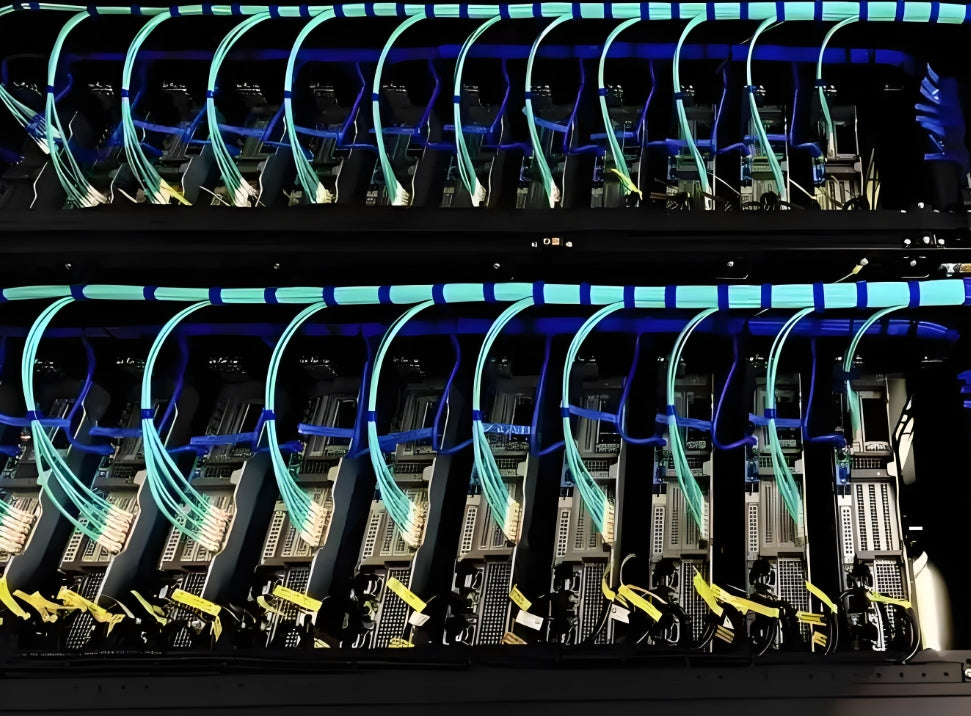
High-density AI clusters are where the 16-fiber math matters most — every recabled link is a labor and downtime cost that a Base-16 design avoids
Chapter 2: Decoding "Base-16" — Fiber Application Standards Explained
"Base-16" is not a marketing term — it is a formal fiber application space defined alongside Base-2, Base-8, and Base-12 in the TIA-568 cabling standards. Each "Base-N" defines how many fibers an application consumes and how they are allocated between transmit and receive. Understanding the family is the fastest way to see why Base-16 wins for 800G and 1.6T.
The Base-N family
| Application space | Fibers (Tx + Rx) | Typical connector | Serves which optics |
|---|---|---|---|
| Base-2 | 2 (1 + 1) | Duplex LC | 100G-FR/LR, 400G-FR4, 800G-FR8/LR8 (WDM on 2 fibers) |
| Base-8 | 8 (4 + 4) | MPO-12 (8 of 12 used) | 40G/100G-SR4, 400G-SR8 (legacy parallel) |
| Base-12 | 12 (legacy workhorse) | MPO-12 | 10G/40G-era trunking; breakout legacy |
| Base-16 | 16 (8 + 8) | MPO-16 | 400G/800G/1.6T SR8 & DR8 (8-lane parallel) |
Why Base-16 fits 8-lane optics perfectly
An 8-lane optic such as 800G-SR8 or 1.6T-DR8 transmits on 8 fibers and receives on 8 fibers. Base-16 delivers exactly that: 8 transmit pairs and 8 receive pairs in one connector, with a clean 1:1 mapping to the optic's lanes. There are no split pairs, no wasted fibers, and no need to gang two connectors to serve a single module. That is the structural reason Base-16 is "balanced" for the current roadmap in a way Base-8 and Base-12 are not.
The reach split: singlemode vs multimode within Base-16
Base-16 is a fiber-count concept; the fiber type is chosen by reach. For DR8 (≤500 m, building-to-building and long intra-cluster runs) you use OS2 / G.657.A2 singlemode. For SR8 (multimode) you use OM4 (≤100 m) or OM5 (≤150 m at 800G; ≤100 m at 1.6T). Singlemode gives the cleanest forward path because one fiber type carries both 800G and 1.6T with no reach penalty — only the optics change.
Base-16 is the fiber-count standard behind 8-lane optics — one MPO-16 maps 1:1 to an 800G or 1.6T DR8/SR8 module
Chapter 3: Base-16 vs Base-8 vs Base-12 — The Comparison That Decides Your Rack
If you are designing a new build or a major zone upgrade in 2026, the three realistic candidates are Base-8, Base-12, and Base-16. Here is the head-to-head that should decide your rack.
| Dimension | Base-12 (MPO-12) | Base-8 (MPO-12, 8 used) | Base-16 (MPO-16) |
|---|---|---|---|
| Fibers per connector | 12 | 8 | 16 |
| Native optics served | Legacy 10G–100G breakout | 400G-SR8, some 800G | 800G & 1.6T DR8/SR8 |
| Single-connector 1.6T | ❌ Requires ganging | ❌ Requires 2× connectors | ✅ Yes |
| Breakout flexibility | Best legacy breakout | Clean 4-pair splits | 8-pair, 1:1 to 8-lane optic |
| Fiber waste at 800G/1.6T | High (4 spares / mismatch) | Moderate | Zero |
| Density per RU | High | High | High (same faceplate) |
| Verdict | Legacy / retrofit only | 400G-era compromise | Future-ready default |
The verdict is straightforward. Base-12 is the installed base you inherit and must interoperate with, but it is the wrong choice for new 800G/1.6T trunking — it either wastes fibers or forces you to gang connectors. Base-8 was the popular "balanced" compromise during the 400G era and still works for many 800G links, but it cannot carry a single 1.6T DR8 in one connector. Base-16 is the only application space that natively serves 800G and 1.6T parallel optics with one connector and zero fiber waste — which is precisely the definition of future-ready. Our deeper dive into MPO fiber solutions — choosing 8, 12, or 24 fibers for high-density cabling walks through the 12- and 24-fiber trade-offs for aggregation layers.

In a high-speed computing center, Base-16 trunking keeps one connector per 800G/1.6T link — no ganging, no wasted fibers
Chapter 4: MPO-16 — The Connector That Makes Base-16 Real
Base-16 is the fiber-count standard; MPO-16 is the physical connector that carries it. MPO-16 packs 16 fibers into the same rectangular ferrule footprint as the familiar MPO-12, but the mechanical and optical details matter enormously at 800G and 1.6T.
Polarity: default to Type B
TIA-942-C recommends Type B (Method 2) as the default polarity for all new parallel-optics installations. Type B uses a flipped (key-up to key-down) trunk paired with straight harnesses, so transmit and receive lanes land correctly at the far end. Mixing Type A and Type B in the same link is one of the most common causes of "everything looks connected but nothing links" failures at 800G.
Polish: APC for singlemode, never PC
For singlemode DR8 (OS2 / G.657.A2), MPO-16 must use APC polish (green boot). PC (blue) polish reflects too much light back into the transmitter and will violate the stricter return-loss budget of 100G/200G PAM4 lanes. PC polish is acceptable only for multimode SR8, where return loss is not the limiting factor.
Loss budget gets tighter at 1.6T
Because 1.6T pushes 200G per lane over PAM4, the optical margin is thinner than at 800G. Plan to:
- Target ~0.35–0.5 dB per mated MPO-16 pair (factory-grade components)
- Keep the end-to-end channel within roughly 3–4 dB total insertion loss
- Reserve 100% endface inspection and cleaning as a commissioning gate, not a suggestion
Where VSFF fits
For ultra-high-density switch faceplates, Very Small Form Factor (VSFF) connectors such as SN, CS, and MDC deliver duplex 200G per fiber pair and pack more ports per RU than MPO. But VSFF is a faceplate technology — the trunk behind it is still MPO-16 carrying Base-16. Standardize the trunk on MPO-16 and use VSFF only where port density at the switch demands it.
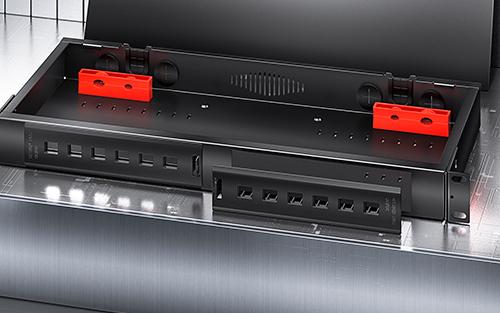
An MPO-16 termination point implementing Base-16 with Type B polarity — the physical realization of the 16-fiber application space
Chapter 5: The Migration Playbook — 800G Today, 1.6T Ready Tomorrow
A future-ready Base-16 deployment is not a separate "phase 2" project. It is a set of choices you make now so that 1.6T becomes a transceiver swap instead of a rebuild. Here is the playbook.
Step 1 — Standardize new trunking on MPO-16, Type B
Specify MPO-16 trunk cables with verified Type B polarity and full factory test reports for every new AI-cluster or high-speed zone. Do not mix MPO-12 and MPO-16 in the same link, and label polarity and key orientation on every boot.
Step 2 — Choose fiber by reach, singlemode for the upgrade path
Use OS2 / G.657.A2 singlemode for DR8 runs (≤500 m) and OM5 multimode for short SR8 runs (≤150 m). Where the budget allows, standardize on singlemode: it carries both 800G and 1.6T with no reach penalty and keeps one sparing/testing workflow across the plant.
Step 3 — Treat 1.6T as an optics-only upgrade
When 1.6T DR8 modules are qualified, swap the transceivers at each end of the existing MPO-16 / G.657.A2 plant. The 16 fibers do not change. This is the whole point of Base-16.
Case study: a hyperscale AI cluster that skipped recabling
A cloud operator deployed an 800G GPU fabric across 12 rows in 2025 using MPO-16 Type B trunking on G.657.A2 singlemode, designed from day one to the Base-16 application space. In 2026, when 1.6T-DR8 optics were qualified, the upgrade was a transceiver-only swap — zero trunk cables, zero panels, zero rack-faceplate changes. The operator estimated the Base-16 design avoided roughly $2.4M in recabling capex and several weekends of maintenance windows that a Base-12 or Base-8 design would have required. The same principle applies at smaller scale to enterprise AI zones, as structured cabling for AI data centers continues to evolve.
The 1.6T-ready checklist
- ✅ New trunking specified as MPO-16, Type B polarity, factory-tested
- ✅ Singlemode OS2 / G.657.A2 as the default fiber (OM5 only for short SR8)
- ✅ APC polish on all singlemode MPO-16 (green boots)
- ✅ 100% endface inspection + cleaning as a commissioning gate
- ✅ Labeled polarity/key orientation on every connector boot
- ✅ Spare MPO-16 trunks sized for 1.6T growth, not just 800G

A Base-16 deployment done right: the same MPO-16 plant carries 800G today and 1.6T tomorrow as a transceiver-only upgrade
Chapter 6: Five Migration Mistakes That Break 1.6T Readiness
Most 1.6T-readiness failures are made at the 800G design stage. These are the five that cost the most.
1️⃣ Mixing MPO-12 and MPO-16 in the same link
They have different ferrule geometries and cannot mate. If your 800G DR8 module is MPO-16, every patch cord, trunk, and adapter in that chain must be MPO-16. Never use MPO-12-to-MPO-16 adapters in a live link — the added insertion loss blows the budget. Standardize on MPO-16 for all new parallel-optic work.
2️⃣ Wrong polarity (Type A vs Type B)
Tx/Rx lands in the wrong place and the link never comes up. Make Type B the documented default for every new parallel-optics installation, label polarity on each boot, and verify key orientation before commissioning. Mismatched polarity between two switch vendors is a frequent, expensive surprise.
3️⃣ Skipping endface inspection
A single 1μm particle on one of 16 fibers can add 0.5–2 dB of loss — enough to consume most of a 1.6T link's margin. With 16 fibers per connector face, contamination risk multiplies. Mandatory microscope inspection and cleaning of every MPO-16 endface is the cheapest insurance against 2 a.m. outages.
4️⃣ Using PC polish on singlemode
PC (blue) polish reflects light back into 100G/200G PAM4 transmitters and fails the stricter return-loss budget at 1.6T. For all OS2 / G.657.A2 DR8 links, specify APC (green) MPO-16. Reserve PC for multimode SR8 only.
5️⃣ Recabling when only the optics need upgrading
The most expensive mistake is designing for 800G in a way that forces a rebuild at 1.6T. A Base-16 / MPO-16 plant carries both generations on the same 16 fibers. If your design needs new trunks for 1.6T, you under-specified at 800G — fix it now, before the fabric scales.

Endface inspection and cleaning of every MPO-16 fiber is the commissioning gate that protects 1.6T link margin
Chapter 7: The Future-Ready Verdict
The 800G→1.6T migration is no longer a future bet — IEEE 802.3dj ratification, the OIF 1600ZR interface, and volume-produced 1.6T switches have made it a near-term procurement decision. The good news for cabling teams is that the hard part is already solved at the standards level: Base-16 / MPO-16 is the fiber design that survives both generations without recabling.
If you remember one thing: specify MPO-16, Type B, APC-on-singlemode, factory-tested trunking for every new high-speed zone, and 1.6T will arrive as a module swap instead of a construction project. Base-12 is for the plant you inherited; Base-8 was the 400G compromise; Base-16 is the future-ready default for the AI era.

AMPCOM Technical Team
Industry experts with 17+ years in structured cabling, data center infrastructure, and fiber optic network design
Planning an 800G→1.6T-ready fiber plant?
AMPCOM provides MPO-16, MPO-24, and MPO-32 assemblies with verified Type B polarity, OS2 / G.657.A2 singlemode trunks, and bend-insensitive patch cords — all shipped with factory test reports and endface inspection.
Talk to Our Infrastructure Experts

