
Why AI's Next Growth Phase Is Redefining Data Center Infrastructure
Published:Executive Summary: The first AI buildout was a race for raw training compute. The next phase is different — inference, agentic AI, and reasoning models are turning data centers into AI factories that manufacture tokens, and that shift is rewriting the rules on power, cooling, and cabling. Here's what is changing and why it matters.
Quick Navigation
- 1 From Training to Inference: AI's New Center of Gravity
- 2 The AI Factory: Data Centers That Manufacture Intelligence
- 3 Three Scaling Laws That Break Traditional Data Centers
- 4 The Power Wall: 1 MW Racks & 800V DC
- 5 Liquid Cooling: Thermal Goes Mainstream
- 6 The Network: Back-End Fabric, 800G/1.6T & Million-GPU Scale
- 7 What It Means for Cabling: A Checklist
- 8 Key Questions (FAQ)

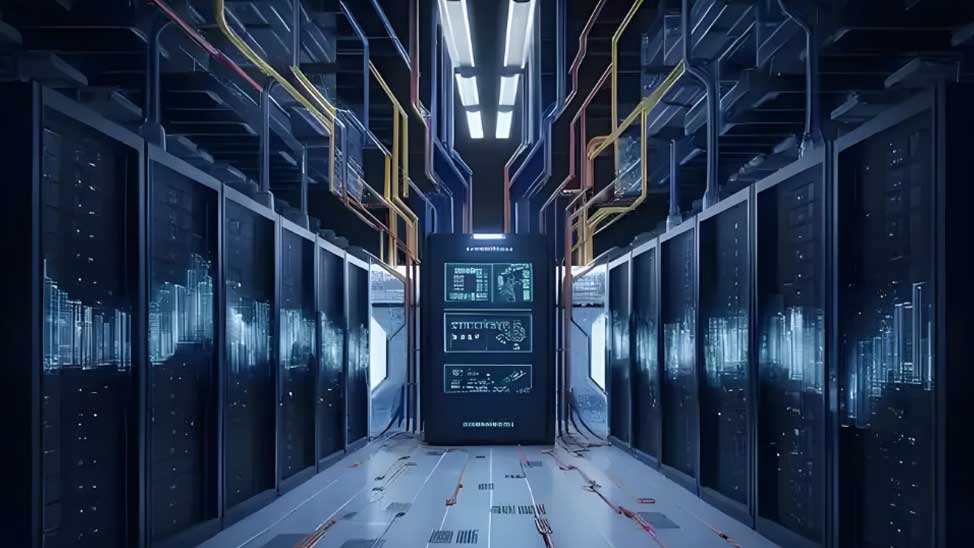
The AI factory looks different from a traditional data center — denser, hotter, and cabled for east-west traffic instead of north-south
1. From Training to Inference: AI's New Center of Gravity
The first chapter of AI infrastructure was a compute-capacity race: build the biggest clusters, train the largest models. That chapter, defined by the xPU, is giving way to a second one defined by inference — the continuous, real-time processing that actually puts AI to work.
Two forces are driving the shift. First, reasoning models that "think" before answering consume dramatically more inference compute than a single forward pass. Second, agentic AI — autonomous systems that plan and act — and physical AI (robots, software-defined vehicles) turn inference from a batch job into a constant stream. Industry estimates suggest humanoid robots alone could approach a billion units by mid-century.
The consequence for infrastructure is simple and profound: the workload that dominates the data center is no longer the one it was originally built to run.
2. The AI Factory: Data Centers That Manufacture Intelligence
NVIDIA's framing captures the shift in one phrase: the data center is becoming an AI factory. A traditional data center stores and processes data; an AI factory manufactures intelligence, and its unit of output is the token — a real-time prediction or decision that drives an application.
| Dimension | Traditional data center | AI factory |
|---|---|---|
| Core function | Store and process data | Manufacture intelligence |
| Primary output | Processed data | Tokens (real-time predictions) |
| Workload | Diverse, general-purpose | AI lifecycle: ingest, train, fine-tune, infer |
This is not marketing language — it is an engineering reality. AI factories are being treated as national infrastructure on par with telecom and energy, and the economics are unforgiving: at a gigawatt scale, a single day of downtime can cost over $100 million.
3. Three Scaling Laws That Break Traditional Data Centers
What makes the AI factory different is that three scaling laws are now pulling compute demand upward at once:
| Scaling law | What it means | Compute impact |
|---|---|---|
| Pretraining | Bigger models on bigger datasets | ~50 million x growth over 5 years |
| Post-training | Fine-tuning for specific tasks | ~30 x pretraining compute |
| Test-time reasoning | Models "think" through many responses | Up to 100 x traditional inference |
Traditional data centers were not built for this. The AI factory is — and the redesign shows up first in the two things every facility fights hardest: power and cooling.
4. The Power Wall: 1 MW Racks & 800V DC
The most concrete number in the whole conversation: next-generation AI racks can draw more than one megawatt each — enough for over a thousand homes. A few rows of those and a facility's original power design is obsolete.
The industry's answer is a power-architecture overhaul:
- Higher-voltage distribution (800V DC) — raising voltage lowers current, cuts conduction losses, and restores density as rack power climbs.
- Vertical power delivery — modular, high-density power stages placed close to the processor to shorten the current path.
- Gallium-nitride (GaN) switching — efficient high-voltage conversion for the new architecture.
As one analysis put it: if the xPU defined the first chapter of AI infrastructure, power architecture is shaping the next. For the power-side pressures on AI data centers, see our AI data center power guide.
5. Liquid Cooling: Thermal Goes Mainstream
Pack a megawatt into a rack and air simply cannot carry the heat away. Direct-to-chip liquid cooling has moved from a niche option to a first-class design requirement, because thermal management now limits how much compute you can fit as much as electrical performance does.
This matters for more than the chillers: liquid cooling changes the physical layout of the data hall, the routing of every cable, and the maintenance procedures. A cabling plant designed for air-cooled racks does not simply survive the move to liquid — it has to be planned around it from day one. See our in-rack cooling and cable architecture guide.
Liquid cooling and high-density fiber are no longer separate concerns — they share the same rack and must be planned together
6. The Network: Back-End Fabric, 800G/1.6T & Million-GPU Scale
AI training and inference both depend on a dedicated back-end fabric — the east-west, GPU-to-GPU network that is separate from the front-end network serving users. That fabric is what lets tens of thousands of accelerators act as one machine.
- NVLink binds GPUs tightly within and across nodes; InfiniBand or Spectrum-X Ethernet handles the scale-out network.
- Interconnects are moving to 800G and 1.6T, with the cabling plant shifting toward high-density MPO single-mode fiber.
- The target is million-GPU systems — a cabling and optics challenge on a scale the industry has never faced.
For the 800G/1.6T cabling roadmap, see our 800G/1.6T cabling trends guide.
7. What It Means for Cabling: A Checklist
Every layer of this shift lands on the physical plant. The cabling implications are concrete:
AI-Era Cabling Checklist
- Design for east-west back-end traffic, not north-south — the GPU fabric dictates the topology
- Plan for 800G/1.6T fiber density with MPO assemblies and single-mode OS2 for reach
- Use short in-rack copper (DAC/AEC) for GPU-to-switch links, fiber beyond the rack
- Route around liquid cooling — cable paths and coolant manifolds share the same space
- Leave headroom for scale — today's 400G is tomorrow's 1.6T on the same fiber plant
For the structured-cabling re-think this demands, see our structured cabling for AI data centers.
Key Questions (FAQ)
Q1: What is an AI factory?
An AI factory is a data center re-purposed to manufacture intelligence rather than just store and process data. Its primary output is measured in AI tokens — the real-time predictions and decisions that power applications. The shift from generic computing to token production is what is redefining data center design.
Q2: Why is AI shifting from training to inference?
Reasoning models and agentic AI have made inference the main driver of the AI economy. Inference now dominates compute demand because of post-training scaling (roughly 30x the compute of pretraining) and test-time reasoning (up to 100x traditional inference), which run continuously rather than in one-time training jobs.
Q3: How much power does an AI rack consume?
Next-generation AI racks can exceed one megawatt each — enough to power more than a thousand homes. This is driving a shift to higher-voltage distribution such as 800V DC, vertical power delivery, and gallium-nitride power stages, because traditional power architecture is reaching its limits.
Q4: Why is liquid cooling now necessary?
As accelerators are packed more densely, air cooling can no longer remove the heat. Direct-to-chip liquid cooling is becoming a first-class design requirement rather than an option, because thermal management now determines how much compute you can fit in a rack as much as electrical performance does.
Q5: What network changes does AI infrastructure require?
AI factories need a dedicated high-bandwidth back-end fabric (GPU-to-GPU, east-west) separate from the front-end network, using NVLink, InfiniBand, or high-performance Ethernet that can scale toward million-GPU systems. Interconnects are moving to 800G and 1.6T.
Q6: What does this mean for data center cabling?
The AI shift pushes cabling toward higher-density fiber (MPO assemblies, 800G/1.6T links), shorter in-rack copper (DAC/AEC), and routing that coexists with liquid cooling. Back-end east-west traffic, not north-south, now dictates the cabling plant.
About AMPCOM
AMPCOM supplies the high-density fiber and copper infrastructure behind AI factories — MPO-16/MPO-32 assemblies, OS2 single-mode and OM4/OM5 multimode trunks, DAC/AEC solutions, and ODF systems engineered for 800G and 1.6T. Every product is tested for insertion loss, return loss, and polarity to support the tight budgets of high-speed AI fabrics. Our team provides free consultation and custom-length, factory-terminated solutions for the back-end networks that AI's next growth phase demands.
Related Articles
- Structured Cabling for AI Data Centers: What Is Changing — Why east-west GPU traffic, higher density, and heat are forcing a rethink of the traditional cabling plant
- AI Infrastructure Data Center Cabling Requirements — The specific cabling demands of AI compute, from back-end fabrics to high-density fiber
- 800G/1.6T Data Center Cabling Trends 2026 — The optical roadmap from 400G to 1.6T that AI scale-out networks are following
- Power Flexibility in AI Data Centers 2026 — How the megawatt-rack power wall is reshaping data center electrical design

AMPCOM Technical Team
Industry experts with 17+ years in enterprise network infrastructure and structured cabling systems
Need help preparing your data center for AI's next phase?
Our technical team provides free consultation and high-density fiber and copper solutions for AI factory deployments worldwide.
Get Free Expert Consultation

