
Horizontal Cabling Costs: Fiber vs Copper Calculations
Published:Executive Summary: The per-drop answer is consistent across the industry: a Cat6 copper drop runs $150-300, Cat6A runs $200-400, and a fiber drop runs $300-800 — so fiber costs roughly two to three times copper at the outlet. But per-drop cost is a misleading number for horizontal cabling decisions, because it ignores the two variables that actually move the total: labor (which is 40-70% of the bill and identical across copper categories) and telecom closet architecture (which fiber can reduce or eliminate through its 300 m+ reach). This guide walks through the real calculations — materials, labor, closets, and total cost of ownership — so you can decide on numbers, not intuition.
Quick Navigation
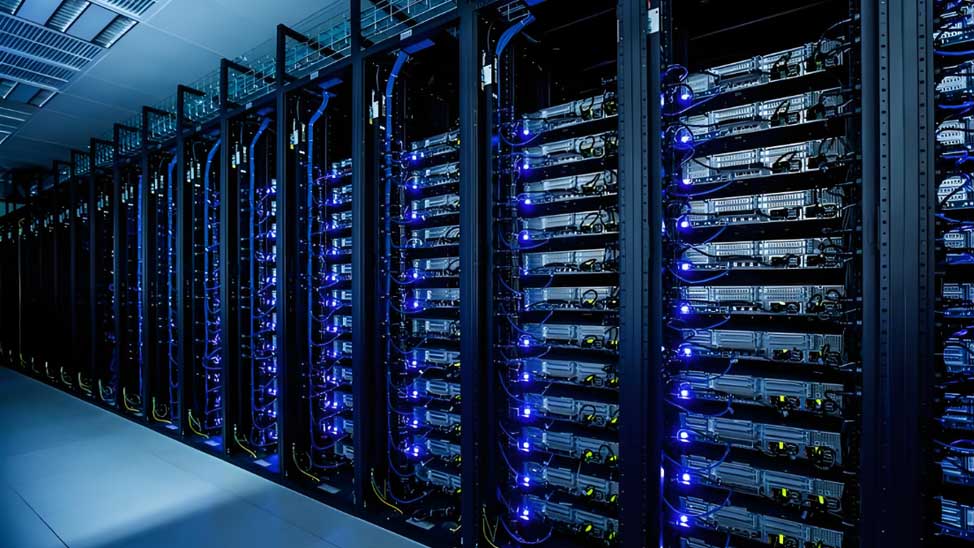
Copper and fiber coexist in most horizontal pathways — the cost decision is about which one earns each drop
1. The Per-Drop Benchmark
The starting point is a per-drop range, because structured cabling is priced by the number of data drops — individual cable runs from a wall plate back to the patch panel. The 2026 benchmarks converge tightly:
| Cable Type | Cost per Drop (Installed) | Notes |
|---|---|---|
| Cat5e | $75 - $150 | Legacy — not recommended for new installs |
| Cat6 | $150 - $300 | The standard commercial copper baseline |
| Cat6A | $200 - $400 | 10-15% premium over Cat6; 10 Gbps capable |
| Multimode fiber | $300 - $800 | OM3/OM4/OM5; backbone and to-the-desk |
| Single-mode fiber | $200 - $450 | OS2; increasingly cost-competitive, future-proof |
Two observations immediately jump out. First, fiber costs two to three times copper per drop — a consistent finding across Unio Digital, ShiftCTRL, and regional installers. Second, single-mode is often cheaper than multimode, which contradicts the common intuition that fiber must be uniformly expensive. Single-mode glass has commoditized at telecom scale: OS2 12-strand cable runs roughly $408-460 per 1,000 feet, while equivalent OM4 multimode runs $1,215-1,370 — nearly three times as much for the glass. The fiber premium is concentrated in termination labor and hardware, not the fiber itself. For fiber selection detail, see our single-mode vs multimode selection guide.
2. Breaking Down a Drop: Materials vs Labor
To understand where the money goes, decompose a drop into its line items. A published 85-drop Cat6A retrofit case from Chicago (April 2026) is the cleanest itemization in the trade press:
| Line Item | Per-Drop Cost | Share |
|---|---|---|
| Cat6A plenum cable + keystone jack | $45 | 17% |
| Patch panel port + patch cord | $15 | 6% |
| Labor (after-hours, building access) | $140 | 54% |
| Fluke certification (add-on) | $25 - $50 | ~13% |
| TIA-606 labeling + as-builts (add-on) | $15 - $35 | ~10% |
| Total | ~$260 | 100% |
The same structure holds for fiber, just shifted up. A 2026 metro comparison puts the fiber line items at: cable material $40-80, termination labor $120-280, hardware $40-90, and testing $50-100, for a fiber drop of $250-550 versus $150-300 for Cat6A. The delta is not the glass — it is the termination and certification precision fiber demands. Fusion splicing requires certified technicians and equipment; copper punch-down does not. For the certification side, see our Fluke test report interpretation guide.

The fiber premium is concentrated in termination labor and hardware — the glass itself is not the cost driver
3. Why Labor Dominates the Bill
Across every cable category, installation labor is the dominant line item. At volume (200+ drops), labor is roughly 40-60% of installed cost; at low volume, long runs, or difficult retrofit jobs, it climbs to 60-70%. The Texas DIR public-record contract pricing confirms it: Cat6 labor alone runs $60-84 per drop at volume, and the combined labor line stays at 40-60% of the total even on large jobs.
This has a critical implication for cost modeling: labor is identical across copper categories. Upgrading Cat5e to Cat6, or Cat6 to Cat6A, changes only cable and connectivity — a single-digit to low-double-digit percentage of the drop — because the pathway work, terminations, testing, and building access are the same. That is why copper categories cluster so tightly on a per-drop basis, and why the Cat6A premium is a modest 10-15% (all of it materials).
Fiber breaks the pattern because its labor is genuinely more expensive: 30-50% higher than copper, per installers, driven by splicing equipment, certified technicians, and slower termination. The practical budgeting rule follows directly: budget by drop count and building access first, cable category second. For a full costing framework, see our network cabling TCO procurement strategy.
4. The Telecom Closet Factor
Here is where the fiber-vs-copper cost conversation actually gets decided, and it is the part most per-drop comparisons miss. Copper is limited to 100 meters per horizontal run, which forces a telecom closet (with switches, UPS, and cooling) on every floor or zone. Fiber — multimode reaching 300 m+ and single-mode reaching kilometers — can run from a single central equipment room across an entire building or campus, eliminating or shrinking those intermediate closets.
The classic cost model (Pearson Technologies with the TIA Fiber Optic LAN Section) quantified exactly this. On an 8-floor building with 48 ports per floor, the copper design required a $20,000 telecom closet per floor — floor space amortization, UPS, and a dedicated HVAC unit for the active electronics. The centralized fiber design shrank that to $4,500 per floor by removing the active gear. Across 8 floors, that single factor produced a $124,000 swing in favor of fiber. Centralized fiber also raised port utilization from roughly 70% to 90%, because ports could be shared across the whole building rather than stranded floor by floor.
The Number Most Teams Forget
A telecom closet is not a passive room. It carries floor-space cost, a UPS, and often a dedicated cooling unit — and every floor you can eliminate by running fiber instead of copper removes that entire line item. When the TIA FOLS model priced the closet properly, the fiber option won on first-install cost even though its per-drop cable cost was higher. The lesson transfers directly to 2026: if your design needs more than one closet per floor, you are comparing copper drops against fiber plus a $124,000-scale structural saving.
This is why the "fiber is always more expensive" claim is usually an artifact of comparing only the cable. For the architecture-level view, see our structured cabling fundamentals guide.

Centralized fiber runs from one equipment room across floors; distributed copper needs a telecom closet on every floor
5. The 100-Meter Wall, PoE, and Wi-Fi 7
Two capability differences drive the horizontal decision as much as price does.
Distance. Copper's 100-meter channel limit is a hard wall. Beyond it, the only options are a new closet with active electronics (expensive) or fiber (longer reach). Multimode handles 300 m+ and single-mode handles kilometers, which is why fiber is mandatory for backbone runs between closets and buildings regardless of cost.
Power. Fiber cannot deliver power — and that is copper's single strongest argument in 2026. A Cat6A drop delivers multi-gigabit data plus up to 90W of PoE++ in one cable, powering Wi-Fi 7 access points, IP cameras, and phones without a local power source. Wi-Fi 7 APs need 2.5G+ backhaul, which makes Cat6A the practical horizontal default even where fiber handles the backbone.
The practical result is a division of labor: copper owns the last 100 meters to powered endpoints; fiber owns the backbone and any distance beyond 100 meters. For the same boundary drawn inside the data center, see our data center copper vs fiber guide.
6. Total Cost of Ownership
First-install cost is only part of the story, because horizontal cabling outlasts every other IT asset in the building — 15-20 years in the walls versus 3-5 years for switches and servers. The TCO variables favor different media over time.
- Modification cost. Adding or changing a copper drop costs $100-250 and can be done by standard IT staff. A fiber modification costs $400-600 and requires specialized equipment and training. Copper wins every time you expect frequent MACs.
- Upgrade cost. This is fiber's counter-punch. Installed single-mode OS2 fiber survives speed transitions — the same plant supports 400G today and 800G/1.6T tomorrow by swapping transceivers. Copper requires a category re-cabling event to climb the speed ladder, and the cost of re-cabling (downtime, labor, pathway access) far exceeds any upfront savings. For the speed-migration economics, see our 800G and 1.6T cabling trends report.
- Operational cost. Fiber runs cooler and thinner, improving airflow and reducing cooling load — part of why it is favored in dense facilities. For the sustainability angle, see our sustainable data center fiber analysis.
7. When Each Medium Wins
Bringing it together, the decision is a small matrix rather than a single number.
| Scenario | Winner | Why |
|---|---|---|
| Desktop, phone, camera, Wi-Fi AP drops | Cat6A copper | PoE++ plus multi-gig data in one cable; lowest per-drop cost |
| Backbone (MDF-to-IDF, floor-to-floor, building-to-building) | Single-mode fiber | Distance, bandwidth headroom, future-proof OS2 plant |
| Multi-floor building with many closets | Centralized fiber | Eliminates per-floor telecom closets and stranded ports |
| Runs over 100 m | Fiber | Copper hits the hard channel limit |
| High-bandwidth workstations (video/imaging) | Fiber to the desk | 10G+ and beyond without re-cabling |
| Frequent MACs, cost-sensitive retrofit | Cat6 copper | Lowest cost, easiest modification by standard IT staff |
The consensus recommendation from installers across North America is the hybrid approach: fiber backbone between floors and closets, Cat6A horizontal to the desk, and fiber-to-the-desk reserved for specialized workstations. It delivers 10 Gbps to every desk, PoE where you need it, and a future-proof backbone — the practical cost-performance optimum for 2026. For the category-by-category detail behind that recommendation, see our Cat6 vs Cat6a vs Cat7 vs Cat8 comparison and our cable category selection framework.
Key Questions
Q1: How much does a copper horizontal drop cost versus a fiber drop?
In 2026 a standard commercial Cat6 copper drop runs $150-300 installed, Cat6A runs $200-400, and a standard interior multimode fiber drop runs $300-800 (single-mode $200-450). Fiber typically costs two to three times a copper drop per outlet, driven by termination labor, certification, and connectivity hardware rather than the glass itself.
Q2: Why is labor the dominant cost in horizontal cabling?
Installation labor is 40-70% of installed cost depending on volume and building access. Because labor is identical across copper categories, Cat6 and Cat6A drops cluster tightly in price; the category premium is only materials. Fiber adds 30-50% more labor than copper because termination requires splicing or field connectorization with certified technicians and precision equipment.
Q3: Can fiber ever be cheaper than copper for horizontal cabling?
Yes, when you look beyond the drop. Fiber's 300 m+ reach enables centralized cabling — you can eliminate or shrink per-floor telecom closets, consolidate active electronics into one room, and raise port utilization from roughly 70% to 90%. The FOLS cost model showed telecom closet savings can more than offset higher per-drop fiber cost, especially when equipment is bought at street rather than list price.
Q4: What is the 100 meter limit and why does it matter for cost?
Copper horizontal runs are limited to 100 meters total channel length. Beyond that, you must add a telecom closet with active electronics — which brings UPS, cooling, and floor space costs. Multimode fiber reaches 300 m or more and single-mode reaches kilometers, so fiber can run from a central equipment room across a campus without intermediate electronics.
Q5: Why is multimode fiber sometimes more expensive than single-mode?
Single-mode glass has commoditized at telecom scale, so OS2 12-strand cable can cost less than half of equivalent OM4 multimode. Multimode cable is often pricier per strand, but its transceivers are cheaper at short reach. For horizontal distances, the real cost is labor and termination precision, which is identical across fiber types — so single-mode is increasingly the future-proof horizontal choice.
Q6: How do PoE and Wi-Fi 7 change the copper vs fiber calculation?
PoE and Wi-Fi 7 are copper's strongest card. Fiber cannot deliver power, and a single Cat6A drop carries both multi-gigabit data and up to 90W of PoE++ to access points, cameras, and phones. Wi-Fi 7 APs need 2.5G+ backhaul, which makes Cat6A the practical horizontal default even where fiber handles the backbone.
Q7: What does it cost to upgrade or modify cabling later?
Adding or modifying a copper drop costs $100-250 per connection and can be done by standard IT staff. Fiber modifications cost $400-600 per connection and require specialized equipment and training. However, installed single-mode fiber survives speed upgrades (800G to 1.6T) without replacement, whereas copper categories require re-cabling to move up the speed ladder.
Q8: What is the best horizontal cabling strategy for most businesses?
The hybrid approach: fiber backbone between floors, buildings, and network closets, with Cat6A horizontal runs to desktops, cameras, access points, and phones. Fiber-to-the-desk is reserved for specialized high-bandwidth workstations. This gives 10 Gbps to every desk, PoE where you need it, and fiber's future-proof backbone — the practical cost-performance optimum for 2026.
About AMPCOM
AMPCOM is a global manufacturer of data center and enterprise network infrastructure, serving hyperscale, enterprise, and campus facilities in over 120 countries. Our portfolio spans Cat5e through Cat8 copper cabling, OS2/OM3/OM4/OM5 fiber, patch panels, keystone jacks, and pre-terminated trunk assemblies — so a single supplier can cover both sides of your fiber-vs-copper decision. We help you run the real cost calculations and build the hybrid architecture that matches your budget and your upgrade path. Contact our team for a cabling cost consultation.
Related Articles
- Data Center Cabling: Copper or Fiber? — The same fiber-vs-copper decision applied inside the data center, with distance, density, and latency trade-offs for 400G and 800G
- Network Cables TCO and Procurement Strategy — How to model total cost of ownership across the cable lifecycle and avoid the upfront-cost trap in procurement
- Single-Mode vs Multimode Fiber — The fiber type decision behind the cost numbers, including why single-mode is increasingly the future-proof choice
- Cat6 vs Cat6a vs Cat7 vs Cat8 — Copper category selection for SMB and enterprise upgrades, with the 10G and PoE capabilities that justify each premium

AMPCOM Technical Team
Structured cabling specialists with 17+ years in copper and fiber cost modeling, campus network design, and TCO analysis
Planning a horizontal cabling project?
Our technical team provides free consultation on fiber vs copper cost modeling, telecom closet design, and the hybrid architecture that fits your budget and upgrade path.
Get Free Expert Consultation

