
800G or 1.6T: How to Choose the Right Optical Module for Your AI Workload
Published:Executive Summary: With 800G optical module shipments exceeding 40 million units in 2026 and 1.6T modules entering mass production alongside NVIDIA's GB300 platform, data center managers face a critical infrastructure decision that will define their network fabric for the next decade. This guide provides a complete framework for matching optical module selection to your AI workload type, covering technical specifications, form factors, power and thermal constraints, and a practical phased migration strategy from 400G to 1.6T.
Quick Navigation
- 1 Why 800G vs 1.6T Is the Defining Question of 2026
- 2 Market Context: 800G Mainstream, 1.6T Enters Mass Production
- 3 Technical Specifications Comparison
- 4 Form Factors: QSFP-DD vs OSFP Explained
- 5 Matching Optical Modules to Your AI Workload Type
- 6 Power Consumption and Thermal Considerations
- 7 Migration Strategy: From 400G to 1.6T
- 8 Summary: Quick Decision Guide
- 9 Frequently Asked Questions
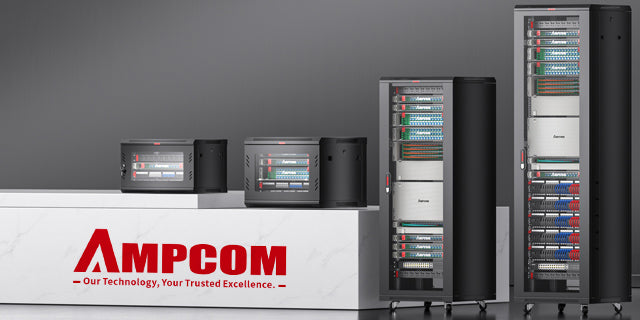
Modern AI data centers demand a clear optical module strategy — the right choice between 800G and 1.6T shapes your infrastructure for years to come
Chapter 1: Why 800G vs 1.6T Is the Defining Infrastructure Question of 2026
Data centers running AI workloads in 2026 face a bottleneck that no amount of GPU compute can solve alone: the network fabric connecting the GPUs. As NVIDIA's Blackwell Ultra (GB300) architecture pushes single-GPU bandwidth demands to unprecedented levels, the choice between 800G and 1.6T optical modules has moved from a procurement footnote to a core infrastructure strategy decision.
The numbers are compelling. 800G and 1.6T optical transceivers are reshaping how data centers handle bandwidth at scale. 800G optical module shipments surpassed 40 million units in 2026, while 1.6T modules — previously a roadmap aspiration — entered mass production, driven by the GB300 chip ramp. The global optical transceiver market is projected to reach $144.2 billion by 2028, growing at a 74% CAGR. This is not a niche technical debate. It is a multi-hundred-billion-dollar infrastructure investment question.
But raw speed is only half the story. Choosing the right module requires understanding your workload profile, thermal constraints, existing infrastructure, and budget horizon. This guide gives you the complete framework.

800G and 1.6T optical modules represent a fundamental shift in data center network design — choosing the wrong path today costs more to fix tomorrow
Chapter 2: Market Context — 800G Goes Mainstream, 1.6T Enters Mass Production
800G: The Established, Available Choice
800G optical modules have crossed the chasm from early adopter to mainstream deployment. The ecosystem is mature: multiple qualified suppliers, competitive pricing, and proven interoperability across major switch ASICs from Broadcom, Marvell, and NVIDIA. For most hyperscale and enterprise AI data centers deploying today, 800G is the safe, available, and cost-effective choice.
1.6T: The Emerging Standard for Next-Gen AI
1.6T optical modules are no longer vaporware. NVIDIA's GB300 platform, with its 1.6T InfiniBand bandwidth per GPU, is driving aggressive 1.6T deployment timelines. Early adopters in AI training clusters of 1,000+ GPUs are already specifying 1.6T for spine and leaf switching layers. However, the 1.6T ecosystem is still maturing — pricing is 2–3× higher than 800G, and some suppliers are still ramping yield.
AMPCOM Insight
If your data center is being built or refreshed in 2026–2027 and will host GB300-class GPUs, planning for 1.6T at the spine layer while using 800G at the leaf can give you a cost-optimized migration path. Blindly going all-in on 1.6T everywhere carries both supply risk and premature CAPEX. 800G is not just a speed upgrade — it changes which fiber designs remain manageable at your facility.

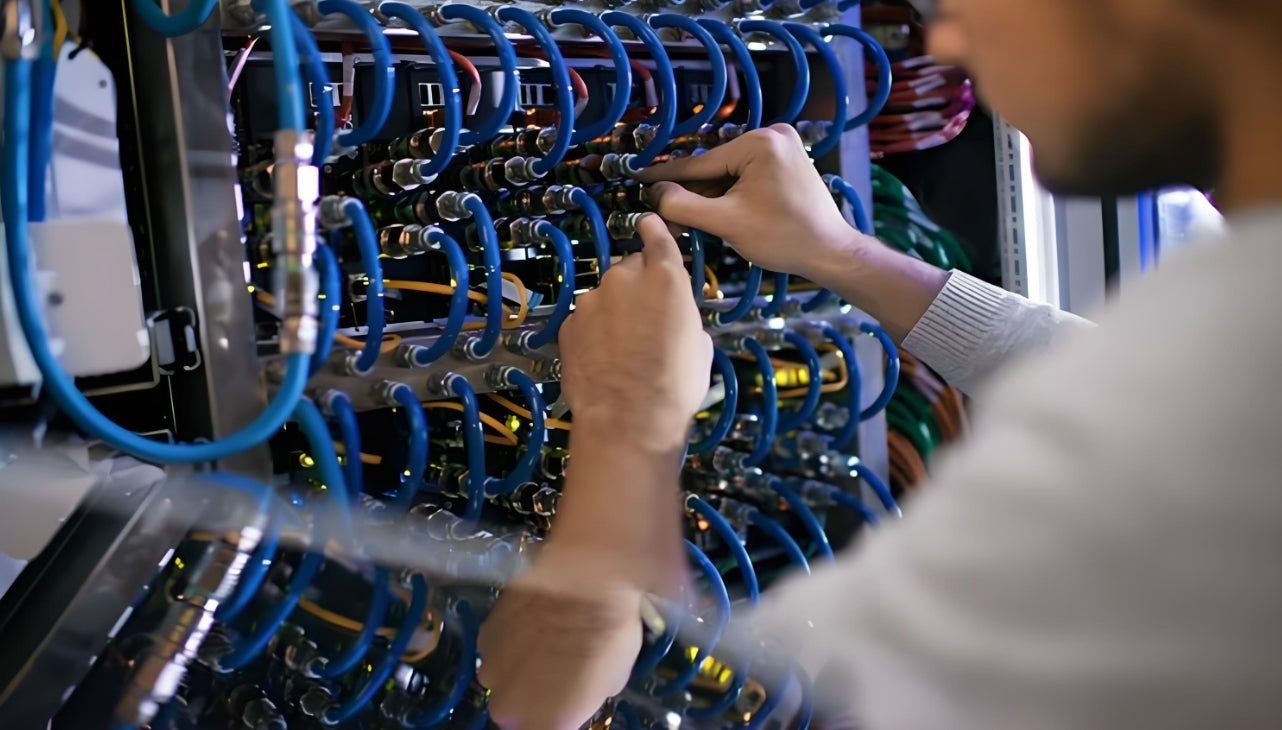
The shift to 800G and 1.6T demands a fresh look at your fiber infrastructure — from MPO termination density to rack layout and cable management planning
Chapter 3: Technical Specifications Comparison
| Specification | 800G Optical Module | 1.6T Optical Module |
|---|---|---|
| Aggregate Bandwidth | 800 Gbps | 1,600 Gbps |
| Primary Use Case | Leaf-to-spine, GPU-to-GPU, short-reach | Spine-to-spine, AI cluster fabric, backbone |
| Typical Reach | Up to 500m (MMF/SMF depending on variant) | Up to 300m (MMF); limited SMF options currently |
| Lane Speed | 100G × 8 lanes (PAM4 modulation) | 100G × 16 lanes (PAM4 modulation) |
| Typical Power Draw | 12–18W per module | 22–30W per module |
| Form Factor | QSFP-DD, OSFP | OSFP primarily; QSFP-DD emerging |
| Ecosystem Maturity | ✅ Mature — multiple qualified sources | 🟡 Early stage — ramping in 2026 |
| Typical Cost Range | $400–$900 per module | $1,200–$3,000 per module |
| Cabling Required | 8-fiber MPO/MTP or duplex LC | 16-fiber MPO/MTP or 8× duplex LC |
Key Implication: 1.6T modules require double the fiber count of 800G for the same port count. If you are designing a greenfield facility, plan your MPO fiber infrastructure with 16-fiber or higher-count assemblies from day one to avoid costly retrofitting.
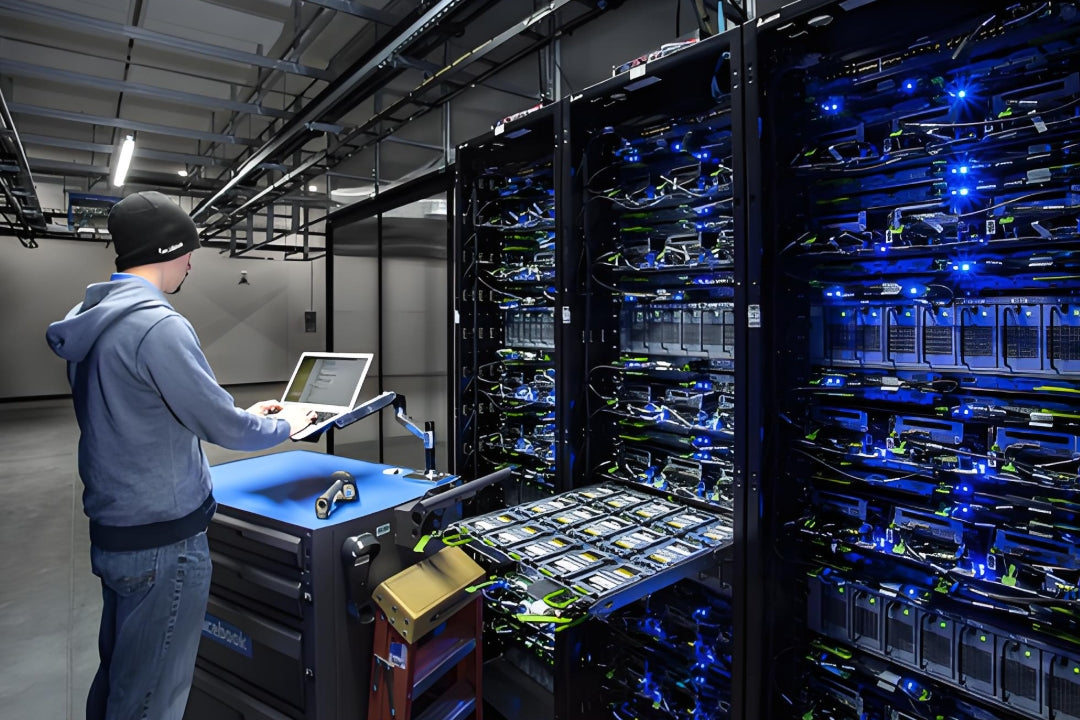
High-speed optical module deployments demand precision in fiber cabling — every dB of loss matters at 800G and 1.6T line rates
Chapter 4: Form Factors — QSFP-DD vs OSFP Explained
QSFP-DD (Quad Small Form Factor Pluggable Double Density)
The most widely deployed form factor in hyperscale data centers. QSFP-DD is backward compatible with QSFP56 (400G), making it the natural upgrade path for existing 400G deployments. It supports 800G across both electrical and optical interfaces and has the broadest switch ASIC support from Broadcom, Marvell, and NVIDIA.
OSFP (Octal Small Form Factor Pluggable)
OSFP was designed from the ground up for 800G and beyond. Its larger heat sink area enables better thermal management at higher power envelopes, making it the preferred choice for 1.6T modules. However, OSFP does not mechanically fit into QSFP-DD slots — this is a critical physical layer consideration for your infrastructure planning.
✅ Choose QSFP-DD When
- You have existing QSFP-DD infrastructure
- You need backward compatibility with 400G
- You prefer a wider supplier base
- You are deploying 800G only today
✅ Choose OSFP When
- You are deploying 1.6T modules
- You need superior thermal performance
- Your switch ASIC natively supports OSFP
- You are building a greenfield AI cluster
⚠️ Migration Warning: Mixing QSFP-DD and OSFP in the same network segment requires careful planning. Ensure your TOR (Top of Rack) switches support both form factors before committing to a mixed deployment. There is no backward compatibility at the physical layer between these two form factors.
Choosing the right form factor is a one-way door — plan for your target bandwidth, not just your current requirement
Chapter 5: Matching Optical Modules to Your AI Workload Type
Not all AI workloads have the same network demands. The right optical module depends heavily on your workload profile. Here is how to match your choice to your reality.
1. Large-Scale AI Training Clusters (1,000+ GPUs)
Case Study: Large Language Model Training Cluster
A customer deploying a 4,096-GPU NVIDIA GB200 cluster for LLM training found that intra-rack GPU-to-GPU traffic alone generated 800G of bandwidth demand per server. Their spine switch needed 64× 1.6T ports to aggregate leaf switches running at 800G. They chose 800G at leaf, 1.6T at spine — a pattern that is becoming the de facto standard for large AI training facilities. The key lesson: spine bandwidth aggregation is the primary driver for 1.6T adoption in training environments.
Recommendation: 800G at leaf + 1.6T at spine
- 800G QSFP-DD or OSFP for GPU server uplinks (short reach, MMF)
- 1.6T OSFP for spine aggregation and inter-pod connectivity
- Fiber: OM4 or OM5 multimode fiber for leaf, OS2 singlemode for longer spine runs
2. AI Inference Deployments
Inference workloads are typically less bandwidth-sensitive than training but demand consistent low latency. Most inference deployments in 2026 are running at 400G or transitioning to 800G. Jumping to 1.6T for inference is generally over-engineered unless you are serving extremely large foundation models at hyperscale.
Recommendation: 800G QSFP-DD
3. High-Performance Computing (HPC) Clusters
HPC workloads feature dense all-to-all communication patterns, similar to AI training. The bandwidth demands are real but more predictable than generative AI. Many HPC facilities are finding 800G sufficient for current deployments, with a planned 1.6T upgrade path in 2027–2028.
Recommendation: 800G (with a documented 1.6T upgrade path for 2027–2028)
4. Enterprise AI and Hybrid Deployments
If you are an enterprise running AI workloads on a smaller scale (under 100 GPUs), 400G is still viable today, and 800G is the natural next step. The jump to 1.6T is unlikely to be cost-justified for sub-100 GPU deployments.
Recommendation: 800G QSFP-DD — the right ceiling for this scale
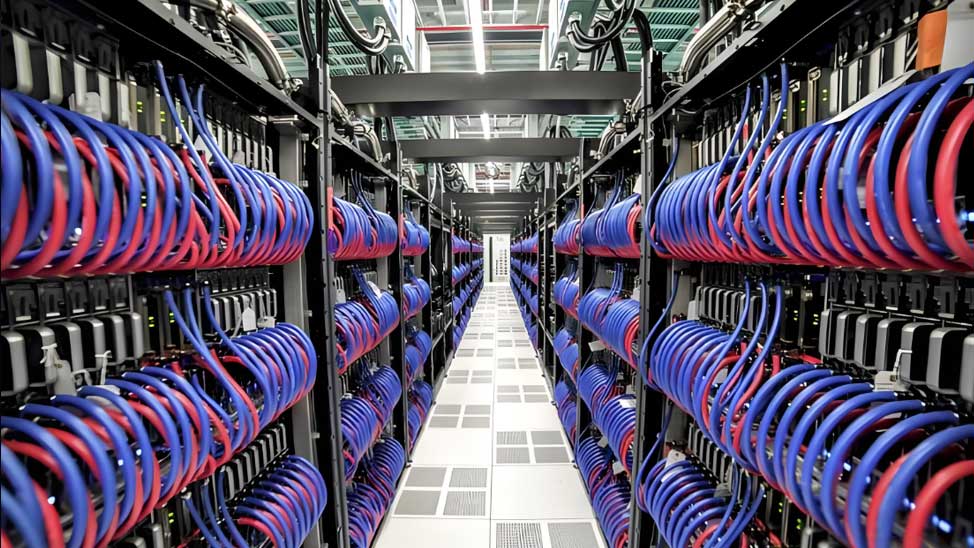
Each AI workload type has a distinct bandwidth profile — match your optical module strategy to your actual traffic patterns, not your marketing materials
Chapter 6: Power Consumption and Thermal Considerations
Power and cooling are often the hidden constraints that make or break an optical module deployment. 800G modules typically draw 12–18W, while 1.6T modules consume 22–30W. This is not trivial at scale — it directly affects your rack power density design, cooling architecture, and infrastructure CAPEX.
A standard 48-port TOR switch with 1.6T modules could consume 1,000W+ in optical modules alone — before accounting for the switch silicon. This has direct implications for:
- Rack power density: Plan for 10–15 kW per rack at full 1.6T port density
- Cooling architecture: 1.6T modules at scale often require rack-level liquid cooling or direct-to-chip cooling
- Infrastructure CAPEX: Budget for power distribution and cooling upgrades alongside optical module procurement
2026 Thermal Reality Check
NVIDIA's Rubin architecture (successor to Blackwell) is pushing toward 2,300W per GPU. At that power density, liquid cooling penetration has reached 53% of new AI data center deployments. Your optical modules must coexist with this thermal environment. For facilities still using air-cooled racks, 800G at moderate density may be the practical ceiling. Liquid-cooled racks can comfortably accommodate 1.6T modules at high port density.
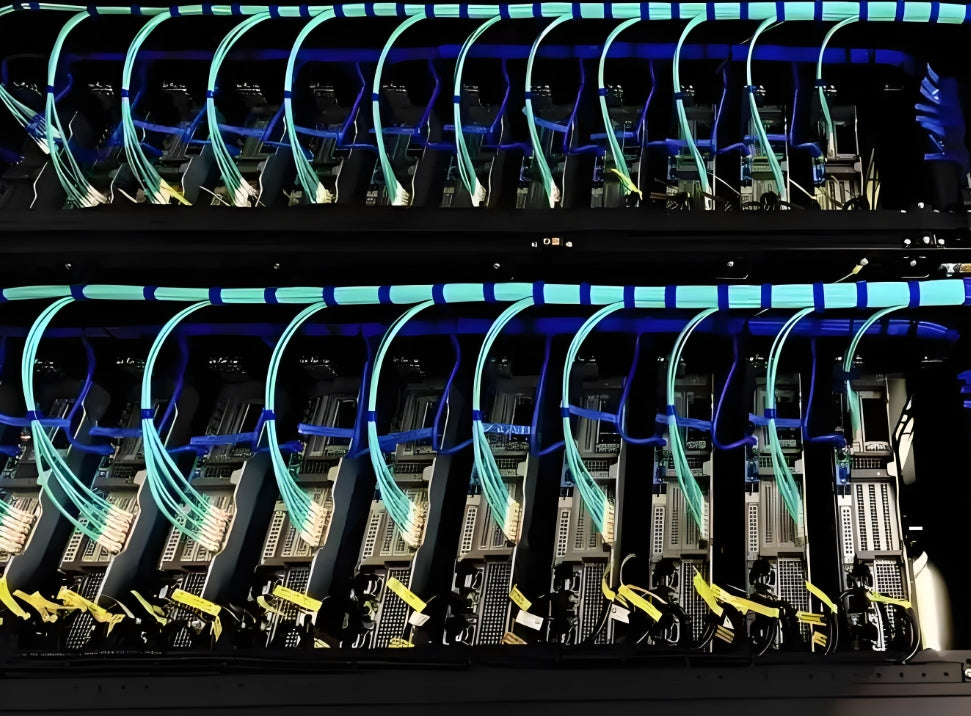
Thermal management at 1.6T density requires deliberate planning — from rack airflow design to liquid cooling integration, every watt matters
Chapter 7: Migration Strategy — From 400G to 1.6T
Most data centers are not starting from a blank slate. Here is a practical phased migration approach that minimizes stranded assets while building toward your target architecture.
Phase 1: Validate 800G at Leaf (Now — Q4 2026)
Key Milestones
- Deploy 800G QSFP-DD at all new GPU server uplinks
- Upgrade TOR switches to 800G-capable platforms
- Use 8-fiber MPO/MTP-12 pre-terminated fiber for fast deployment and reduced field terminations
- Standardize on OM4 or OM5 multimode fiber for intra-rack and inter-rack runs up to 100m
- Document baseline performance with Fluke certification testing at 800G line rates
Phase 2: Deploy 1.6T at Spine (2027 — Mid 2027)
Key Milestones
- Refresh spine switches to 1.6T-capable platforms (OSFP-native preferred)
- Plan fiber infrastructure for 16-fiber MPO/MTP or 8× duplex LC connectivity
- Evaluate SMF (OS2) for longer spine runs exceeding 100m
- Validate thermal capacity in rack design before deploying high-density 1.6T
- Update structured cabling documentation to reflect the new fiber topology
Phase 3: Full 1.6T Edge-to-Edge (2028+)
As 1.6T pricing normalizes and the supplier ecosystem matures, full 1.6T edge-to-edge deployment becomes the target for new builds. Existing 800G leaf infrastructure can remain in service for non-AI workloads or secondary clusters — there is no rush to rip out working 800G infrastructure.

A phased migration strategy lets you capture 800G benefits today while building a 1.6T-ready fiber foundation for tomorrow
Chapter 8: Summary — Quick Decision Guide
| Your Situation | Recommended Choice | Key Consideration |
|---|---|---|
| Large AI training cluster (1,000+ GPUs, GB300) | 800G leaf + 1.6T spine | Spine aggregation drives the 1.6T requirement |
| Mid-size AI cluster (100–1,000 GPUs) | 800G throughout | 800G is sufficient now; plan 1.6T upgrade in 18 months |
| AI inference at scale | 800G QSFP-DD | 1.6T not cost-justified for inference bandwidth needs |
| Enterprise AI (under 100 GPUs) | 400G → 800G QSFP-DD | 800G is the right ceiling for this scale |
| HPC cluster | 800G (with 1.6T upgrade planned) | Predictable traffic; 800G adequate through 2027 |
| Air-cooled data center | 800G QSFP-DD | Thermal headroom limits 1.6T density in air-cooled racks |
| Liquid-cooled greenfield build | 800G + 1.6T mixed | Design spine for 1.6T from day one |
Chapter 9: Frequently Asked Questions
Q1️⃣ Can I use 800G and 1.6T modules in the same switch?
A: Generally no. Most switches are single-form-factor — either QSFP-DD or OSFP. QSFP-DD switches support 800G. OSFP switches support both 800G and 1.6T. You cannot physically or electrically mix the two form factors in the same cage. Plan your form factor choice before you select your switch platform.
Q2️⃣ What fiber type do I need for 800G and 1.6T modules?
A: For short-reach intra-rack and inter-rack connections (under 100m), OM4 or OM5 multimode fiber is the standard choice. For longer runs, singlemode fiber (OS2) is required. 800G typically uses 8-fiber MPO/MTP or duplex LC connectors. 1.6T typically requires 16-fiber MPO/MTP or 8× duplex LC. Plan your fiber count accordingly — MPO fiber solutions with the right fiber count prevent costly retrofits.
Q3️⃣ Is 1.6T worth the premium over 800G for a new AI data center?
A: It depends on your timeline and GPU architecture. If you are deploying GB300-class GPUs now, 1.6T at the spine is justified by the bandwidth requirements. For older GPU generations (H100, H200), 800G is the more cost-effective choice and will remain viable for 2–3 years. 800G and 1.6T trends for data center cabling show 800G as the dominant deployment through 2027, with 1.6T scaling in 2027–2028.
Q4️⃣ What is the lead time for 800G and 1.6T optical modules in 2026?
A: 800G modules have 4–8 week lead times from most major distributors. 1.6T modules may require 12–20 weeks due to continued supply constraint as production ramps. Plan procurement accordingly — the global fiber and optical module supply crunch remains a real consideration. Early ordering for 1.6T is strongly recommended.
Q5️⃣ Does AMPCOM provide fiber cabling solutions compatible with 800G and 1.6T deployments?
A: Yes. AMPCOM offers a complete range of pre-terminated MPO/MTP fiber assemblies (OM4, OM5, OS2), duplex LC patch cords, and fiber panel solutions rated for high-speed data center deployments. Learn more about MPO fiber solutions for high-density cabling and how to choose the right fiber type for your deployment.

AMPCOM Technical Team
Industry experts with 17+ years in structured cabling, data center infrastructure, and fiber optic network design
Need help planning your 800G or 1.6T fiber infrastructure?
AMPCOM provides a full range of fiber cabling solutions — including MPO/MTP assemblies, singlemode and multimode fiber, and high-density fiber panels designed for next-generation AI data center deployments.
Talk to Our Infrastructure Experts

