
Reader Q&A: What's the Difference Between MPO and MTP Connectors?
Published:Reader Question: "I've been looking at fiber patch cables for our data center upgrade and keep seeing both MPO and MTP connectors mentioned. Are they the same thing? Our procurement team says MTP is just a brand name for MPO, but a colleague insists they're fundamentally different. Who is right?"
— David T., Network Engineer, Manufacturing Firm
Quick Navigation

High-density fiber connectivity in modern data centers: understanding MPO vs MTP starts with knowing your connector basics
1. The Short Answer: MTP Is a Brand of MPO
Your colleague is closer to the truth, but your procurement team isn't entirely wrong either. Here is the precise distinction:
MPO (Multi-Fiber Push-On) is the industry standard — a connector type defined by IEC 61754-7 and TIA-604-5. It specifies the physical interface, pinout, and dimensional tolerances for multi-fiber connectors used in data centers worldwide. Any manufacturer that makes a multi-fiber push-on connector is technically making an "MPO-compatible" product.
MTP is a registered trademark owned by US Conec. It refers to a specific high-performance line of MPO-style connectors that exceed the base MPO specification in several important ways. Think of it like the relationship between "SSD" (a technology category) and a specific premium brand of SSDs — all MTP connectors are MPO, but not all MPO connectors are MTP.
2. Why the Confusion Exists
The confusion stems from three factors:
Terminology Overlap
In casual conversation, engineers and salespeople often use "MPO" and "MTP" interchangeably. In data sheets and procurement specs, the distinction matters more.
Visual Similarity
MPO and MTP connectors look nearly identical to the naked eye. Both use the same physical footprint, the same 12- or 24-fiber array, and the same push-pull mating mechanism. You cannot tell them apart without close inspection.
Price Difference
MTP connectors typically cost 2–4x more than generic MPO equivalents. This price premium reflects the tighter tolerances and premium materials — which often justify the cost in mission-critical deployments.
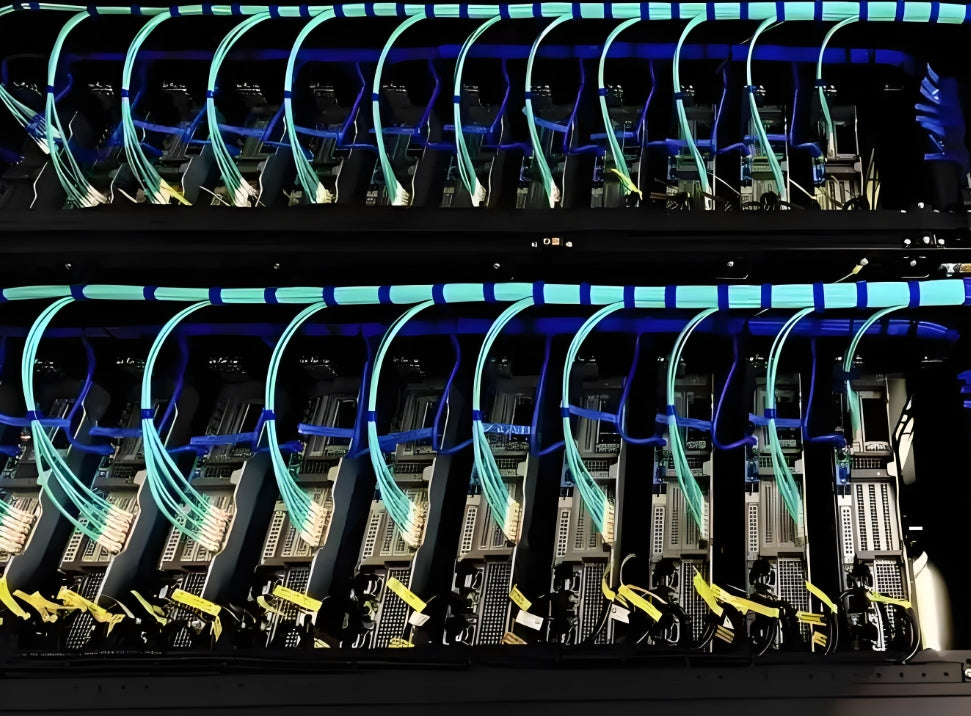
Both MPO and MTP use the same physical form factor, making visual identification difficult without close inspection
3. MTP Connectors: Key Mechanical Differences
While both connector types share the same standard footprint, US Conec's MTP design includes several engineered improvements:
| Feature | Generic MPO | MTP (US Conec) |
|---|---|---|
| Standard | IEC 61754-7 / TIA-604-5 | Exceeds base MPO specification |
| Floating Ferrule | Fixed | Spring-loaded float for improved contact |
| Housing | Standard molded plastic | Precision metal or high-grade polymer |
| Insertion Loss | Typically 0.5–0.75 dB | As low as 0.10 dB (ultra-low loss) |
| Return Loss | ~20–30 dB | Typically >55 dB (APC versions) |
| Guide Pins | Often loose or inconsistent | Precision stainless steel pins |
| Boot Design | Standard strain relief | Elliptical strain relief for bend protection |
| Typical Use Case | General purpose / cost-sensitive | Data center, HPC, enterprise backbone |
Key Takeaway: When MTP Performance Matters Most
The floating ferrule and precision guide pins of MTP connectors become critical in:
High-speed links (40G/100G/400G): Lower insertion loss means longer reach between switches without repeaters
MPO-to-MPO trunk cables: Multiple mating cycles in structured cabling demand consistent, repeatable performance
PoF (Physical Contact) polishing:
The elliptical guide pins in MTP reduce ferrule rotation during mating, protecting the physical contact polish
High fiber counts (24-fibers and beyond): Tight tolerances across more fibers amplify the benefit of precision manufacturing
4. Which Should You Choose for Your Project?
Choose Generic MPO When:
✓ Budget is the primary constraint
✓ The link is short (<100m) and low-speed (10G)
✓ Mating cycles are infrequent (e.g., patching panels only)
✓ The project does not require IEC or TIA compliance certification
Choose MTP When:
✓ Deploying 40G, 100G, 200G, or 400G QSFP-DD / OSFP links
✓ The data center requires Fluke channel certification
✓ You need ultra-low insertion loss (<0.35 dB) for long-reach or multi-span links
✓ Long-term reliability and manufacturer warranty matter
✓ Deploying in AI/HPC environments where every dB of loss counts
AMPCOM's Recommendation
For most enterprise and data center projects, we recommend specifying MTP-grade components for your backbone trunk cables while using quality MPO assemblies for horizontal connections. This balanced approach optimizes cost without sacrificing the link performance that your switches and transceivers require.
All AMPCOM MPO and MTP fiber assemblies are individually tested for insertion loss and return loss, with test reports available upon request.
Related Articles
- MPO Fiber Solutions for Data Center and High-Density Cabling — Choosing between 8, 12, or 24 fibers for high-density deployments
- What 800G and 1.6T Trends Mean for Data Center Cabling in 2026 — How faster speeds reshape fiber connector requirements
- How to Choose the Right Fiber Type: Singlemode vs Multimode — Matching fiber type to your network architecture
- How to Choose the Right Fiber ODF for FTTH and Network Projects — Fiber termination and distribution infrastructure

AMPCOM Technical Team
Industry experts with 15+ years in enterprise network infrastructure
Need help choosing the right MPO/MTP solution?
Contact our technical team for a free consultation and product recommendation for your specific application.
Get Free Consultation

