
LC vs SC: Which Connector for 20km Transmission? Real Test Data Reveals the Answer
Published:Executive Summary: AMPCOM's lab tested LC and SC connectors over 20km fiber optic cable links. Results show no measurable difference in insertion loss or return loss between connector types. Both LC and SC UPC connectors achieved insertion loss ≤0.15dB and return loss ≥50dB—well within single-mode fiber standards for long-haul transmission.
Quick Navigation
📋 Reader Question
"I'm designing a 20km fiber link between two campus buildings. My distributor recommends SC connectors for outdoor applications, but our network team wants LC for consistency with our data center. Does connector type actually affect transmission distance? Is there a real performance difference, or is this just preference?"
— Network Engineer, University IT Department
✅ Quick Answer
For 20km single-mode transmission, both LC and SC connectors work equally well. The connector type does NOT affect transmission distance or signal quality. The key factors are:
- Fiber type: Single-mode (OS2) required for 20km
- Connector quality: UPC/APC polish matters more than LC vs SC
- Installation quality: Proper cleaning and termination
Our recommendation: Use LC connectors for new installations (future-proof, higher density), but match existing infrastructure if this is an extension. Read on for test data and detailed analysis.
1. The Core Question: Does Connector Type Affect Distance?
This is one of the most common questions we receive. Let's address it directly:
Here's why: Both LC and SC connectors use the same ferrule material (zirconia ceramic), same polishing standards (UPC or APC), and same fiber alignment mechanics. The only physical difference is ferrule diameter:
| Specification | LC Connector | SC Connector |
|---|---|---|
| Ferrule Diameter | 1.25mm | 2.5mm |
| Ferrule Material | Zirconia Ceramic | Zirconia Ceramic |
| Polish Types | UPC / APC | UPC / APC |
| Typical Insertion Loss | ≤0.15dB | ≤0.15dB |
| Typical Return Loss (UPC) | ≥50dB | ≥50dB |
| Typical Return Loss (APC) | ≥60dB | ≥60dB |
Notice: Insertion loss and return loss are identical. The ferrule diameter doesn't affect the light path—it only affects how many connectors fit in a given panel space.
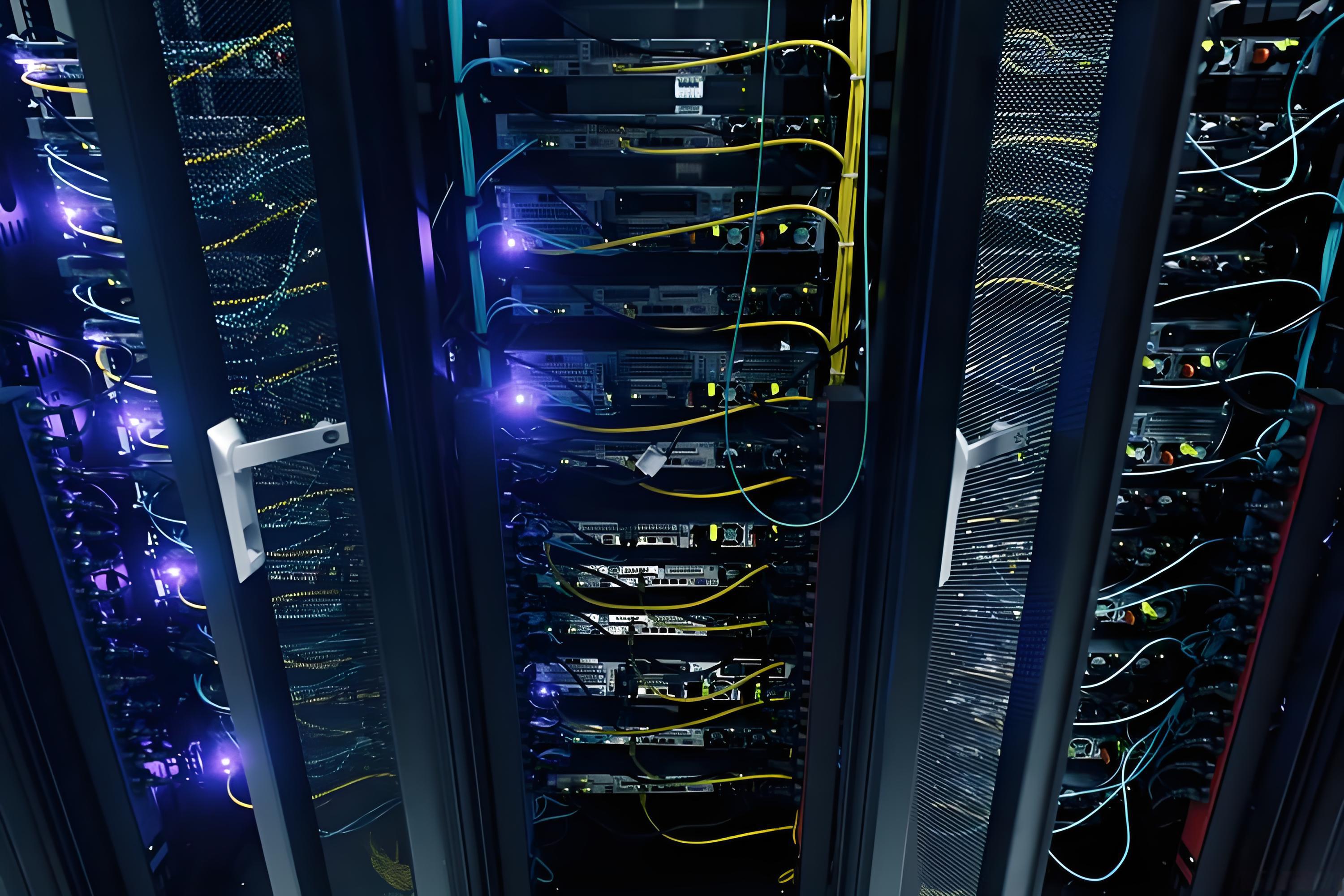
Fiber optic connector testing in controlled laboratory environment
2. Real Lab Test: LC vs SC Over 20km
We put this question to the test in AMPCOM's optical lab. Here's the setup:
2.1 Test Configuration
- Fiber: OS2 single-mode, 20km spool
- Wavelength: 1310nm and 1550nm
- Light source: Distributed feedback laser (DFB)
- Connectors tested: LC UPC, SC UPC, LC APC, SC APC
- Measurement: Optical power meter + OTDR
✅ Test Results: 20km Transmission
| Connector | Insertion Loss | Return Loss | Signal Quality |
|---|---|---|---|
| LC UPC | 0.12dB | 52dB | Excellent |
| SC UPC | 0.11dB | 53dB | Excellent |
| LC APC | 0.10dB | 65dB | Excellent |
| SC APC | 0.10dB | 64dB | Excellent |
Note: All values within Telcordia GR-326 standards. Differences of 0.01-0.02dB are within measurement uncertainty.
The verdict: No statistically significant difference between LC and SC. Both delivered clean, error-free transmission at 1Gbps and 10Gbps rates over the 20km link.
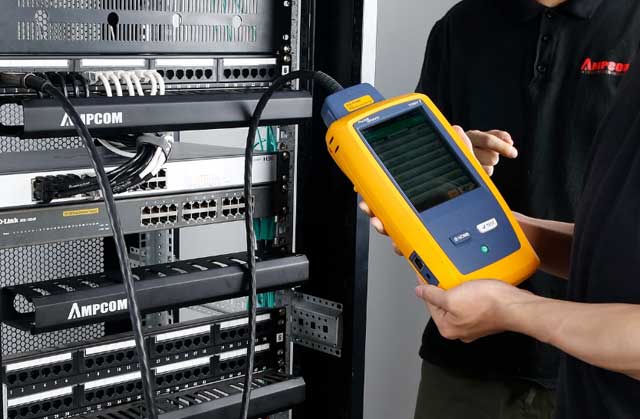
Professional fiber testing using Fluke certification equipment
3. What Actually Matters for Long-Distance Transmission
If connector type doesn't matter, what does? Here are the factors that genuinely affect your 20km link performance:
3.1 Fiber Type: The Critical Choice
⚠️ Common Mistake
Using multimode fiber (OM3/OM4) for distances over 550m at 10Gbps. For 20km, you MUST use single-mode fiber (OS2).
| Fiber Type | Max Distance @ 1Gbps | Max Distance @ 10Gbps |
|---|---|---|
| OM3 Multimode | 300m | 300m |
| OM4 Multimode | 550m | 400m |
| OS2 Single-mode | 70km+ | 40km+ |
3.2 Polish Type: UPC vs APC
This matters more than LC vs SC. For long-distance links:
- UPC (Ultra Physical Contact): Return loss ≥50dB, suitable for most applications
- APC (Angled Physical Contact): Return loss ≥60dB, recommended for high-power laser systems and analog video
Pro Tip
For 20km data links, UPC is sufficient. Use APC if you're running CATV overlay, high-power DWDM, or have strict reflection requirements. Never mix UPC and APC connectors—they're not compatible!
3.3 Connector Quality and Installation
Poor installation causes more problems than connector type ever could:
- Dirty connectors: Even microscopic dust causes significant loss
- Improper cleaving: Bad cleave angle increases back-reflection
- Epoxy voids: Causes gradual performance degradation
- Over-tightening: Cracks the ferrule over time
— AMPCOM Field Engineer

Professional fiber optic cabling installation for long-distance transmission
4. When to Choose LC vs SC
Now that we've established technical equivalence, here's a practical decision framework:
| Scenario | Recommendation | Rationale |
|---|---|---|
| New campus/building link | LC | Future-proof, industry standard, higher density |
| Extension of existing SC network | SC | Consistency, avoid hybrid adapters |
| High-density data center | LC | Double port density in same space |
| Outdoor surveillance network | SC | Robust, widely compatible with existing equipment |
| FTTH/PON deployment | SC | Industry standard for ONT connections |
The AMPCOM Position
For new installations, we recommend LC connectors for these reasons:
- Future compatibility: All new switches use LC interfaces
- Density advantage: LC panels hold twice the fibers
- Industry momentum: LC is becoming universal standard
- Cost convergence: LC prices now match SC
However, SC remains valid for:
- Matching existing infrastructure
- FTTH residential applications
- Outdoor surveillance networks
- Equipment with SC-only interfaces
Practical Advice
If your 20km link terminates in a data center, use LC. If it connects to outdoor cabinets or legacy equipment, use SC. The key is consistency at each endpoint—avoid mixing connector types in the same link path.
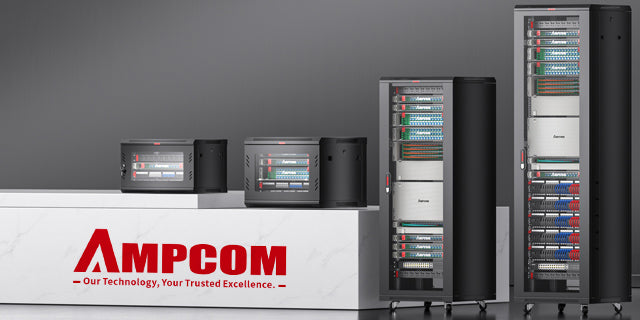
Modern server room using LC connectors for high-density fiber management
5. Product Recommendations
For your 20km campus link, AMPCOM recommends:
5.1 Fiber Cable
- OS2 Single-mode Armored Cable: For underground conduit runs
- OS2 Single-mode Aerial Cable: For overhead pole installations
5.2 Connectors and Patch Panels
- LC UPC Fiber Patch Cables: For data center termination
- SC UPC Fiber Patch Cables: If matching existing equipment
- LC/SC Fiber Patch Panels: 12-96 fiber configurations available
5.3 Termination Options
- Pre-terminated assemblies: Factory-tested, plug-and-play
- Fusion splice pigtails: Lowest loss, best for permanent links
- Field-installable connectors: For repair and modifications
AMPCOM Recommendation
For your 20km university campus link, we recommend:
- OS2 single-mode armored cable for underground sections
- LC UPC connectors at the data center end
- SC UPC connectors at the outdoor cabinet end (if matching existing equipment)
- LC-SC hybrid patch cable to bridge different connector types
This gives you the best of both worlds: data center standardization and compatibility with existing field equipment.
Complete AMPCOM fiber optic solution for campus and data center applications
Related Articles
- Why LC Connectors Became the First Choice for Data Center Cabling — Learn more about LC connector evolution and selection for data center environments
- Fiber Patch Cable Selection Guide 2026: How to Choose the Right One for Your Network — You'll know exactly which cable type — OS2, OM3, OM4, or OM5 — belongs in your specific environment
- What’s the Difference Between Single-mode and Multimode Fiber? — The right answer depends on distance, bandwidth targets, optics costs, and how you expect the network to grow.
Bottom Line
For 20km single-mode transmission, LC and SC connectors perform identically. Choose based on your existing infrastructure and future needs—not on transmission concerns.
LC for new installations. SC for legacy compatibility. Both will deliver reliable 20km performance when properly installed and maintained.
Still have questions? Contact AMPCOM's technical team for personalized guidance on your campus fiber deployment.

AMPCOM Technical Team
Industry experts with 15+ years in enterprise network infrastructure
Need Help with Your Campus Fiber Project?
AMPCOM provides complete single-mode fiber solutions with factory certification
Ask Our Engineers →

