
Field Fusion Splicing Is Dying in AI Data Centers: Why Factory Termination Became a Structural Necessity
Published:Executive Summary: For two decades, fusion splicing was the default way to join fiber inside the data center — clean, low-loss, and permanent. But inside today's AI hyperscale facilities, that assumption is collapsing. As GPU clusters scale to tens of thousands of accelerators and deployment windows shrink from months to weeks, AI data center cabling requirements now favor plug-and-play, factory-terminated, pre-tested MPO/MTP trunks. Field splicing hasn't disappeared — it survives in outside plant, long-haul, and repairs — but as the primary build method for AI fabrics, it is fading fast. This article explains what changed, why on-site splicing can't keep up, and how to design your next build around factory termination as a structural default.
Quick Navigation
- 1 The Slow Fade of Field Fusion Splicing
- 2 The Deployment Cadence Problem: Why Splicing Can't Keep Up With the AI Buildout
- 3 The Quality Problem: Inconsistent Loss at Scale
- 4 The Economics: Labor Scarcity, Rework, and Total Cost of Ownership
- 5 Factory Termination: How Plug-and-Play Became the Default
- 6 Designing Your Next AI Build Around Factory Termination
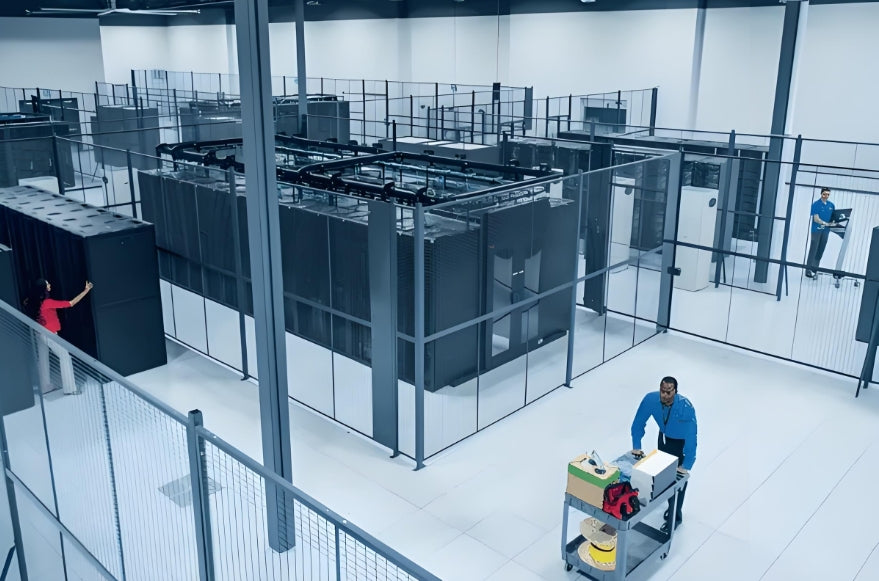
Inside AI hyperscale facilities, fiber is now expected to land "ready to click in" — not "ready to be spliced on site"
Chapter 1: The Slow Fade of Field Fusion Splicing
What Fusion Splicing Was Built For
Field fusion splicing — welding two stripped fiber ends together with an electric arc — earned its place in the data center because it delivered a near-seamless joint with very low insertion loss, and it let installers join any two fibers on demand, anywhere. For decades that flexibility was the whole point: build the raceway, pull the loose-tube or tight-buffered cable, and splice to length at the patch panel.
It still works. A good technician in a clean environment can hit 0.1–0.3 dB per splice, and splices remain the backbone of long-haul, metro, and campus outside-plant (OSP) networks where a connector every few hundred meters would be impractical. The problem isn't the technology — it's the context it now sits in.
Why the AI Facility Changed the Math
Three things happened at once in the AI era that quietly broke the case for splice-everything:
- Density exploded. A single GPU cluster now demands tens of thousands of fiber links, not hundreds. Every "join on site" step is multiplied by 10x–100x.
- Schedules compressed. Hyperscalers are standing up capacity at a pace measured in weeks. Splice-and-cure labor simply doesn't fit the window.
- Speeds tightened the budget. At 800G and 1.6T, link-loss headroom is thinner, so every unpredictable joint is a risk the network team would rather not carry.
The result: in the AI build, factory termination stopped being a "nice-to-have alternative" and became the path of least resistance. Field splicing didn't get worse — the job got bigger, faster, and less forgiving.

High-density AI fabrics multiply every on-site termination step by orders of magnitude — exactly where field splicing falls behind
Chapter 2: The Deployment Cadence Problem — Why Splicing Can't Keep Up With the AI Buildout
The Arithmetic of Splicing at Scale
Consider a single 24-fiber MPO trunk that needs to be terminated at both ends on site. Even at a healthy pace, one fusion splice takes roughly 90 seconds to 3 minutes once you include strip, clean, cleave, splice, and apply the protection sleeve — and then the joints must be organized into splice trays inside a closure. For one 24-fiber end that's ~45–70 minutes of pure bench time; double it for both ends, and you're past two hours per trunk before routing and testing.
Now scale that to an AI fabric. A modest cluster can call for hundreds to thousands of MPO trunks. The splice workload alone becomes the critical path of the entire fit-out.
When "Weeks" Replaces "Months"
The AI buildout is not a leisurely phased rollout. Capacity that misses its window loses its value — training clusters are booked before the building is finished. Operators optimizing for structured cabling for AI data centers increasingly treat installation speed as a revenue variable, not just a cost line. Factory-terminated trunks collapse the on-site work to routing and mating: pull, dress, insert, verify. No splicer, no generator, no cleanroom tent.

Gigawatt-pace AI buildouts leave no slack in the schedule for slow, labor-intensive on-site termination
💡 So is fusion splicing "dead"?
No — it's migrating. Splicing remains essential for OSP, long-haul, repairs, and any scenario where you must join arbitrary fiber in the field. What's dying is its role as the primary termination method for the AI server-room fabric. Inside the white space, factory termination is now the structural default.
Chapter 3: The Quality Problem — Inconsistent Loss at Scale
Field Conditions Are Not a Factory
A fusion splice's loss depends on cleave quality, fiber geometry, cleanliness, and environmental stability. In a controlled plant those are held to tight tolerances. On a construction floor — dust, vibration, humidity, and a technician racing the schedule — variation creeps in. At 10,000 links, even a small tail of high-loss or reflectance outliers becomes a reliability and troubleshooting headache.
Tighter Budgets at 800G/1.6T
Higher line rates leave less margin for loss and reflection. A connection that was "fine at 100G" can push an 800G link toward its penalty threshold. Factory-polished connectors are interferometer-inspected and insertion-loss (IL) / return-loss (RL) verified individually, so the worst-case joint is bounded by the spec — not by the luck of the day's cleaves.
The Test-Report Advantage
Every factory-terminated assembly ships with a Fluke (or equivalent) test report certifying IL/RL per fiber. On day one you know exactly what you deployed; during troubleshooting you can trust the as-built loss budget instead of guessing which field splice drifted. That traceability is what procurement and network teams now expect as standard.

Factory-terminated fiber ships with per-fiber IL/RL test reports — bounded loss budgets instead of on-site guesswork
🔧 Doesn't a field splice give lower loss than a connector?
Individually, a perfect splice can beat a connector by a hair. But "individually" is the catch. At scale, the distribution matters more than the best case: a factory connector gives a guaranteed, documented loss across every link, while field splices give a spread. For AI fabrics where consistency protects the link budget, the bounded spread wins.
Chapter 4: The Economics — Labor Scarcity, Rework, and Total Cost of Ownership
The Splicer Shortage Is Real
Skilled fusion technicians are a finite, trainable-but-slow resource, and the AI buildout is competing for the same pool across every region. When a project's critical path depends on a handful of certified splicers, scheduling risk becomes financial risk. Factory termination shifts that skill off the critical path and into the plant, where it's repeatable and scalable.
Rework Is Where Budgets Die
Field splicing's hidden cost isn't the splice — it's the one that fails OTDR, the one with a contaminated cleave, the one buried in a tray that has to be reopened. Each rework event means access, time, and re-certification. Pre-terminated trunks fail forward: if a connector is bad, you swap a labeled pigtail or harness, not a closure.

Unmanaged field terminations multiply rework risk — the real cost driver behind on-site splicing
The TCO Reframe
Factory-terminated cable carries a higher unit price than bare cable-plus-splicing on paper. But the TCO comparison has to include: splicer rental, technician hours, cleanroom/tent setup, rework loops, testing time, and schedule risk. Once those are in the model, pre-terminated trunks usually win on the projects that actually ship on time.
Chapter 5: Factory Termination — How Plug-and-Play Became the Default
What "Factory Termination" Actually Means Here
In the AI context it means connectors (LC, and especially MPO/MTP in 8/12/16/24-fiber arrays) are polished, assembled, and 100% tested in a controlled environment, then delivered as ready-to-deploy trunks, harnesses, and breakout cables. You route the cable and mate the connector — no field fusion required.
For the highest-density AI fabrics, pre-terminated MPO/MTP trunk cables are the workhorse: a single 24-fiber MPO carries a whole spine-leaf bundle in one pull, lands in a cassette or adapter panel, and is verified against its shipped test report in minutes.
Head-to-Head: Field Splicing vs Factory Termination
| Dimension | Field Fusion Splicing | Factory Termination (Pre-terminated) |
|---|---|---|
| On-site time per link | Minutes of bench work + tray organization | Seconds to minutes — route and mate |
| Loss predictability | Variable (skill + environment dependent) | Bounded by spec, per-fiber tested |
| Skill requirement on site | Certified fusion technician | General cabling installer |
| Rework model | Reopen tray / re-splice | Swap labeled connector or harness |
| Test evidence | Spot OTDR; full IL/RL harder | Per-fiber IL/RL report shipped |
| Scalability to 10k+ links | Critical-path bottleneck | Parallelizable, off critical path |
| Best fit | OSP, long-haul, repairs, ad-hoc joins | AI server-room fabric, spine-leaf, GPU rails |

Pre-terminated MPO/MTP trunks turn the AI fabric into a plug-and-play build — the structural default for new capacity
Case Sketch: A Hyperscale AI Cluster Cut Install Time by ~70%
A build team swapping a splice-everything plan for factory-terminated MPO trunks on a spine-leaf GPU fabric reported install time dropping from roughly three weeks to under one week for the fiber portion — driven almost entirely by removing on-site splicing, tray organization, and rework loops. The shipped IL/RL reports also shortened acceptance testing. (Illustrative of widely reported industry outcomes; your numbers depend on topology and phasing.)
Chapter 6: Designing Your Next AI Build Around Factory Termination
Make It the Default, Not the Exception
If your next facility is an AI or high-density build, design the fabric for plug-and-play from day zero:
- Standardize the topology. Spine-leaf and GPU-rail patterns map cleanly to pre-terminated MPO trunks and cassettes — exactly the scenarios where factory termination shines.
- Plan lengths precisely. Pre-terminated cable needs accurate route lengths up front. Invest in BIM/as-built measurements so harnesses arrive the right size.
- Demand per-fiber test reports. Make shipped IL/RL certification a purchase requirement, not a courtesy.
- Keep splicing for what it's good at. OSP entrance, long-haul handoff, and repairs stay field-spliced; the in-room fabric stays factory-terminated.
- Treat install speed as capacity. Faster, cleaner termination means earlier revenue from the cluster.
The Strategic Takeaway
Field fusion splicing isn't obsolete — it's being pushed to the edge of the data center, where joining arbitrary fiber in the field still makes sense. In the white space of the AI facility, factory termination won the structural argument on three fronts at once: speed (it fits the schedule), consistency (it protects tight link budgets), and economics (it removes the splicer bottleneck and rework risk). For new AI capacity, plug-and-play isn't a compromise — it's the baseline.
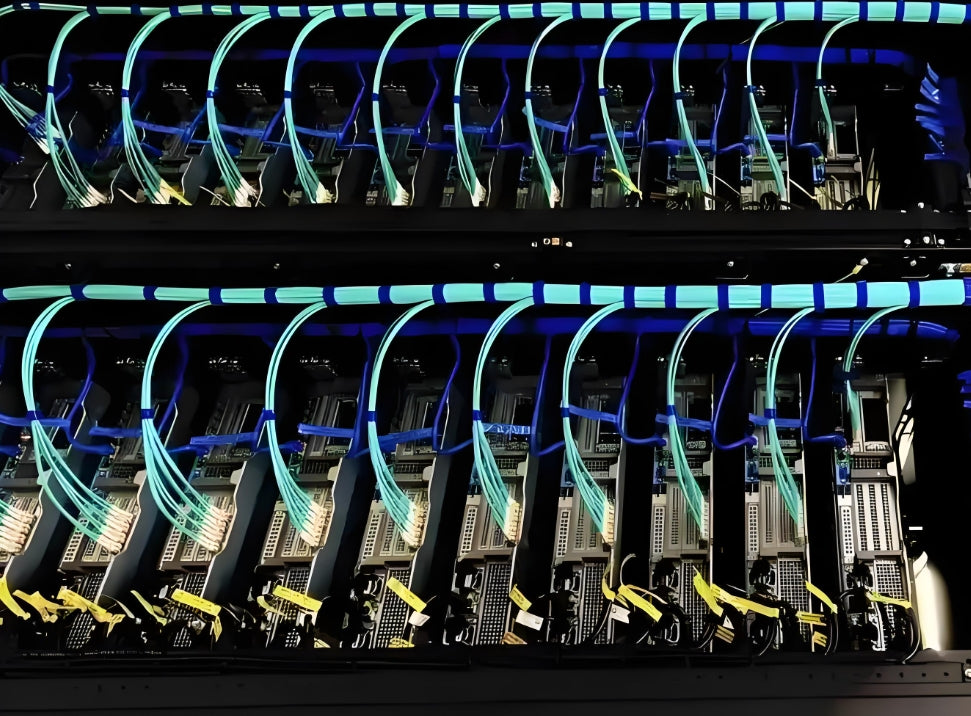
Factory-terminated, pre-tested fiber is the foundation for fast, consistent, scalable AI data center builds

AMPCOM Technical Team
Industry experts with 17+ years in structured cabling, data center infrastructure, and fiber optic network design
Planning a fast, consistent AI data center build?
AMPCOM supplies factory-terminated, per-fiber IL/RL-tested MPO/MTP trunk cables, harnesses, and cassettes engineered for high-density AI fabrics — built to ship ready to click in, not ready to splice on site.
Talk to Our Infrastructure Experts

