
BICSI Fall 2026 + ECOC 2026: Updating Your AI Data Center Cabling Specs for Hollow-Core Fiber, 1.6T and OFNP Compliance
Published:Executive Summary: Every few years the cabling industry gets a reset — and September 2026 delivered two of them in the same month. BICSI Fall 2026 (Fort Lauderdale) and ECOC 2026 (Málaga) between them set the roadmap for the next five years of data center cabling: a proposed Cat 6A extension to 165 m (GigaREACH XL), the maturing of hollow-core fiber (HCF) with sub-0.5 dB/km attenuation, the acceleration of 1.6T optical modules, and renewed scrutiny on OFNP fire-rating compliance as AI fiber density climbs. This guide is written for specifiers and installers: it translates each announcement into the practical field rules — fiber selection, connector choice, bend-radius discipline, pathway separation, and test procedures — that you should actually build into an AI data center project in the second half of 2026.
Quick Navigation
- 1 Why the September 2026 Standards Cycle Changes Your Spec
- 2 BICSI Fall 2026 — Copper Standards Updates Installers Must Apply
- 3 ECOC 2026 — Fiber Innovations You Can Specify Today
- 4 Hollow-Core Fiber — Installation Rules for the New Latency Layer
- 5 Getting 1.6T-Ready — MPO-16 / Base-16 Installation Rules
- 6 OFNP & Fire-Rating Compliance — The Code Item Inspectors Catch
- 7 The Updated AI Data Center Cabling Checklist
- 8 Putting It Together: A 1.6T-Ready Specification
- 9 Key Takeaways
- 10 Frequently Asked Questions
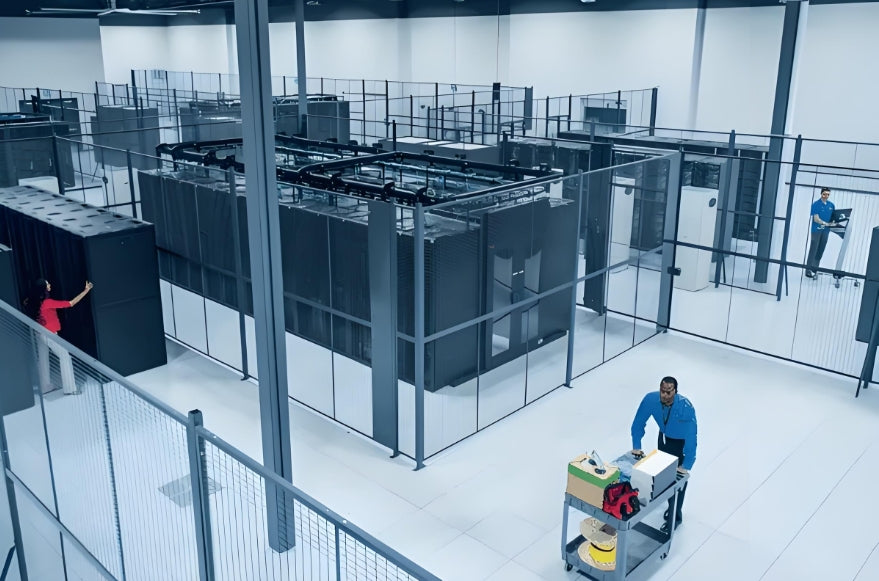
The standards published in September 2026 decide how AI data centers will be cabled through 2030 — and the installation details are where projects succeed or fail
Chapter 1: Why the September 2026 Standards Cycle Changes Your Spec
Data center cabling is governed not by one document but by a stack of complementary frameworks — and the AI era has made the differences between them matter. TIA-942-C sets the minimum floor a facility must meet. BICSI 002-2024 is the best-practice ceiling, covering design, commissioning and operations. ISO/IEC 24764 extends the same logic internationally, and EN 50600 adds the European regulatory context. When the conference season drops new proposals and clarifications, specifiers have to decide — quickly — which ones are adoptable today and which are still on the roadmap.
Two events this month carried most of the news:
🏛️ BICSI Fall 2026 — Fort Lauderdale
- Focused on the copper plant and horizontal infrastructure
- GigaREACH XL: proposed Cat 6A reach extension to 165 m
- Cat 8.2 / TERA connector standardization push
- MPTL testing clarified in TIA-568.2-D Rev C
- Commissioning and documentation emphasis (TIA-606-C)
🔬 ECOC 2026 — Málaga
- Focused on the optical plant and photonics
- 8,000+ industry experts, 340 exhibitors
- Hollow-core fiber (HCF) reaching production readiness
- 1.6T optical module progress across IEEE study groups
- C+L-band dual-window transmission
The practical takeaway is that the two halves of an AI data center cable plant are being pushed in opposite directions. Copper is being asked to reach further (165 m) for large horizontal campus deployments, while fiber is being asked to carry more — more lanes, higher rates, and lower latency. Your specification has to reconcile both.
The fiber-density figure is the one that reframes everything. A single 72-GPU rack using 800G-DR4 optics can consume 864 individual single-mode fibers — roughly 10× the optical fiber of a conventional server rack in the same footprint. Multiply that by 100 racks and you have more than 86,000 fibers before a single spine link is added. The installation discipline that a plant like this needs — polarity control, bend radius, pathway capacity, fire rating, and testing — is what the rest of this guide addresses. If you want the broader design context first, see our article on what is changing in structured cabling for AI data centers.
Chapter 2: BICSI Fall 2026 — Copper Standards Updates Installers Must Apply
BICSI Fall 2026 concentrated on the copper side, where three proposals have direct installation consequences. None of them are ratified standards yet — but a good specifier tracks them now so the design does not need to be reopened later.
2.1 GigaREACH XL — Cat 6A to 165 m
The headline proposal is an extension of Cat 6A to 165 m over 4-pair Class FA channels. This closes a long-standing gap: today, if a horizontal run exceeds 100 m, you must jump to Cat 8.1 (limited to 30 m) or move to fiber — neither of which is a clean answer for a large campus building where the actual requirement is simply "a bit more than 100 m." If ratified, GigaREACH XL lets a single balanced-twisted-pair channel serve distances that previously forced a media conversion.
For AI-adjacent campus deployments — where the GPU hall is a long walk from a management or out-of-band IDF — this directly reduces fiber or extender hardware previously specified to bridge the gap.
2.2 Cat 8.2 and the TERA Connector
There is a continuing push to standardize the TERA connector for data center environments that need 40G at 30 m over copper. The traditional RJ45 interface struggles with the higher-frequency performance Cat 8.2 demands, and TERA's four-pair construction handles the bandwidth more cleanly. For AI racks where a short, robust copper link at 40G is genuinely useful (top-of-rack console, management, or short intra-row runs), TERA is a specifier's option to watch — but it requires a coherent end-to-end ecosystem, so you cannot deploy it piecemeal.
2.3 MPTL Testing — TIA-568.2-D Rev C
The third update is the least visible and, for installers, the most immediate. TIA-568.2-D Revision C is expected to clarify MPTL (Modular Plug Terminated Link) testing procedures for 10 Gbit infrastructure in emerging single-pair architectures. If your AI deployment uses MPTL anywhere — a direct-terminated link from a panel to a device — this revision determines how you set up the tester, which adapters you use, and what constitutes a passing record. Getting the test method wrong means either false failures or, worse, false passes that surface only under production traffic.
⚠️ Installer note: MPTL is a permanent-link-style test configuration, not a channel test. Mixing a channel adapter onto an MPTL link — or testing an MPTL run as if it were a permanent link — is one of the most common certification disputes on AI builds. Confirm the Rev C procedure and record the test configuration in your submittal package.
❓ Should I specify GigaREACH XL before it is ratified?
A: Do not write an unratified proposal into a binding specification as if it were a standard. Instead, capture the option in the design intent: size pathways and infrastructure so that a 165 m Cat 6A channel is achievable if — and when — the standard ratifies. Practically, that means maintaining true 4-pair Class FA channel components (not Class E) and documenting the channel topology so a later extension needs only a re-test, not a rebuild.
Chapter 3: ECOC 2026 — Fiber Innovations You Can Specify Today
ECOC 2026 in Málaga — more than 8,000 industry experts and 340 exhibitors — produced three developments with near-term specification impact.
3.1 Hollow-Core Fiber Reaches Production Readiness
Multiple vendors showed hollow-core fiber (HCF) products now capable of production deployment, with attenuation below 0.5 dB/km and latency below 1.0 ns/m. Because light propagates through an air core rather than a glass core, HCF is roughly 47% faster in terms of propagation velocity, translating to about 30–32% lower propagation latency than conventional single-mode fiber. Microsoft has already deployed HCF in production, reporting a 47% speed increase and 32% latency reduction. For AI all-reduce collective-communication patterns, where total training time is partly set by how long it takes a signal to cross the fabric, that latency reduction is a direct performance feature — not a curiosity.
3.2 1.6T Optical Modules Advance
IEEE study groups continue to push 1.6TbE across both single-mode and multimode fiber, evaluating 16 × 100G and 8 × 200G lane options. As we detailed in our analysis of what 800G and 1.6T trends mean for data center cabling in 2026, the 8-lane parallel-optic path keeps the fiber count identical between 800G and 1.6T — which is what makes a 16-fiber MPO-16/Base-16 plant future-proof without recabling.
3.3 C+L-Band Dual-Window Transmission
Dual-band C+L EDFAs let operators transmit simultaneously in the C and L bands, effectively doubling fiber capacity without installing new fiber. This is largely a long-haul and DCI development, but it matters to the data center edge: it changes the economics of when a new duct or a new cable run is actually necessary, and it favors single-mode OS2 as the backbone medium of record.
❓ Is hollow-core fiber a drop-in replacement for OS2 single-mode?
A: Not yet as a general replacement — but it is very close in the connectors and hardware sense. HCF uses the same LC/SC-style connector interfaces and is a single-mode medium, so the interface is familiar. The differences are in practice details: attenuation budget, splice and termination procedures, bend behavior, and cost premium. For most 2026 data centers, conventional OS2 remains the correct default, and HCF is specified selectively for the latency-critical segments (AI scale-up/scale-out fabrics and other propagation-sensitive paths).

Hollow-core fiber and 1.6T optics are converging on the same single-mode connectivity interfaces — the installation complexity is in the details, not the connector
Chapter 4: Hollow-Core Fiber — Installation Rules for the New Latency Layer
If you are going to specify HCF anywhere, specify it in the right place and install it by a stricter rulebook than OS2. HCF is not a "faster cable" in the sense of more bandwidth; it is a lower-latency medium. Its value is concentrated in paths where propagation delay matters: GPU scale-up links, all-reduce paths, time-sensitive control, and latency-critical DCI.
4.1 Where HCF Belongs
| Use Case | Latency Sensitivity | Recommended Medium |
|---|---|---|
| AI scale-up fabric (all-reduce, NVLink-class) | Very high | HCF where certified; otherwise OS2 |
| Scale-out / spine-leaf leaf uplinks | High | OS2 (G.657.A1/A2 bend-insensitive) |
| Latency-critical DCI | High | HCF or OS2 depending on distance & budget |
| Storage, management, out-of-band | Low | OM4/OM5 multimode or Cat 6A copper |
| General intra-facility backbone | Low–medium | OS2 single-mode |
4.2 The Installation Rules for HCF
✅ Do
- Follow the manufacturer's splice and termination procedure exactly — HCF splice parameters differ from conventional SMF
- Budget attenuation at the HCF-specified figure, not the OS2 figure
- Inspect every endface per IEC 61300-3-35 before mating
- Verify insertion loss with an OLTS calibrated for the wavelength in use
- Store and pull with conservative bend-radius margins
❌ Don't
- Assume OS2 splice recipes transfer directly
- Mix HCF and conventional SMF in the same channel without a documented transition point
- Re-use field test budgets set for glass-core fiber
- Route HCF tighter than the manufacturer's rated bend radius
- Deploy HCF as a site-wide default "because newer"
💡 Specifying tip: Treat HCF as a segment, not a strategy. Identify the specific links where propagation latency changes a business outcome, specify HCF only there, and document the transition (connector or splice point) to the conventional OS2 backbone on the as-built drawings. This keeps HCF's cost premium contained and its operational risk isolated.
Chapter 5: Getting 1.6T-Ready — MPO-16 / Base-16 Installation Rules
The 1.6T discussion is really a connector discussion. If the dominant AI optic stays on eight parallel lanes, then the fiber connector for 800G-DR8/SR8 and 1.6T-DR8/SR8 is the same 16-fiber interface — carried today by MPO-16 and by the smaller-form-factor MMC16 (designated by OCP). Specify a Base-16 plant now and the 1.6T upgrade becomes a transceiver swap, not a recabling project. Our dedicated guide, MPO Fiber Solutions: Choosing 8, 12, or 24 Fibers, covers the fiber-count decision in depth; here are the installation rules that follow from it.
🔌 Connector choice
- MPO-12 for legacy 400G and 100G parallel optics
- MPO-16 / MMC16 for 800G-SR8/DR8 and 1.6T
- Specify MPO-16 trunks for new builds even if today's gear is 400G
- Leave 50–100% spare fiber for the next generation
🧭 Polarity discipline
- Lock one polarity method (Type A recommended) in the spec
- Hold every vendor to it — mixing types breaks the channel
- Verify with an MPO polarity checker before commissioning
- Record polarity on as-built drawings
📏 Bend radius
- Single-mode minimum bend radius ≈ 15 mm under load
- Never below the manufacturer's rated MPO trunk radius
- Violations cause return-loss failures and 800G+ bit errors
- Support cable trays per TIA-569-D (~1.5 m spacing)
⚡ Pathway separation
- Keep fiber trays away from busbars and high-current runs
- Maintain NEC separation from unshielded power conductors
- Respect fill limits of trays and raceways
- Plan pathways for AI fiber density (864/rack) from the outset
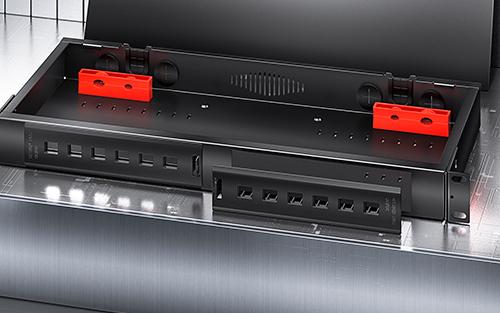
High-density termination enclosures with MPO-16/MMC interfaces let a Base-16 plant carry both 800G today and 1.6T tomorrow through the same fiber infrastructure
❓ If I install MPO-16 trunks but only deploy 400G today, is the extra fiber wasted?
A: No — it is the cheapest insurance you can buy. The spare fibers are dark until needed; the cost of adding them at installation is a fraction of the cost of pulling new trunk cable later. When the site moves to 800G-SR8/DR8 or 1.6T, those fibers come alive with nothing more than a transceiver change. The alternative — an MPO-12-only plant — forces a full recable at the next generation, at field-labor prices, during live operation.
Chapter 6: OFNP & Fire-Rating Compliance — The Code Item Inspectors Catch
As AI racks push fiber density up, more fiber is routed through overhead return-air and raised-floor supply plenums — which makes the fire rating of the cable a first-order compliance item, not a footnote. Under NEC Article 770, optical fiber carries its own rating hierarchy:
NEC Article 770 — Optical Fiber Fire-Rating Hierarchy
| Rating | Meaning | Test Standard | Where Required |
|---|---|---|---|
| OFNP / OFCP | Optical Fiber Nonconductive / Conductive Plenum | NFPA 262 / UL 910 (Steiner Tunnel) | Air-handling plenums — the highest fiber rating |
| OFNR / OFCR | Optical Fiber Nonconductive / Conductive Riser | UL 1666 | Vertical riser shafts between floors |
| OFNG / OFCG | Optical Fiber Nonconductive / Conductive General Purpose | UL 1581 (vertical tray flame test) | General horizontal spaces, no special code need |
| OFN / OFC | Optical Fiber Nonconductive / Conductive (limited use) | UL 1581 VW-1 | Limited indoor use where no fire path exists |
The decisive rule is simple: if air can freely circulate around the cable pathway, the space is a plenum and requires OFNP. A higher-rated cable may always substitute for a lower-rated one, but never the reverse. So OFNP may be used in a riser or general space; OFNR may not be used in a plenum.
6.1 What Inspectors Actually Check
- Jacket markings — the rating must be printed legibly on the jacket at intervals not exceeding 24 inches (610 mm), with a UL listing mark. Faded or missing markings are grounds for rejection.
- Rating vs. location — inspectors verify plenum-rated cable is present in any ceiling cavity where HVAC air returns, and they check the transition points where cable leaves a conduit into open plenum.
- Pathway compliance — trays and supports must suit the rated cable and respect bend radius and fill limits.
- Documentation — cut sheets, UL listings and country-of-origin records on regulated projects.
6.2 OFNP Is Not LSZH — and Not CPR
⚠️ Common spec error: OFNP and LSZH are independent properties. Most OFNP cables achieve their flame/smoke performance with fluoropolymer jackets (FEP/PVDF), which contain halogens — the opposite of LSZH, which means zero halogens by definition. If a project requires both, state both explicitly and demand separate test reports: NFPA 262 for fire rating and IEC 60754 for halogen content. Likewise, North American NEC ratings do not translate directly to European CPR (EN 50575) Euroclasses (e.g., B2ca-s1a,d0,a1); specify cable that carries both UL and CPR certifications for global projects.
The good news is that high-density AI cables are increasingly available in plenum-rated construction. Recent OFNP certifications for ribbon fiber cables in the 48–576 fiber range specifically target AI infrastructure deployments — high fiber counts, plenum-rated, ready for overhead pathways. For a deeper dive on jacket materials and ratings, see our practical guide to fiber optic cable types: OS2, OM3, OM4, OFNR and OFNP.

Plenum-rated cable is a code decision, not a performance upgrade — and the jacket marking is what the inspector verifies on site
❓ My AI racks use overhead return-air cooling. Do I need OFNP?
A: Almost certainly yes. Overhead return-air designs frequently turn the ceiling cavity into an environmental air-handling space, and any fiber exposed there without full conduit isolation must be OFNP-rated per NEC Article 770. The most common field failure is using a riser (OFNR) or general-purpose cable for the final exposed segment above the ceiling. Confirm the ceiling cavity classification with the mechanical engineer before specifying the cable type, and standardize on OFNP for all indoor fiber if you want to eliminate classification risk across the site.
Chapter 7: The Updated AI Data Center Cabling Checklist
Pulling the standards updates into one field checklist makes the gap between a compliant plant and a network that actually passes cleanly at 800G/1.6T. Use this as a project-commissioning reference.
Pre-Installation
- ☐ Media selection: OS2 (G.657 bend-insensitive) for 400G+ and all >500 m; OM4/OM5 for short intra-row; Cat 6A/8.1 for horizontal copper.
- ☐ Fiber count: plan for 3–5× growth; 50–100% spare fibers in every trunk.
- ☐ Connector: MPO-16 / MMC16 for new builds; MPO-12 only where legacy 400G/100G dictates.
- ☐ Polarity: one method (Type A recommended), locked in the BOM and drawings.
- ☐ BOM freeze: all lengths, labels and port maps fixed before the factory order.
Installation
- ☐ Pathways: sized for AI density; supports per TIA-569-D (~1.5 m); fill limits respected.
- ☐ Separation: fiber kept clear of busbars and high-current runs; NEC power separation maintained.
- ☐ Bend radius: ≥15 mm single-mode under load; never below the trunk's rated radius.
- ☐ Fire rating: OFNP in all plenum/air-handling spaces; jacket markings present.
- ☐ Endface care: inspect and clean every connector per IEC 61300-3-35 before mating.
Testing & Handover
- ☐ Copper: Level 2E/2G certifier, including TCL and ELTCTL for Cat 8; correct MPTL configuration per TIA-568.2-D Rev C.
- ☐ Fiber: OTDR for trunk/splice/connector loss; OLTS for channel insertion loss against the transceiver loss budget.
- ☐ System test: end-to-end BERT or live-traffic validation before the cluster goes live.
- ☐ Labeling: TIA-606-C class-compliant, machine-printed, both ends, integrated with DCIM.
- ☐ Records: OTDR traces and test reports archived and cross-referenced to as-built drawings.
Two of these items deserve special emphasis for AI builds. First, reading the Fluke test reports before accepting a delivery is what catches defective links while they are still the vendor's problem. Second, tight loss budgets at 400G/800G mean that a link which passed at 10G will not necessarily pass now — test against the specific loss budget of the optic you actually intend to deploy.
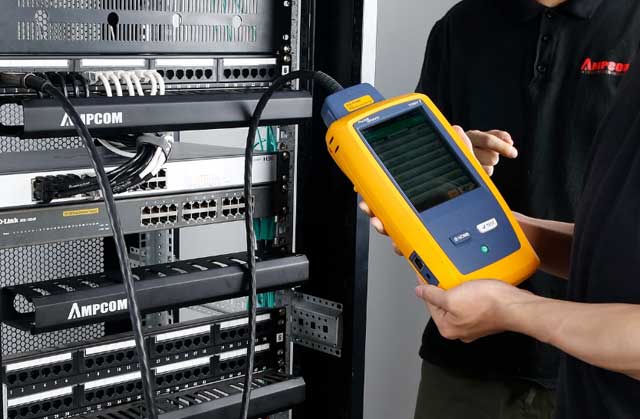
Certification testing is the acceptance gate — every AI data center link must be verified against its own transceiver loss budget, not a legacy 10G figure
Chapter 8: Putting It Together — A 1.6T-Ready Specification
Here is how the September 2026 standards updates resolve into a single, coherent AI data center cabling specification. It is deliberately conservative: it adopts what is ready and stages what is coming.
📍 Reference Specification: AI Data Center Build (2026 H2)
| Layer | Specification | Standard / Driver |
|---|---|---|
| Horizontal copper | Cat 6A (Class FA channel; pathway provisioned for 165 m GigaREACH XL) | TIA-568.2-D; BICSI Fall 2026 |
| Intra-rack interconnect | DAC/AEC under 3 m; OM4/OM5 MPO for 100–500 m | IEEE 802.3; TIA-568.3-D |
| Scale-out fiber backbone | OS2 (G.657.A2 bend-insensitive), MPO-16/Base-16 trunks with spares | IEEE 802.3dj; OCP MMC16 |
| Latency-critical fabric | OS2 baseline; hollow-core fiber (HCF) for certified latency-critical segments | ECOC 2026 HCF readiness |
| Fire rating | OFNP for all indoor plenum-rated runs; CPR-rated equivalents for EU scope | NEC Art. 770; NFPA 262; EN 50575 |
| Administration | Machine-printed labels, both ends, TIA-606-C class, DCIM-integrated | TIA-606-C |
| Testing | Level 2E/2G copper certifier; OTDR + OLTS on fiber; BERT on live links | TIA-568.2-D; IEC 61300-3-35 |
| Design framework | TIA-942-C (minimum) + BICSI 002-2024 (best practice) + ISO/IEC 24764 / EN 50600 | Multi-standard compliance |
This specification delivers an 800G plant today that reaches 1.6T with a transceiver swap, contains HCF's cost premium to the links that benefit from it, and closes the fire-rating gap that AI fiber density makes acute. It is not the cheapest build — but it is the one least likely to require recabling before 2030.
Chapter 9: Key Takeaways
📌 Six things to carry into your next AI data center cabling project:
1. Track, don't prematurely adopt. GigaREACH XL (165 m Cat 6A) and the TIA-568.2-D Rev C MPTL clarifications are proposals/clarifications — design for them, but do not write unratified items into binding specs.
2. Specify hollow-core fiber as a segment, not a strategy. Its value is propagation latency (≈47% faster light, ~30–32% lower latency), which matters only on specific AI fabric and DCI paths. OS2 remains the correct default everywhere else.
3. Build Base-16 now. MPO-16 / MMC16 trunks make the 800G→1.6T migration a transceiver swap. Spare fibers cost little at install time and save a recable later.
4. Fire rating is a code decision. If air circulates around the pathway, it is a plenum and it needs OFNP — with legible jacket markings. OFNP is not the same as LSZH, and NEC ratings do not equal CPR Euroclasses.
5. Respect the fiber math. A single 72-GPU rack can need 864 OS2 fibers. Size pathways, connectors and labor for AI density from day one.
6. Test to the real budget. Verify every link against the loss budget of the optic you intend to run — a link that passed at 10G may fail at 400G/800G.
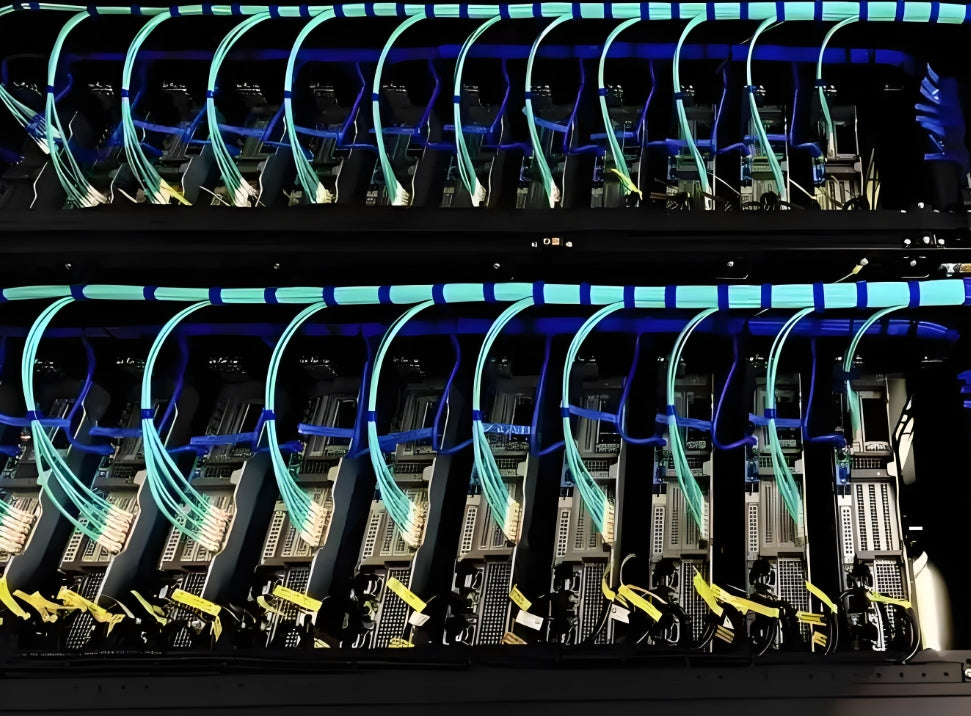
The standards set in September 2026 point in one direction: single-mode, high-density, plenum-rated fiber as the backbone of the AI-era data center
Chapter 10: Frequently Asked Questions
❓ What is the single most important update from BICSI Fall 2026 and ECOC 2026 combined?
A: For most installers, it is the combination of Base-16 / MPO-16 as the 1.6T-ready connector standard and OFNP compliance under rising fiber density. The 1.6T roadmap tells you what to install (16-fiber single-mode trunks with spares); the fire-rating scrutiny tells you where and how to install it safely. Together they define a new build that will not need recabling before the next generation.
❓ Is 1.6T available now, or is it still future?
A: The standards work (IEEE 802.3 study groups evaluating 16 × 100G and 8 × 200G lanes) and the module ecosystem are advancing fast, with 1.6T switches entering production around this period. The practical position for a 2026 build is to be 1.6T-ready rather than necessarily 1.6T-deployed: install Base-16 fiber and MPO-16/MMC16 connectivity now, run 800G today, and upgrade the modules when the optics you need are qualified for your fabric.
❓ Do the new standards change how I test my copper links?
A: Yes, if you use MPTL. TIA-568.2-D Rev C is expected to clarify MPTL test procedures for 10 Gbit infrastructure in single-pair architectures. Set up the certifier for the correct configuration, record the test configuration in your submittal package, and for Cat 8 include TCL and ELTCTL in the test suite. Channel vs. permanent-link (and MPTL) testing are not interchangeable — know which one your specification requires.
❓ Will hollow-core fiber replace OS2 single-mode in data centers?
A: Not wholesale, and not soon. HCF is a latency-optimization medium with a cost premium and specialized installation practices. Expect it to be deployed selectively — in AI scale-up/scale-out fabrics and other propagation-sensitive paths — alongside conventional OS2, not instead of it. The realistic outcome is a heterogeneous fiber plant where each medium is used where its strengths pay off.
Building an AI-Ready Cabling Plant?
AMPCOM supplies OS2 and hollow-core-ready fiber assemblies, MPO-16/Base-16 trunks, OFNP plenum-rated cable, Cat 6A/8.1 copper and certification-grade test support — engineered for the standards that came out of BICSI Fall 2026 and ECOC 2026. Get a custom BOM and lead-time quote for your next project.
Contact AMPCOM for a Custom Quote →

