
Why Are Hyperscalers Pouring $220 Billion Into Self-Built Infrastructure?
Published:Executive Summary: Amazon just announced a record $220 billion AI capital expenditure for 2026 — yet the company says it's still capacity-constrained. That paradox sits at the heart of the biggest infrastructure shift in data center history: hyperscale operators are abandoning the "buy-what-you-need" model and building their own empire from the ground up. This article examines why hyperscalers are pivoting to self-built infrastructure, where the money is going, and what it means for the data center supply chain.
Quick Navigation
- 1 The Great Pivot: From Buying to Building
- 2 What's $220 Billion Actually Buying?
- 3 The Cabling Infrastructure Angle Nobody Talks About
- 4 Geography, Water, and the New Site Selection Calculus
- 5 What This Means for Enterprise Buyers and Channel Partners
- 6 The Cabling Vendor Perspective: How AMPCOM Fits In
- 7 Key Takeaways and FAQ
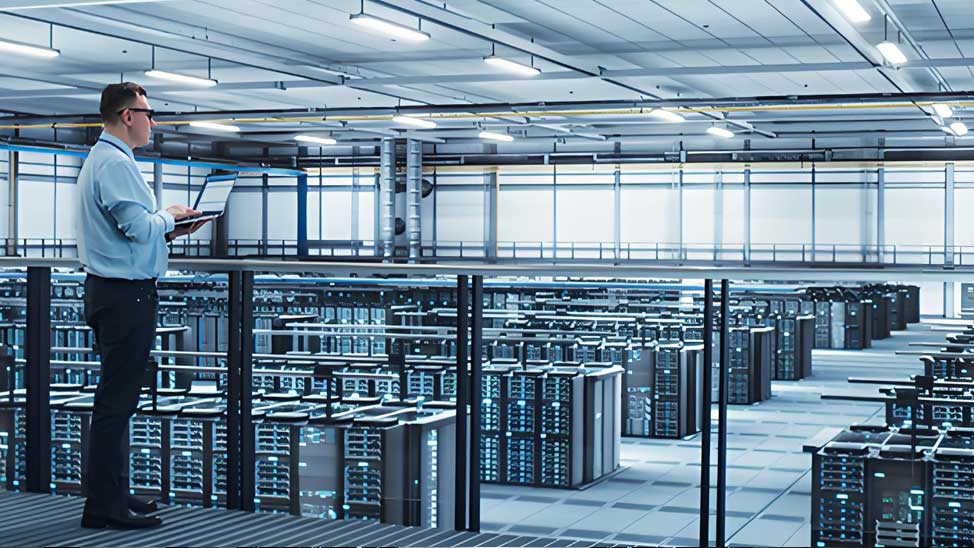
Modern hyperscale campuses are engineered for power densities that demand purpose-built infrastructure — from cooling to high-speed interconnects
Chapter 1: The Great Pivot — From Buying to Building
Why the "Buy" Model Hit a Wall
The shift didn't happen overnight. For years, Amazon Web Services grew by renting out server capacity — and that model made AWS the most profitable business unit in corporate history. But as AI workloads exploded in scale and specificity, the calculus changed entirely.
Legacy colocation was designed for general-purpose workloads: web servers, databases, standard compute. AI training clusters — particularly those running Nvidia GB200 NVL72 systems drawing 120kW+ per rack — are something categorically different. They demand:
- Custom power delivery — Standard 10–15kW per rack designs can't support GPU-dense configurations without rethinking the entire PDU-to-server path
- Direct liquid cooling integration — Rear-door heat exchangers and direct-to-chip cooling aren't optional add-ons at these densities
- Tight network latency requirements — GPU-to-GPU communication inside AI clusters demands sub-microsecond switching and massive bandwidth between nodes
- Predictable, long-term capacity reservations — AI training runs are planned months in advance; waiting for colocation availability is not an option
When you're building a 25,000-GPU training cluster that needs 300MW of power, off-the-shelf colocation simply doesn't fit. That's why Amazon, Microsoft, Alphabet, and Meta have all pivoted toward purpose-built, owned data center campuses.
The Capacity Paradox
Here's what many observers miss: Amazon's $220B CapEx announcement came with a warning — the company is still capacity-constrained despite record investment. The constraints aren't silicon; they're steel, fiber, and power. Getting a 500MW site permitted and connected to the grid takes three to five years. That's why hyperscalers are betting on vertical integration — control every layer or lose to whoever does.
Chapter 2: What's $220 Billion Actually Buying?
Amazon's $220 billion AI capital expenditure isn't just a number — it's a construction mandate. Here's where those dollars are going:
Where Hyperscale CapEx Goes in 2026
| Category | Investment Priority | Infrastructure Impact |
|---|---|---|
| GPU Compute Clusters | Nvidia GB200 NVL72 / Blackwell Ultra | 120kW+ per rack; requires liquid cooling and ultra-high-density cabling |
| Power Infrastructure | Dedicated substations, on-site generation | 300–500MW per campus; custom switchgear and redundancy design |
| Custom Silicon | Trainium, Graviton, MaaS, MTIA | Different power/thermal profiles; purpose-designed racks |
| Networking Fabric | 800G/1.6T spine, RDMA over Converged Ethernet | High-count MPO fiber, DAC/AOC cables, ultra-low-latency switches |
| Real Estate & Civil | Land acquisition, permitting, shell construction | 3–5 year lead times; first-mover geography advantage |

AI clusters demand purpose-built cabling architectures — from top-of-rack switches to inter-row fiber trunks rated for 800G and beyond
Chapter 3: The Cabling Infrastructure Angle Nobody Talks About
When industry press covers hyperscale spending, they focus on GPU counts and power capacity. But the network is the nervous system of these clusters — and cabling infrastructure is where the rubber meets the road for real-world performance.
Rack Density Is Rewriting Cabling Standards
The jump from 9kW to 11kW modal rack density sounds incremental. In practice, it means:
- Copper cable PoE limits are being stress-tested — At 11kW, even Cat6A struggles with thermal management inside dense bundles. Our PoE++ cabling guide covers the math on safe bundle sizes at elevated power levels.
- Short-reach DAC and AOC cables are displacing transceiver+patch cord combinations — Inside AI racks, the distance from switch to GPU is often under 3 meters, making DAC the most cost-effective and lowest-latency choice.
- MPO fiber trunk counts are skyrocketing — 800G switch ports use 16×56G NRZ or 8×10⁶G PAM4, requiring 12-fiber or 24-fiber MPO arrays per port.
- End-of-row fiber patching density is becoming a physical constraint — At 48-port 800G switches with MPO breakout, a single end-of-row cabinet can terminate thousands of fibers. Clean, labeled, maintainable fiber management is no longer optional.
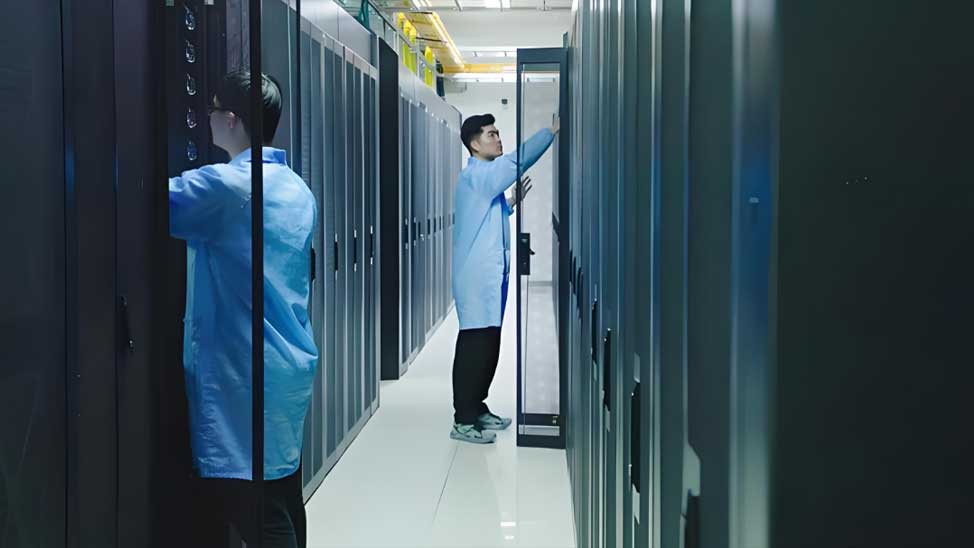
High-density cabling environments require careful thermal management planning — every watt saved in cooling is a watt saved on infrastructure costs
Chapter 4: Geography, Water, and the New Site Selection Calculus
It's not just about building — it's about building where. The same analysis that flagged AI's $220 billion spend also highlighted an uncomfortable truth: water is becoming the new land.
AI data centers aren't just power-hungry — they're water-hungry. Cooling towers evaporate millions of gallons monthly. US communities in Virginia, Texas, and Arizona are already pushing back against data center water consumption. The result: hyperscalers are making geography decisions based on water rights, not just power availability.
Infrastructure Priorities for Emerging Hyperscale Corridors
| Factor | Traditional Priority | 2026+ Priority |
|---|---|---|
| Power | Reliability (99.99%+ uptime) | Capacity headroom (500MW+ per campus) |
| Connectivity | Carrier neutrality, Meet-Me-Rooms | On-net cloud exchange, private fiber to campuses |
| Water | Generally ignored | Critical: access rights, wastewater recycling |
| Permitting | 6–12 months | 12–24 months; community engagement required |
| Cabling Infrastructure | Standard structured cabling | AI-grade: liquid-cooling integration, 800G-ready fiber trunks |
This geographic diversification will create new data center corridors — and new opportunities for infrastructure vendors who can move fast in emerging markets.
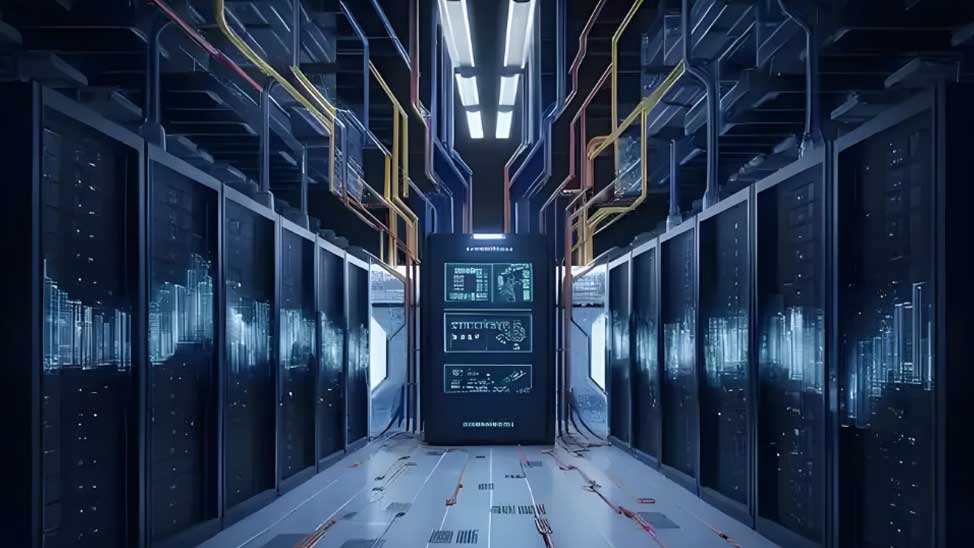
High-speed network centers demand meticulous fiber management: color-coded MPO trunks, clear labeling, and bend-radius protection on every run
Chapter 5: What This Means for Enterprise Buyers and Channel Partners
The hyperscale self-build wave isn't just a story about Amazon and Google. It's reshaping the entire data center ecosystem — and the ripples are reaching enterprise procurement desks now.
For Enterprise IT and Network Teams
If your colocation provider is suddenly investing in purpose-built AI cages and liquid cooling infrastructure, that's a good signal — they're adapting. But if they're not, your AI workloads may face long wait times or cost premiums. Our Cat8 direct-connect guide covers the copper cabling requirements for enterprise 40G/100G AI inference clusters connecting back to hyperscale clouds.
For Cabling Contractors and Integrators
The skill gap is widening. Installing structured cabling in a hyperscale-grade AI facility requires:
- Familiarity with MPO/MTP pre-terminated fiber and polarity management
- Understanding of DAC vs. AOC trade-offs for different intra-rack topologies
- Knowledge of liquid cooling environments — moisture ingress, cable jacket ratings (LSZH vs. plenum), and cold-aisle vs. hot-aisle routing
- Certification to TIA-942 and familiarity with Uptime Institute Tier requirements
Chapter 6: The Cabling Vendor Perspective — How AMPCOM Fits In
As hyperscalers build their own infrastructure, they still need high-quality components — and they need them at volumes and specifications that standard enterprise procurement can't deliver. AMPCOM's position in this landscape is strategic:
- AI-grade fiber connectivity — Our MPO trunk assemblies, LC/SC adapters, and fiber patch panels are rated for 800G+ data center environments
- High-power PoE copper cables — Cat8 and Cat7A cables rated for 100W+ PoE with proper thermal performance in bundle configurations
- DAC and AOC solutions — Direct attach copper and active optical cables for GPU-to-switch short-reach applications
- Custom fiber solutions — AMPCOM's custom fiber program supports non-standard MPO counts, hybrid copper/fiber trunks, and application-specific fiber routing for hyperscale and colocation deployments
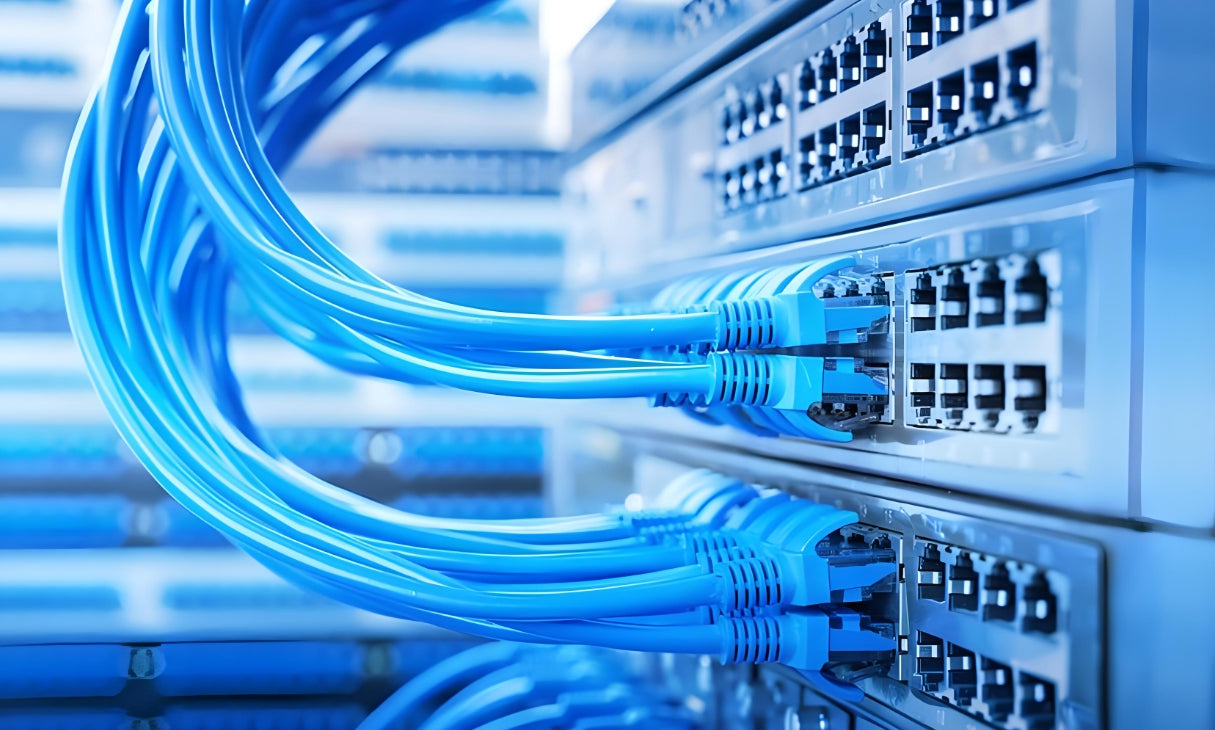
Structured cabling for AI-grade infrastructure requires specialized components and installation expertise — from MPO fiber management to thermal-aware cable routing
Chapter 7: Key Takeaways and FAQ
🔑 Key Takeaways
- $220 billion in AI CapEx is a construction mandate, not just a technology spend — hyperscalers are building purpose-built campuses because off-the-shelf colocation can't handle 120kW+ GPU racks
- The "buy vs. build" pivot is driven by power density, cooling complexity, and latency requirements that general-purpose data centers were never designed for
- Rack density jumping from 9kW to 11kW is rewriting cabling thermal math — Cat6A bundle limits, MPO fiber counts, and DAC vs. transceiver choices all need re-evaluating for AI workloads
- Water is the new land — geography decisions are now driven by water rights as much as power availability, creating new data center corridors
- Structured cabling for AI is a specialized discipline — MPO fiber management, liquid-cooling integration, and 800G-ready infrastructure require contractors with AI-specific training
Frequently Asked Questions
Q: Is the hyperscale self-build trend going to eliminate colocation providers?
No — in fact, Uptime Institute's 2026 survey shows managed/colocation services at 46%, now slightly ahead of enterprise-owned facilities at 44%. Hyperscalers are building for their own AI workloads; enterprises and mid-market companies will continue relying on colocation and cloud for flexibility and capital efficiency.
Q: What cabling infrastructure is needed for 120kW+ GPU racks?
At 120kW per rack, traditional copper cabling hits thermal limits quickly. Best practices include: using Cat8 or Cat7A with proper gauge (23AWG minimum for PoE), limiting bundle sizes based on thermal modeling, considering DAC/AOC for short-reach intra-rack connections, and integrating cooling-pipe-safe cable routing in liquid-cooled deployments.
Q: How does the hyperscale spending wave affect my enterprise network upgrade decision?
Two practical implications: (1) Your cloud connectivity backbone should be rated for 100G+ going forward, as hyperscale AI services will increasingly require high-bandwidth, low-latency connections. Cat8 copper for direct connects and OM4/OM5 multimode or OS2 singlemode fiber for longer runs are the baseline. (2) Plan cable infrastructure with 800G headroom — the transition cycle is accelerating.
Q: Why is water becoming a bottleneck for data center expansion?
Modern data centers use evaporative cooling (cooling towers) that consume millions of gallons per month. As AI campuses scale to 300–500MW — the size of a small city — water consumption becomes a community and regulatory issue. Hyperscalers are now evaluating water rights, wastewater recycling, and air-side economizer potential as part of site selection, alongside the traditional metrics of power availability and fiber connectivity.
AMPCOM Technical Team
Industry experts with 17+ years in structured cabling, data center infrastructure, and fiber optic network design
Need Cabling Solutions for AI-Grade Infrastructure?
AMPCOM provides hyperscale-ready fiber and copper connectivity — from MPO trunk assemblies to Cat8 PoE++ patch cords — engineered for 800G+ data center environments.
Browse AI-Grade Cabling Solutions![AMPCOM Blog-Fiber Optic Cable Market Size, Share, and Forecast [2026–2035]](http://www.ampcom.com/cdn/shop/articles/AMPCOM_fiber_patch_cable_16_70131270-8c09-4395-a295-c8fce9efa87b.jpg?v=1792059310&width=533)

