
Ask AMPCOM: DAC vs AOC vs Fiber — How to Choose the Right Link for AI Clusters
Published:Executive Summary: "Should this link be DAC, AOC, or fiber with transceivers?" is the single question AI cluster builders ask us most in 2026. The good news is that the answer is not a matter of taste — it is decided by distance, speed, latency, power, and airflow. In this FAQ, AMPCOM engineers explain what each of the three link types actually is, where each one wins, and how to read a GPU cluster in tiers: copper DAC inside the rack, AOC or active copper for row-level runs, and singlemode fiber with pluggable optics for everything beyond. We also cover how 800G and the coming 1.6T generation are shrinking passive DAC reach — and why planning for 800G and 1.6T cabling trends starts with the shortest link in the rack.
Quick Navigation
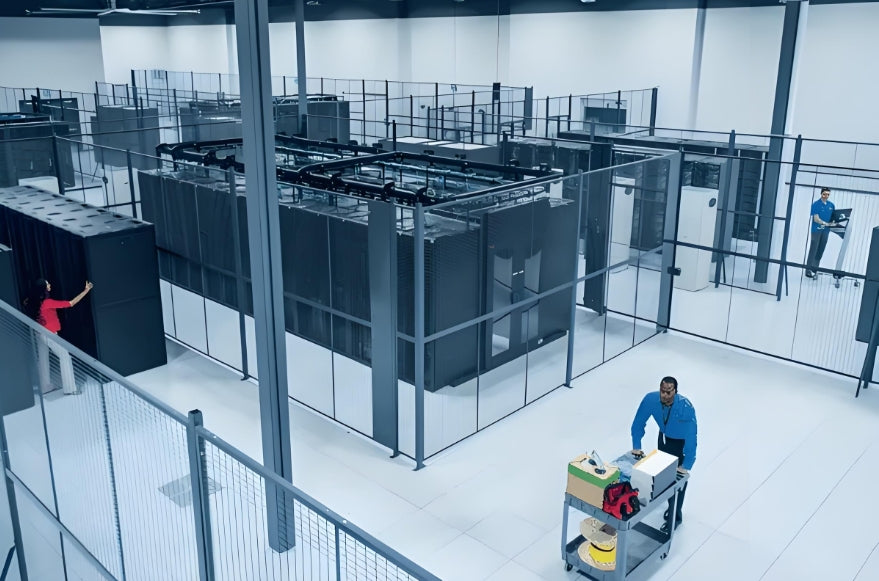
Choosing between DAC, AOC, and fiber is a distance-and-speed decision — and in AI clusters it is made tier by tier, not once for the whole facility
Question 1: What Is a DAC Cable — and When Does It Win?
A DAC (Direct Attach Copper) cable is a factory-assembled copper twinax cable with a fixed transceiver shell molded onto each end. It plugs directly into a switch or NIC port — there is no separate module and no field fiber to terminate. Because there is no electro-optical conversion, a passive DAC is the cheapest, lowest-power, and lowest-latency option available for a given port speed. Our dedicated guide, What Are DAC Cables? Types, Latency and When They Beat AOC and Transceivers, goes deeper, but the headline is simple: passive DAC is the default for the shortest links in the rack.
Passive vs active copper
- Passive DAC (P-DAC): no signal conditioning, near-zero power (~0.1 W), ~0.1–0.5 ns/m propagation delay. Reach falls sharply as speed rises — roughly 7 m at 10G, 5 m at 25G, 3 m at 100G, 2–3 m at 200G, and only ~1 m at 400G/800G.
- Active copper (ACC) / active electrical cable (AEC): adds a retimer/equalizer chip, extending copper reach to ~5 m at 100G and beyond — a useful bridge at 800G where passive DAC runs out of span.
| Speed | Passive DAC reach | Typical AI use |
|---|---|---|
| 25G / 40G | ~5 m | Management, OOB, low-speed ToR uplinks |
| 100G | ~3 m | Intra-rack switch-to-switch, storage ToR |
| 200G | ~2–3 m | Server-to-ToR inside a single rack |
| 400G / 800G | ~1–2 m (ACC/AEC extends it) | GPU-to-leaf within one rack only |
When DAC wins
Choose DAC when the link is short, fixed, and inside the rack — ToR-to-server, within-rack leaf-spine, or storage paths under a few meters. You get the lowest cost, lowest latency, and lowest power, with no optics to clean and no fiber to terminate. The moment the run leaves the rack, DAC's reach advantage evaporates.
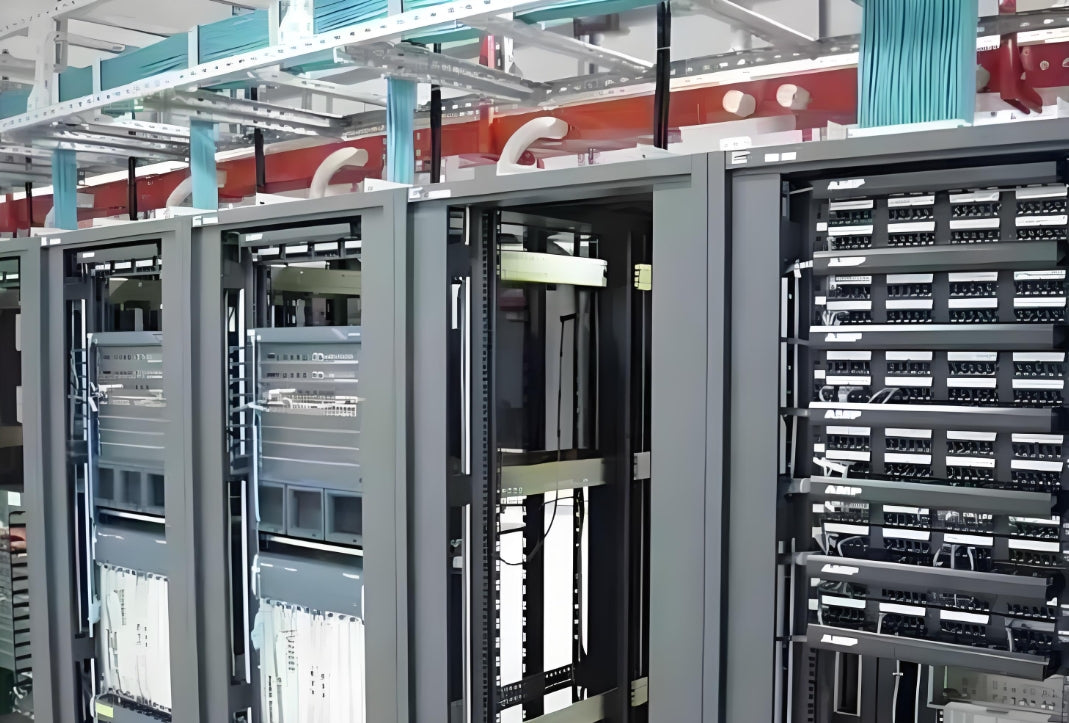
Passive DAC is the copper workhorse of the AI rack — cheapest, coolest, and fastest, but only for the shortest in-rack runs
❓ Why does DAC reach shrink so much at higher speeds?
Copper attenuates high-frequency signals, and PAM4 signalling at 100G-per-lane uses far more bandwidth than 10G NRZ did. The higher the lane rate, the faster the signal degrades over copper, so passive DAC span falls from ~7 m at 10G to roughly a meter at 800G. That is exactly why active copper (AEC) and optics take over at 800G.
❓ Is DAC latency really lower than fiber?
Yes, marginally. A passive DAC has no electro-optical conversion and no retiming, so its latency is essentially the signal propagation of a few metres of copper — a fraction of a nanosecond. Fiber adds E-O-E conversion on both ends plus retiming in the module, typically hundreds of nanoseconds. For latency-sensitive AI fabrics, DAC wins on the shortest links — though at rack-to-rack distances, the fiber route itself is often shorter than a copper path, which can offset the module penalty.
Question 2: What Is an AOC — The Middle Ground?
An AOC (Active Optical Cable) is a factory-terminated assembly with optical transceivers fixed at each end and a fiber strand run between them — you cannot separate the optic from the cable. It behaves like a "plug-and-play fiber DAC": it costs and consumes more than passive copper, but it delivers much longer reach and the electrical immunity of fiber, without the complexity of loose optics and patch cords.
Where AOC sits on the spectrum
- Reach: commonly up to 100 m on multimode, far beyond any passive DAC — ideal for row-level and across-the-hall runs.
- Latency: higher than DAC (E-O-E conversion) but still low and predictable — a few hundred nanoseconds.
- Power: a few watts per end, higher than copper but often lower than a full retimed pluggable module.
- Physical advantages: much lighter and thinner than a heavy copper bundle, and immune to EMI — a real benefit for airflow and cable management at high density.
| Attribute | Passive DAC | AOC |
|---|---|---|
| Reach | 1–5 m (speed-dependent) | Up to 100 m |
| Power per end | ~0.1 W | A few watts |
| Latency | Lowest | Low (E-O-E conversion) |
| EMI immunity | Susceptible | Immune (fiber) |
| Cable weight / bend | Heavy, stiff | Light, flexible |
| Field flexibility | Fixed length, fixed optics | Fixed length, fixed optics |
When AOC wins
Choose AOC when a link must go just a few metres further than DAC allows — row-to-row, ToR-to-AoR, or across a hot/cold aisle where copper cannot reach and where you do not yet need the flexibility of separate pluggable optics. It is the pragmatic middle tier: more reach than copper, less complexity than loose fiber and modules.

AOC bridges the gap between in-rack copper and long-reach fiber — up to 100 m with the weight and EMI benefits of optics
❓ Can I repair or re-terminate an AOC if it gets damaged?
No. The optics are permanently bonded to the fiber inside the assembly, so an AOC is a single sealed unit. If it is cut or a module fails, you replace the whole cable. That is the trade-off for plug-and-play simplicity — keep spares, and choose AOC where the length is fixed and known.
❓ Is AOC or 25G/100G DAC better for a dense 48-port ToR?
For GPU-to-ToR links under ~2 m at 400G/800G, passive DAC (or AEC) is still the cooler, cheaper, lower-latency choice. For 100G links up to ~3 m, DAC remains fine. Once the run exceeds DAC's reach — or when cable weight and airflow in a hot aisle become the limiting factor — AOC is the better engineering answer.
Question 3: Transceivers + Fiber — When You Must Go Optical
The third option separates the two functions that DAC and AOC bundle together: a pluggable transceiver (QSFP28/QSFP-DD/OSFP) plus a separate fiber run — typically MPO/MTP for parallel multimode or singlemode, or duplex LC. This is the most flexible, most serviceable, and longest-reaching option — and it is the only one that gives you structured cabling, field-replaceable optics, and a clean path to the next speed generation.
What makes fiber the right answer
- Reach: 100 m–500 m on multimode, up to 10 km+ on singlemode — the only option for inter-row, inter-hall, and campus links.
- Flexibility: optics are field-swappable and breakouts are trivial — one MPO-16 or MPO-24 trunk can fan out to multiple 400G/800G links.
- Upgrade path: the same fiber carries 800G today and 1.6T tomorrow — only the module changes, so you avoid a recable.
- Structured cabling: enables patching, cross-connects, and documentation that keep a growing AI hall manageable.
Parallel-optics trunking is where fiber's density advantage is decided. For 400G/800G/1.6T links, the trunk is almost always an MPO fiber solution — choosing 8, 12, or 24 fibers for high-density cabling — and the fiber type is chosen by reach. Our guide to choosing the right fiber type: singlemode vs multimode explains when OS2 / G.657.A2 becomes the default for AI backbones.
| Fiber choice | Typical reach | Best for |
|---|---|---|
| OM4 / OM5 multimode (MPO) | ≤100 m (OM5 to 150 m at 800G) | Intra-row, cost-optimized short SR8 runs |
| OS2 / G.657.A2 singlemode (MPO) | ≤500 m DR8, up to 10 km+ with LR/ER optics | Inter-row, inter-hall, and 1.6T-ready backbone |
When fiber + transceivers win
Choose pluggable optics and fiber whenever a link must leave the row, whenever you need breakout flexibility, or whenever you want a plant that upgrades by swapping modules instead of re-cabling. It is the highest-cost, highest-power option per link — but across a whole AI fabrication it is usually the cheapest path to the next generation, which is the trade that matters.

Pluggable optics plus fiber test out cleanly and stay serviceable — the only option that scales to inter-row and campus distances in an AI cluster
❓ Are separate optics really worse than DAC/AOC if they cost more?
Only on the shortest links. On long runs — where DAC and AOC cannot go — separate optics are not "worse," they are the only option. And their modularity has real value: swap a failed module in seconds, change a speed or breakout without touching the cable, and standardize one fiber plant across many link types. The premium buys flexibility and future-proofing, not just reach.
❓ What about CPO and LPO — do they change this answer?
They change the power and cost of the optical option, not its role in the decision. Linear Pluggable Optics (LPO) remove the DSP to cut power and latency, and Co-Packaged Optics (CPO) move the optics onto the switch package for even lower power at very high port counts. Both make fiber-with-optics more attractive at 800G/1.6T — but they do not extend copper, so DAC stays a short-reach tool.
Question 4: DAC vs AOC vs Fiber — The Decision Matrix
Put the three side by side and the decision almost makes itself. This is the table our engineers use when a customer asks "what should this link be?"
| Dimension | Passive DAC | AOC | Transceiver + Fiber |
|---|---|---|---|
| Cost per link | Lowest | Medium | Highest |
| Reach | 1–5 m | Up to ~100 m | 100 m – 10 km+ |
| Latency | Lowest | Low | Low (module-dependent) |
| Power per end | ~0.1 W | A few watts | Highest (unless LPO/CPO) |
| EMI immunity | Poor | Good | Good |
| Flexibility / breakout | None | None | High |
| Field serviceability | Replace whole cable | Replace whole cable | Swap module only |
| Upgrade path (800G→1.6T) | New cable | New cable | New optics, same fiber |
| Verdict | In-rack default | Row-level bridge | Backbone standard |
Case study: tiering a 512-GPU training cluster
An enterprise AI lab building a 512-GPU cluster used all three link types — deliberately — in one fabric:
- Inside each rack: passive DAC (25G/100G) for management, BMC/OOB, and short leaf-to-node paths under 2 m — lowest cost and power, no optics to clean.
- Rack to rack, same row: AOC (100G/400G) for the 5–30 m runs where DAC could not reach and where heavy copper bundles would have choked the hot aisle.
- Row to spine and inter-hall: OS2 singlemode with 800G pluggable optics on MPO trunks, providing breakout flexibility and a 1.6T-ready path.
The lab reported that right-sizing each tier — rather than defaulting everything to optics — cut its short-reach link cost by roughly a third and lowered rack heat load, while keeping a clean optical backbone for growth. This tiered approach is the practical answer to the "DAC, AOC, or fiber?" question for AI clusters, and it mirrors how AI infrastructure is reshaping data center cabling requirements.

A well-designed AI fabric mixes all three link types by tier — copper in the rack, AOC across the row, singlemode fiber to the spine
❓ Can I mix DAC, AOC, and fiber in the same AI cluster?
You should. A tiered design is best practice, not a compromise. The only rule is to standardize within a tier and document the mapping — so that a given rack position uses one link type, polarity, and speed. Mixing types between tiers is normal; mixing incompatible polarity or connector conventions within a tier is what creates dark links.
❓ Where does "active electrical cable (AEC)" fit?
AEC is an active copper cable that sits between passive DAC and AOC: it reaches a few metres further than passive DAC at 400G/800G while staying copper-cheap and copper-cool. It is increasingly the tool that lets teams keep 800G in-rack links on copper instead of jumping straight to AOC — worth evaluating wherever passive DAC span is "just short."
Question 5: Choosing for AI/GPU Clusters — Tiers, Traps, and the 800G/1.6T Future
AI clusters are not one network — they are several networks stacked. Matching the link type to the tier is what separates a clean, upgrade-ready hall from a tangle of cables that nobody can service. Here is the tiered rule our engineers use.
The three-tier rule for AI clusters
- Tier 1 — inside the rack (≤2–3 m): passive DAC or AEC for GPU-to-leaf and management. Lowest cost, power, and latency.
- Tier 2 — within the row (3–30 m): AOC or AEC where DAC cannot reach; fiber + optics where breakout flexibility is needed.
- Tier 3 — row-to-spine and beyond (>30 m): OS2 singlemode with pluggable optics on MPO trunks. This is your backbone and your 1.6T upgrade path.
How 800G and 1.6T change the math
Two shifts matter. First, passive DAC reach keeps shrinking — by 800G it is roughly a metre, and at 1.6T it is even shorter, so AEC, AOC, and optics take over links that copper used to cover. Second, bandwidth density explodes: an NVL72-class rack can demand hundreds of fibers, versus the two dozen or so of a traditional rack. That pushes the backbone toward high-fiber-count MPO trunking and makes the "one fiber plant, many module generations" approach essential for any team tracking where the copper-to-fiber crossover now sits.
The five traps that cost AI teams the most
- ❌ Forcing DAC past its reach. A 5 m DAC at 400G simply will not link; use AEC/AOC instead of "trying a longer copper."
- ❌ Defaulting everything to optics. Over-speccing short in-rack links adds cost, power, and heat for no benefit.
- ❌ Ignoring polarity and connector convention. MPO Type B should be the documented default for new parallel-optics installs — mismatches cause dark fibers.
- ❌ No spare capacity. Leave spare dark fiber and spare trunk ports; AI racks grow faster than anyone plans.
- ❌ Buying fixed-length AOC for a moving target. If the layout may shift, prefer pluggable optics and fiber so the cable outlives the rack.

In a dense AI cluster, copper covers the rack, AOC covers the row, and singlemode fiber carries the backbone — with spare capacity built in from day one
❓ For a brand-new AI build, what should the backbone be?
OS2 / G.657.A2 singlemode on MPO-16/MPO-24 trunking, with pluggable 800G optics today. That single fiber type carries both 800G and 1.6T with no reach penalty, so the next generation becomes a transceiver swap rather than a recable. Use copper and AOC only for the in-rack and row-level tiers.
❓ Does liquid cooling affect which link type I choose?
Not the link type, but the routing. Direct liquid cooling adds CDU manifolds and wet zones, so keep copper bundles away from coolant paths and plan fiber routing to clear the CDU zone. In hot aisles, AOC and fiber's lower weight and flexibility are a genuine advantage over stiff copper bundles.
Key Takeaways
| Question | Bottom Line | AMPCOM Recommendation |
|---|---|---|
| DAC — when? | Shortest in-rack links; cheapest, coolest, lowest latency | Passive DAC/AEC for ≤2–3 m |
| AOC — when? | Row-level runs beyond DAC reach; light and EMI-immune | AOC for 3–30 m row links |
| Fiber + optics — when? | Inter-row, inter-hall, breakout, and upgrade path | Singlemode MPO backbone |
| Decision driver | Distance decides first, then speed, power, and serviceability | Tier by distance, not by habit |
| 800G/1.6T outlook | Copper reach shrinks; optics and MPO move deeper into the rack | Build an optics-only upgrade path now |
📌 AMPCOM's 5-Step Link Selection Quick Start
- Map every link by distance tier — in-rack, in-row, backbone — before picking any cable.
- Use passive DAC or AEC for the shortest in-rack runs at ≤2–3 m.
- Use AOC for row-level links of 3–30 m where copper cannot reach.
- Standardize the backbone on OS2 singlemode MPO with 800G optics, planned for 1.6T.
- Document polarity, length, and speed per link — and leave spare dark fiber in every trunk.
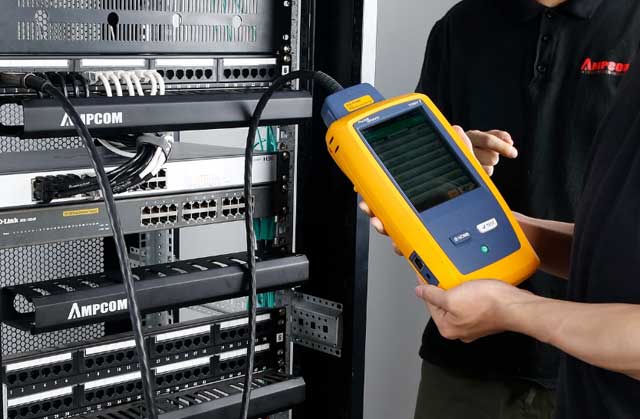
Whatever the link type, certify it before first power-on — copper with a DSX-class tester, fiber with an OTDR and endface inspection

AMPCOM Technical Team
Industry experts with 17+ years in structured cabling, data center infrastructure, and fiber optic network design
Still not sure whether your link should be DAC, AOC, or fiber?
AMPCOM supplies DAC/AEC/AOC assemblies, OS2/OM4 MPO trunking, and pluggable optics for AI infrastructure builds — all with factory test reports. Send us your rack diagram and our engineers will return a tiered link plan.
Talk to Our Infrastructure Experts

