
Why Pre-Terminated Solutions Are Taking Over — Ask AMPCOM
Published:Executive Summary: Every week, our technical team answers dozens of questions from engineers, IT managers, and procurement teams about fiber cabling solutions. One topic comes up more than any other: pre-terminated vs. traditional field-terminated fiber. In this Ask AMPCOM special, we've compiled the eight most frequently asked questions with detailed, practical answers to help you make the right choice for your project.
Quick Navigation
- Q1 What exactly is a pre-terminated solution?
- Q2 What's the core difference between pre-terminated and fusion splice?
- Q3 Is the insertion loss too high? Will it affect my network?
- Q4 Is pre-terminated more expensive?
- Q5 Can I use LC connectors with pre-terminated? What about MPO?
- Q6 Can I upgrade to higher speeds with a pre-terminated system?
- Q7 What are the disadvantages of pre-terminated solutions?
- Q8 What does AMPCOM offer?
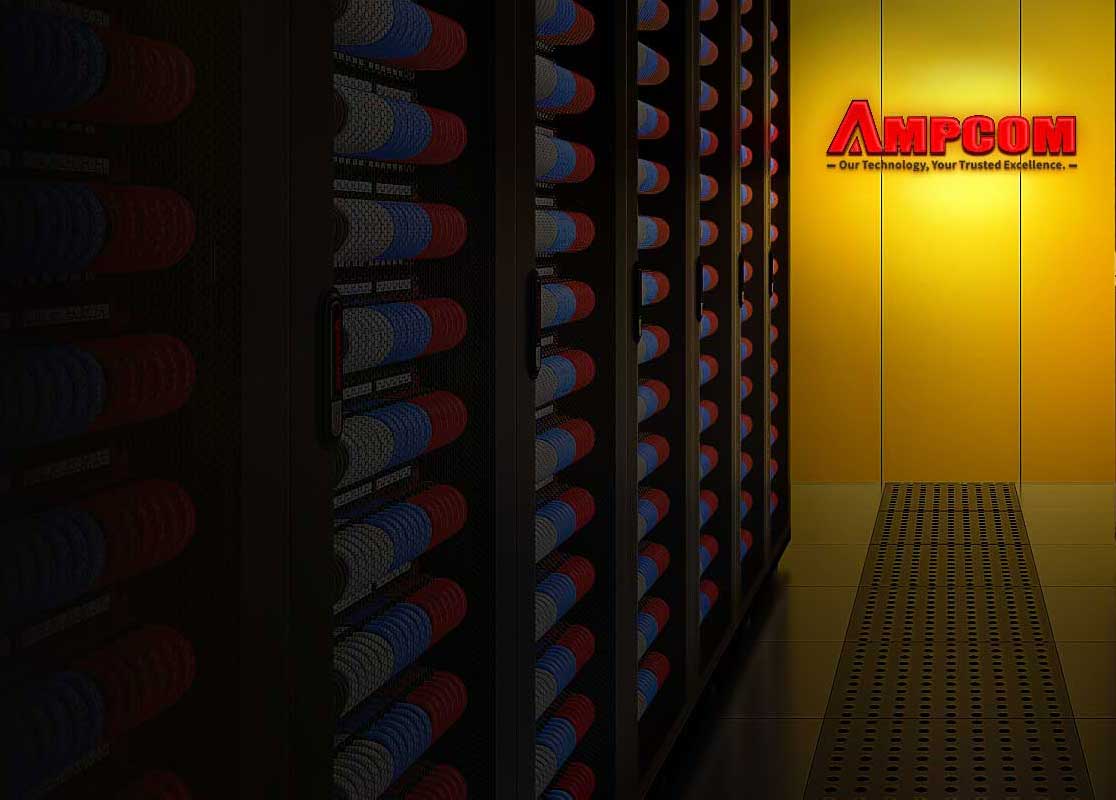
Factory-terminated fiber cables are revolutionizing data center deployment — faster, more reliable, and more flexible than ever before
Q1: What Exactly Is a Pre-Terminated Solution?
A: Pre-terminated fiber cables are manufactured in a controlled factory environment where the fiber endfaces are polished, inspected under a microscope, and 100% tested with an OTDR before shipping. On-site, you simply connect them — "plug-and-play" with no fusion splicer, no field polishing, and no consumables required.
Common pre-terminated product types include:
- MPO/MTP trunk cables: High-density backbone cables carrying 12 or 24 fiber cores in a single assembly
- LC Uniboot jumpers: Duplex LC connectors in a compact, round-cable form factor
- Factory-terminated module boxes: 1U or 4U enclosures pre-loaded with MPO-to-LC fan-out assemblies
- Pre-terminated cassette systems: Sealed fiber management units that snap into rack mounting
The opposite of pre-terminated is field termination, where every connector is installed on-site by a technician using a fusion splicer or mechanical splice.
Q2: What's the Core Difference Between Pre-Terminated and Traditional Fusion Splicing?
A: Yes, both deliver fiber connectivity — but the difference in how they get there is significant:
| Aspect | Pre-Terminated | Fusion Splicing |
|---|---|---|
| Where connections are made | Factory (controlled environment) | On-site (variable conditions) |
| Equipment needed | None (basic tools only) | Fusion splicer, OTDR, power meter, cleaver |
| Deployment time per link | 5–10 minutes | 30–60 minutes |
| Rework complexity | Low — swap module | High — re-splice required |
| Insertion loss | 0.35–0.50 dB (typical) | 0.20–0.30 dB (typical) |
| Quality consistency | 100% factory tested | Depends on operator skill |
| Best for | Data centers, fast deployment | Long-haul OSP, ultra-low loss |
Q3: Is the Insertion Loss Too High? Will It Affect My Network?
A: This is the most common misconception we encounter. Let us put it in perspective with real numbers:
| Link Speed | IEEE Loss Budget Limit | Pre-Terminated Typical IL | Fusion Splicing Typical IL | Pre-Terminated Margin |
|---|---|---|---|---|
| 40G SR4 | 1.9 dB | 0.35 dB | 0.20 dB | 81.6% |
| 100G SR4 | 1.9 dB | 0.35 dB | 0.25 dB | 81.6% |
| 400G SR4 | 2.3 dB | 0.50 dB | 0.30 dB | 78.3% |
Both methods are far below IEEE standard limits. The difference between 0.35 dB and 0.20 dB is negligible in a data center environment. Your network will perform identically regardless of which method you choose.
The Bottom Line
Within data center distances (typically under 100 meters), pre-terminated insertion loss is not a performance concern. The IEEE standards are written with substantial margins specifically to accommodate a variety of deployment methods.
Q4: Is Pre-Terminated More Expensive?
A: Pre-terminated cables have higher material costs (15–25% more per meter), but when you factor in the full project cost, the picture changes dramatically:
| Cost Factor | Pre-Terminated | Fusion Splicing |
|---|---|---|
| Material cost | Medium-high | Medium |
| Labor cost | Low (5–10× faster) | High (slow, skilled) |
| Equipment investment | USD 0 | USD 5,000–30,000 |
| Rework risk | Low | Medium–High |
| 3-Year TCO (100+ links) | Lower overall | Similar or higher |
Real-World Breakeven
For projects with more than 50 fiber links, pre-terminated solutions deliver lower total cost of ownership over three years — primarily through labor savings and near-zero rework costs. Add in faster time-to-revenue from earlier system availability, and the case becomes even stronger.

A proper TCO analysis reveals pre-terminated solutions often cost less than traditional field termination over a 3-year project lifecycle
Q5: Can I Use LC Connectors with Pre-Terminated? What About MPO?
A: Absolutely — pre-terminated solutions come in multiple connector formats:
| Connector Type | Use Case | Typical Application |
|---|---|---|
| MPO/MTP-12 | High-density backbone, 12-fiber trunk | MDA/HDA to EDA trunk runs |
| MPO/MTP-24 | Ultra-high density, parallel optics | 400G SR4 / 800G links |
| LC Uniboot | Duplex, compact form factor | Server rack to leaf switch |
| SC-APC | Wide-key APC for FTTH/PON | Certain service provider equipment |
Our recommendation:
- Backbone (MDA/HDA): MPO/MTP trunk cables — maximum density, fastest deployment
- Access layer (EDA): LC Uniboot or SC — connects to server/storage network ports
- Device-specific: Verify your switch and server SFP+ or QSFP module interface type before ordering
Q6: Can I Upgrade to Higher Speeds with a Pre-Terminated System?
A: This is one of the biggest advantages of pre-terminated modular systems. Here's the upgrade path:
Typical Pre-Terminated Upgrade Path
40G → 100G: No cable change needed. Replace 40G SR4 QSFP+ modules with 100G SR4 QSFP28 modules. The existing OM4 MPO trunk is fully compatible with 100G SR4 optics.
100G → 400G: Replace QSFP28 modules with 400G QSFP-DD or OSFP modules. MPO-12 trunk cables (rated for 40G/100G) can typically be reused for 400G SR4 with MPO-12 at the transceiver — check your optics specification.
For 400G SR8 or 800G with MPO-16/MPO-24: Upgrade trunk cables to MPO-24 assemblies. The module boxes at each end would be swapped accordingly.
In contrast, traditional fusion splice installations often require complete re-splicing during every speed upgrade — with significant labor cost and downtime risk.
Q7: What Are the Disadvantages of Pre-Terminated Solutions?
A: Being honest: yes, there are a few considerations:
- Precision planning required: Pre-terminated cables are manufactured to specific lengths. You cannot cut or modify them on-site. Accurate route measurement and routing planning are essential before ordering.
- Lead time: Factory custom orders typically require 5–15 business days, however, a fiber optic manufacturer with professional R&D and production teams (AMPCOM) can arrange the dispatch of custom products within 1‑3 days. We recommend ordering 2–3 weeks ahead of project start. Keeping standard-length spare cables in inventory helps address urgent needs.
- Inventory management: You need to stock a range of standard jumper lengths. The upside: you can order identical spares at any time.
- Compatibility verification: Confirm that the MPO/LC connector type matches your optics. MPO-12 vs. MPO-24, PC vs. APC, and key orientation all matter.
Honest Assessment
These "disadvantages" are really planning requirements. If you invest proper time in pre-project measurement and routing design, every one of these concerns is fully mitigated. This is exactly what our technical team helps customers with — free technical guidance and solution design before you place an order.
Q8: What Does AMPCOM Offer in Pre-Terminated Solutions?
A: AMPCOM provides a complete end-to-end pre-terminated ecosystem:
AMPCOM Pre-Terminated Product Line
- MPO/MTP-12 and MPO/MTP-24 trunk cables (1m to 300m, OM3/OM4/OM5 and single-mode OS2)
- LC Uniboot pre-terminated jumpers (0.5m to 30m, multimode and single-mode)
- Factory-terminated 1U/4U module boxes (MPO-to-LC fan-out, up to 96 ports)
- MPO/MTP cassette systems (snap-in, tool-free installation)
- Hybrid copper + fiber trunks (for PoE + data in single raceway)
Related Articles
- Data Center Cabling: Copper or Fiber? — A practical comparison of copper and fiber for modern data center connectivity
- Singlemode vs Multimode: How to Choose — A practical guide to choosing the right fiber type for your specific network requirements
- What Is Structured Cabling? — The foundation that makes pre-terminated and future upgrades possible

AMPCOM Technical Team
Industry experts with 15+ years in enterprise network infrastructure — answering your toughest cabling questions every day
Have a Cabling Question?
Our technical team is ready to help with fiber selection, solution design, and free site surveys.
Ask AMPCOM Now

