
Ask AMPCOM: Construction Costs Are Up 21% — How Do We Control Cabling Costs Without Risking the Build?
Published:Executive Summary: The question AMPCOM hears most often this quarter is a budget one: "North American data center construction cost per MW is up roughly 21%, transformers are on 36-month lead times, fiber is in a supply crunch, and liquid-cooling-ready space carries a 22–28% premium. With the whole build inflating, where do we cut cabling cost — and where do we absolutely not?" This FAQ answers it with 2026 data. The short version: cabling is only ~3–8% of a build, so you cannot "save your way out" of a 21% inflation by gutting it — but poor cabling decisions quietly turn that 5% into 15% through rework, schedule slips, and forklift upgrades. The playbook is to shift on-site labor to the factory (pre-terminated), standardize the connector plant (MPO-16 + spare dark fiber), buy ahead through long lead times, and design liquid-cooling-ready now. Read this before you sign the next cable schedule.
Quick Navigation
- 1 The 21% Is Real — But Where Does Cabling Actually Sit in That Number?
- 2 Should We Just Buy Cheaper Cable to Save Money?
- 3 Does Pre-Terminated Cabling Actually Cut Cost and Schedule Risk?
- 4 Lead Times Are 36 Months and Fiber Is Scarce — How Do We Procure?
- 5 800G and 1.6T Are Coming — How Do We Avoid an Expensive Recable?
- 6 Liquid-Cooling-Ready Space Costs 22–28% More — What Does Cabling Do?
- ★ Key Takeaways

Cabling is a small slice of a 21%-inflated build — but the wrong cabling decision is what quietly turns that small slice into a major rework bill
Question 1: The 21% Is Real — But Where Does Cabling Actually Sit in That Number?
First, the framing matters. A ~21% rise in cost per MW in North America is driven mostly by the things that genuinely got expensive: power infrastructure (transformers, switchgear, UPS), liquid-cooling plant, and civil/structural work — not by the copper and fiber in the racks. So the first move in any cost conversation is to put cabling in its proper, modest place.
A realistic build-cost split
| Cost category | Typical share of a new build | 2026 pressure |
|---|---|---|
| Power & electrical (transformers, switchgear, UPS, distribution) | ~35–45% | High — transformer lead times 18–24 mo → 36 mo |
| Cooling & HVAC (incl. liquid-cooling prep) | ~20–30% | High — liquid-cooled-ready premium 22–28% |
| Civil / structure / shell | ~15–20% | Moderate — labor & materials |
| Structured cabling & connectivity | ~3–8% | Mixed — fiber up, copper stable |
| Design, commissioning, on-site labor | remainder | High — the part that inflates with schedule |
The strategic point: you cannot offset a 21% build inflation by trimming a 5% line. Even a heroic 30% cut to cabling saves only ~1.5% of the total project — and usually buys a rework bill that erases it. The real cost lever is not the cable unit price; it is the on-site labor, schedule risk, and upgrade trap that poorly planned cabling creates. Control those, and your cabling budget stays stable even as the rest of the build inflates. For a full picture of what gets overlooked, see our breakdown of the hidden costs of network upgrades most businesses miss.

The biggest cabling cost is rarely the cable — it is the on-site labor, rework, and schedule slip that bad planning creates
❓ So if cabling is only 5%, why are we even talking about it?
Because it is the most controllable slice and the one with the worst downside when mishandled. Power and cooling costs are set by global supply and physics; you have little say over a transformer's 36-month lead time. Cabling, by contrast, is a design-and-procurement decision you own end to end. Get it right and it stays at ~5% and upgrades cheaply; get it wrong and it becomes the line item that needs a full recable two years later — at the worst possible time, when budgets are already strained.
Question 2: Should We Just Buy Cheaper Cable to Save Money?
Short answer: no — "cheaper cable" is the most expensive cost-cutting move available. When teams panic at a 21% build overrun, the instinct is to down-spec the cable. That almost always backfires, because the cable is the cheapest part of the cabling system and the one you are stuck with for a decade.
Why the cheap-cable trap fails
| Cost-cutting reflex | What it actually costs you | Better move |
|---|---|---|
| Down-spec to non-certified cable | Fails Fluke/permanent-link testing → re-pull + re-labor | Certified cable with test reports from day one |
| Buy the lowest-gauge copper | PoE++ heat, voltage drop, bundle thermal failures | Right AWG for the PoE/heat load, no lower |
| Skip spare dark fiber | Re-splice or full recable at next speed jump | 30–50% spare dark fiber in every trunk |
| Field-terminate everything | Labor + schedule slip + inconsistent quality | Pre-terminated, factory-tested assemblies |
The right frame is total cost of ownership (TCO), not unit price. A cable that passes certification on the first try, carries the PoE/heat load without derating, and upgrades by module swap is cheaper than a "discount" cable that needs rework, can't carry the next speed, and forces a recable. The cheapest cable is the one that never has to be touched again. Our guide to cost-effective cable procurement strategies lays out exactly how to buy for lifecycle value rather than sticker price.

Down-specced cable and skipped spare capacity are what turn a clean 5% cabling line into a 15% rework bill
❓ Isn't there some place we can safely trim material cost?
Yes — but on the design, not the spec. You trim by right-sizing: don't over-build 32-fiber trunks to every low-density IDF, don't specify plenum (OFNP) where riser (OFNR) is code-legal, and match copper gauge to the actual PoE and bundle-heat load instead of defaulting to the heaviest option everywhere. Those are engineering choices that save real money without sacrificing the plant. What you never trim is certification quality, polarity correctness, and spare-fiber headroom.
Question 3: Does Pre-Terminated Cabling Actually Cut Cost and Schedule Risk?
Yes — and in a 21%-inflated, schedule-constrained market, this is the single highest-leverage cost control. The cost that inflates fastest with a delayed build is on-site labor and schedule — electricians, installers, and commissioning engineers sitting on a site waiting for transformers or cooling. Pre-terminated (factory-built) MPO trunks and harnesses move that labor from the expensive, delay-prone job site to a controlled factory.
Field termination vs pre-terminated
| Dimension | Field termination | Pre-terminated (factory) |
|---|---|---|
| On-site labor | High — per-connector splicing/termination | Low — plug-and-play pull |
| Install speed | Weeks of skilled labor | Days; parallel to other trades |
| Quality / consistency | Variable (tech-dependent) | Factory-controlled, 100% tested |
| Test & cert overhead | High — every strand on site | Reports shipped with the reel |
| Schedule risk during delays | Idle crew cost accrues | Cabling done early, stored, deployed fast |
Here is the 2026 logic that makes this a cost-control weapon: when your transformer is on a 36-month lead time, the building is finished but idle for months. Pre-terminated cabling lets you complete the entire horizontal and backbone plant early, store it, and deploy in days the moment power lands — instead of paying a crew to wait, then race the clock. The factory test reports also kill the most expensive failure mode: discovering a bad strand during commissioning. AMPCOM builds custom pre-terminated fiber solutions to your exact link schedule, shipped certified and polarity-verified.

Factory-tested, pre-terminated trunks ship with certification reports — eliminating the most expensive failure: a bad strand found at commissioning
❓ Pre-terminated sounds more expensive per meter. How does that save money?
Because the meter price is a small fraction of total cost. Pre-terminated cable typically costs more per meter but drastically less per installed, certified link — you trade a little material premium for a large cut in on-site labor, test overhead, and schedule risk. In a market where idle-crewed months are the real cost driver, that trade pays for itself the first time a delay hits. The savings show up on the project ledger as "installation" and "commissioning," not on the cable PO.
Question 4: Lead Times Are 36 Months and Fiber Is Scarce — How Do We Procure?
This is where budgeting meets reality. Transformer lead times of 18–24 months have stretched to 36, and the optical supply chain is in a super-cycle (G.652.D fiber prices up 400%+ in some regions, global fiber gap reported around 16%). The cost-control move here is not negotiation—it is timing and structure.
Case study: the 20-MW AI build that bought ahead
An AMPCOM customer planning a 20-MW AI data center faced a 30+ month critical-path power delay. Two procurement paths were modeled. Path A (reactive): issue the cabling PO at power-on, accept spot fiber pricing and whatever lead time the market offered — exposed to both the fiber super-cycle and a compressed install window. Path B (structured): lock the OS2/MPO-16 trunk and pre-terminated assembly supply 18 months early under a long-term agreement with dual-source backup, store it, and deploy in days at power-on. Path B's slightly higher early-commit cost was offset by avoiding spot-price fiber premiums, eliminating idle-crewed install weeks, and certifying every strand before the building was even powered. When power finally landed, cabling was the one workstream already finished. The lesson: in an inflationary, supply-constrained market, buying early and structured beats buying cheap and late.
The procurement playbook under long lead times
- Commit early, stage smart: issue the cable/fiber PO as soon as the link schedule is stable — not when the rack lands. Store pre-terminated reels on site.
- Dual-source the long-lead items: transformers you cannot, but fiber, trunks, and panels you can. Never let one supplier's slip become your critical path.
- Buy on TCO, score on a card: use an RFP scorecard that weights certification, lead time, test reports, and support — not just unit price. Our cable procurement strategy playbook (RFP, scorecard, TCO) is built for exactly this.
- Standardize to cut SKU sprawl: fewer connector/cable variants = better volume pricing and faster fulfillment. Standardize on MPO-16 + OS2 + one copper gauge family.
- Qualify the supplier, not just the quote: a supplier who ships certified, polarity-correct, on-time product is cheaper than a discount supplier who doesn't. See our guide to choosing the right network cable supplier.
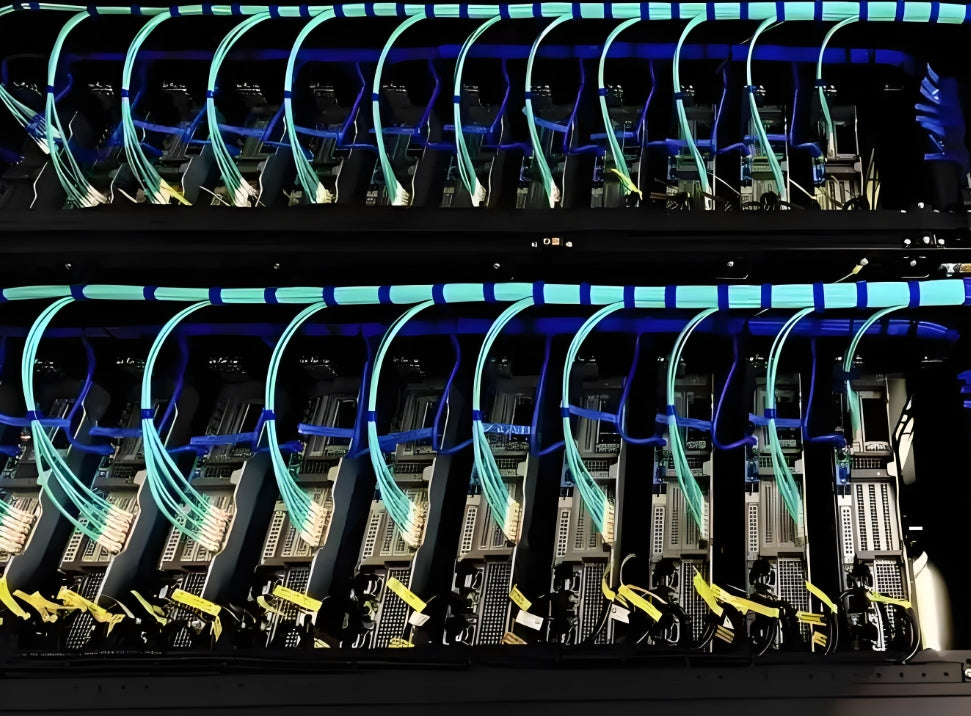
In a fiber super-cycle, early structured commitment and dual-sourcing protect both budget and schedule better than spot negotiation
❓ If fiber is in short supply, should we just substitute copper to avoid the lead time?
Only for the links copper is actually suited to — short, low-speed, PoE-driven runs. For the backbone, spine, inter-hall, and any 400G/800G/1.6T link, singlemode fiber is not optional, and copper can't substitute without blowing past distance, density, and power budgets. The right response to fiber scarcity is to commit early and dual-source, not to abandon the medium. Substitute copper where it is genuinely the right tool; never as a supply-chain workaround for the high-speed plant.
Question 5: 800G and 1.6T Are Coming — How Do We Avoid an Expensive Recable?
This is the cost control that pays off years from now. AI racks are moving from 100G/400G to 800G and 1.6T, and the fiber counts rise with them: 800G = 16 fibers (1× MPO-16), 1.6T = 32 fibers (2× MPO-16) in the mainstream parallel configurations. A plant designed only for today's speeds becomes a recable candidate at the next upgrade — precisely when budgets are tight.
Design the trunk for the generation after next
| Speed tier | Fibers per link | Connector | Cabling implication |
|---|---|---|---|
| 100G / 400G (today) | 8–12 | MPO-12 / MPO-16 | Served by existing plant |
| 800G (imminent) | 16 | 1× MPO-16 | Standardize new trunk on MPO-16 |
| 1.6T (next) | 32 | 2× MPO-16 | High-count trunk + spare absorbs it |
| Future headroom | +30–50% spare | MPO-24 / MPO-32 trunk | Upgrade = module swap, not recable |
The cost-control rule: standardize every new trunk on MPO-16 (with MPO-24/MPO-32 feeding it) and install 30–50% spare dark fiber. That way 800G is a 1× MPO-16 breakout and 1.6T is a 2× MPO-16 breakout — both achieved by swapping modules at the panel, never by pulling new cable through a finished, liquid-cooled, occupied building. A recable in a live AI facility is the single most expensive thing you can do to cabling; designing it out is the highest-ROI budget decision on this list. It also means you buy custom MPO trunking once, correctly, instead of twice.

A standardized MPO-16 trunk with spare dark fiber turns the next speed jump into a module swap — not a recable through a live, liquid-cooled hall
❓ Won't high-count trunks everywhere blow the budget we're trying to protect?
Only if you over-build. The balance is to size each trunk to the rack's realistic peak plus 30–50% spare, and standardize the connector so any trunk can feed 800G or 1.6T. You do not run 32-fiber trunks to every low-density IDF — that is waste. But you do make sure the AI fabric and backbone trunks are future-count-ready, because those are exactly the links that would otherwise force a six-figure recable. Spend the spare-fiber premium where the speed is actually going, and you spend pennies per Watt of avoided rework.
Question 6: Liquid-Cooling-Ready Space Costs 22–28% More — What Does Cabling Do?
The 22–28% premium on liquid-cooling-ready space is a cooling and structural cost, not a cabling cost — but cabling decides whether you pay that premium once or twice. A hall built for air cooling that later needs liquid cooling will be recabled (or at least heavily re-routed) to clear airflow paths and reach top-of-rack manifolds. Cabling designed liquid-cooling-ready from day one avoids that second spend.
Cabling choices that protect the liquid-cooling investment
- Route for airflow, not just reach: overhead tray and top-of-rack egress keep bundles off the cold aisle and out of the future cooling path — no re-route when manifolds arrive.
- Plan for 200 kW+ racks: rack density is heading past 200 kW with full-liquid architectures. Size cable management and bend radius for the dense, heavy bundles that come with it, so you are not replacing trays later.
- Thermal-aware copper: high-density PoE++ and in-rack power cabling generate heat — choose the right AWG and bundle limits now so copper doesn't become a thermal or voltage-drop problem under liquid-cooled density.
- One plant, both cooling modes: because the fiber plant (OS2 + MPO-16 + spare) is cooling-agnostic, a liquid-cooling-ready hall uses the same standardized cabling — you pay the cooling premium once, and the cabling simply carries more bandwidth through it.
The throughline: the cooling premium is unavoidable if you want AI-class density, but cabling is the one element you can make cooling-mode-agnostic. A standardized, overhead-routed, spare-rich fiber plant serves both air- and liquid-cooled halls without rework. That is how you keep the 22–28% to a single charge instead of a recurring one. It also pairs naturally with right-sized cost-effective procurement — buy the plant once, for both cooling futures.

Cabling designed liquid-cooling-ready from day one turns the 22–28% cooling premium into a one-time charge, not a recurring recable
❓ We're not sure we'll go liquid-cooled. Should we still cable for it?
Yes — the incremental cabling cost of being liquid-cooling-ready is near zero, because the fiber plant is identical; what changes is routing discipline (overhead, airflow-clear) and tray sizing. If you later skip liquid cooling, you've lost nothing. If you later adopt it, you avoid a re-route and re-termination project. It is one of the rare cost-control moves that is pure upside: cable once, stay ready, decide later.
Key Takeaways
| Question | Bottom Line | AMPCOM Recommendation |
|---|---|---|
| Where does cabling sit? | ~3–8% of build — can't offset 21% inflation by gutting it | Control labor, schedule & rework — not the cable PO |
| Buy cheaper cable? | Cheapest cable = most expensive rework | Buy on TCO: certified, right-gauge, spare-rich |
| Pre-terminated? | Moves labor to factory, kills schedule risk | Pre-terminated, factory-tested trunks — deploy in days at power-on |
| Long lead times? | 36-mo transformers, fiber scarce | Commit early, dual-source, buy on scorecard/TCO |
| 800G/1.6T? | 16 → 32 fibers per link | MPO-16 trunk + 30–50% spare → upgrade = swap, not recable |
| Liquid cooling? | 22–28% premium, pay it once | Cable liquid-ready from day one — near-zero incremental cost |
📌 AMPCOM's 6-Move Cabling Cost-Control Plan (When the Build Is Up 21%)
- Right-size, don't down-spec: trim on design (gauge, jacket, fiber count) — never on certification quality or spare headroom.
- Shift labor to the factory: pre-terminated, certified MPO trunks deploy in days and sidestep idle-crewed delays.
- Buy early and structured: commit fiber/trunk supply 12–18 months ahead, dual-source, score on TCO not price.
- Standardize the plant: OS2 + MPO-16 + one copper family → volume pricing and fast fulfillment.
- Design for 1.6T: MPO-16 trunks with 30–50% spare dark fiber turn the next upgrade into a module swap.
- Cable liquid-ready now: overhead, airflow-clear routing makes the cooling premium a one-time charge.

AMPCOM Technical Team
Industry experts with 17+ years in structured cabling, data center infrastructure, and fiber optic network design
Planning a build in a 21%-inflated, supply-constrained market?
AMPCOM supplies pre-terminated OS2/OM4 MPO-16 trunks, custom fiber solutions, and high-density panels for AI infrastructure — all factory-tested, polarity-verified, and built to your link schedule so you can deploy in days at power-on. Send us your cable schedule and our engineers will return a cost-controlled, future-ready plan.
Talk to Our Cabling Cost-Control Experts

