
Ask AMPCOM: AI Is Here — Is Your Existing Copper Cabling Still Enough?
Published:Executive Summary: "AI is coming to our data center — do we need to rip out all our copper cabling and go fiber?" This is easily the most common question AMPCOM engineers hear in 2026. The short answer: no, you do not need to replace everything — but the speed at which AI workloads are pushing copper toward its physical ceiling means the question is not "if" but "which links, and when." NVIDIA CEO Jensen Huang framed the industry consensus at Computex 2026: "Use copper wherever you can, optics wherever you must." In this FAQ, we explain what "can" and "must" actually mean in practice — which copper links survive the AI transition, which ones are already obsolete, and how to build a cabling plant that handles AI workloads today and upgrades to 800G/1.6T tomorrow without a full recable.
Quick Navigation
- 1 The Honest Answer: Copper Is Not Dead — But Its Territory Is Shrinking
- 2 Where Copper Still Wins: The In-Rack Stronghold
- 3 Where Copper Already Loses: Anything Beyond the Rack
- 4 The Copper-to-Fiber Tipping Point: How to Audit Your Plant
- 5 The 5-Step Migration Plan: Keep What Works, Fiber What Doesn't
- ★ Key Takeaways
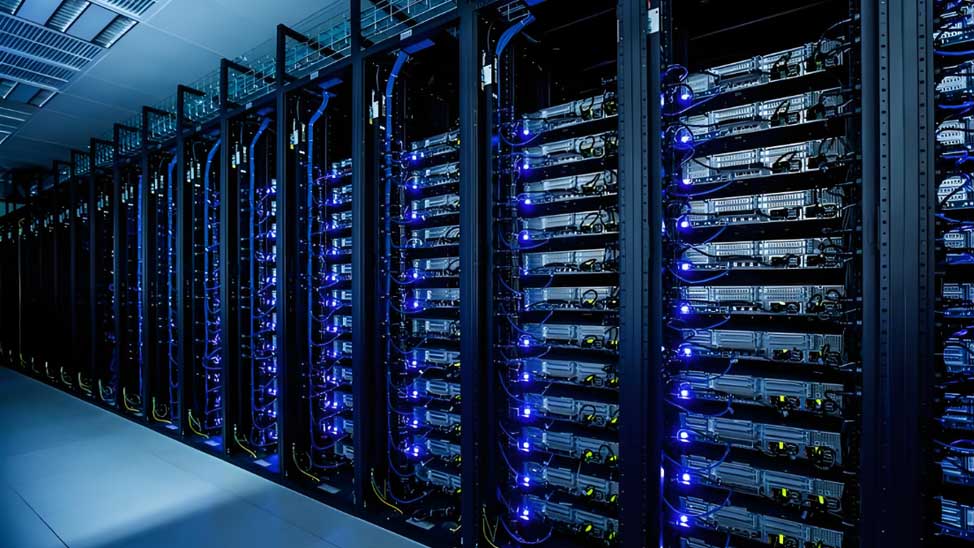
The copper-versus-fiber question is no longer theoretical — AI workloads are forcing a tier-by-tier audit of every link in the data center
Question 1: The Honest Answer — Copper Is Not Dead, But Its Territory Is Shrinking
Let's start with the question exactly as customers ask it: "We have Cat6A horizontal runs, DAC in-rack links, and some old Cat5e patches. AI workloads are coming. Do we need to replace it all?"
The honest, engineer's answer is: it depends on the link, not the facility. The AI era is not a sudden cliff where copper stops working everywhere. It is a steady squeeze — each speed generation shrinks copper's usable reach, and each new GPU density level pushes more links past copper's comfort zone. The result is that copper and fiber are no longer competing; they are coexisting by tier, and the boundary between them is moving inward.
This is not AMPCOM's opinion alone. It is the consensus that emerged at NVIDIA GTC 2026, where Jensen Huang stated: "For the next 5–10 years, we will still use a massive amount of copper, and also a massive amount of optics." Broadcom's CEO Hock Tan reinforced the same position, noting that copper can scale from 100G to 400G per lane within a rack before advanced optical solutions become mandatory. The industry calls this "copper where you can, optics when you must" — and the "must" threshold is what this article helps you identify.
The physics behind the squeeze are straightforward. Copper attenuates high-frequency signals — the higher the data rate, the faster the signal degrades. At 10G NRZ, a passive DAC works to roughly 7 meters. At 100G PAM4, that drops to about 3 meters. At 800G (8×112G PAM4), passive DAC reaches only 1–2 meters. And at the coming 1.6T generation (8×224G PAM4), the practical passive copper span falls to roughly 1 meter or less — a distance that barely covers a single in-rack GPU-to-switch hop. This is what the industry calls the "Copper Wall": the point where equalization, retiming, and signal conditioning consume more power and cost than simply switching to fiber.
| Speed Generation | SerDes Lane Rate | Passive DAC Max Reach | What It Means for Your Copper |
|---|---|---|---|
| 10G | 10G NRZ | ~7 m | Copper is fine for almost any in-room link |
| 25G / 40G | 25G NRZ | ~5 m | Copper still covers most rack-to-rack in a row |
| 100G | 100G PAM4 (4 lanes) | ~3 m | Copper is limited to in-rack or adjacent-rack |
| 400G | 100G PAM4 (8 lanes) | ~2–3 m | Copper is in-rack only; AEC extends to ~5 m |
| 800G | 112G PAM4 (8 lanes) | ~1–2 m | Copper barely covers GPU-to-leaf; optics take over row-level |
| 1.6T | 224G PAM4 (8 lanes) | ~1 m (estimated) | Passive copper is nearly impractical; AEC/AOC mandatory |
So: copper is not dead. But the territory where it is the right choice is shrinking with every speed generation. If your facility is staying at 10G/25G for management and access-layer links, copper remains the correct answer. If you are building AI training clusters at 400G/800G, copper's role contracts to the shortest in-rack hops, and fiber takes over everything else.
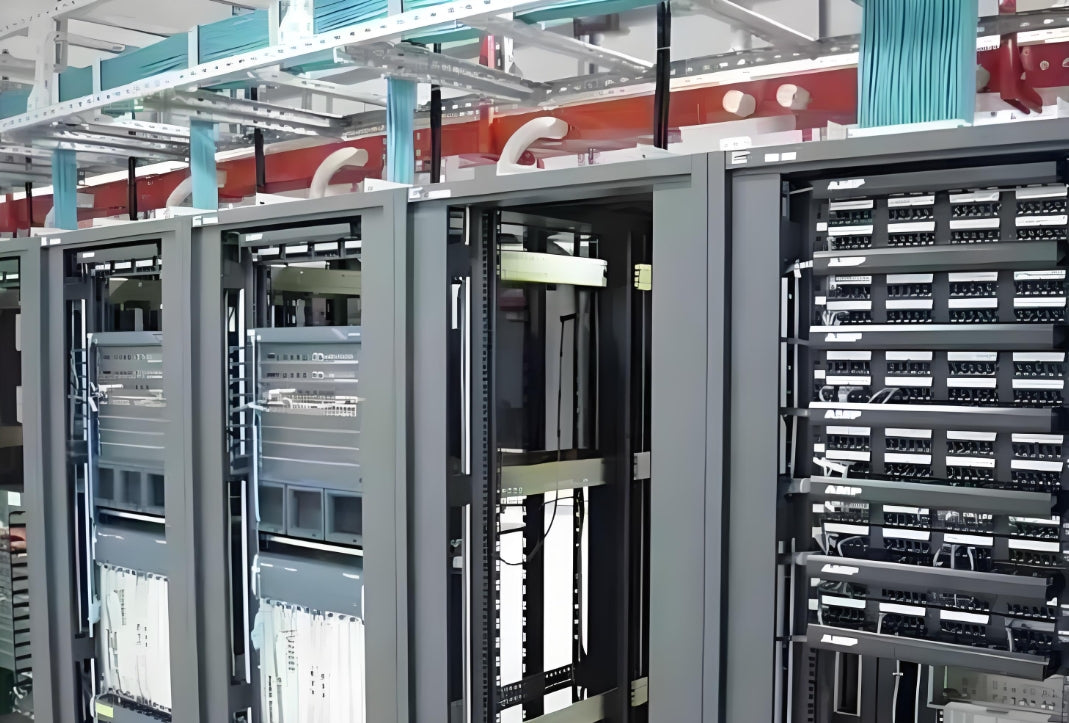
Copper still handles the shortest, most cost-sensitive links — but its reach shrinks dramatically at 800G and beyond
❓ So copper isn't being "replaced" — it's being "pushed inward"?
Exactly. The industry consensus in 2026 — from NVIDIA, Broadcom, Astera Labs, and the OIF — is that copper's role is contracting toward the chip, not disappearing. At 800G, passive copper still handles the 1–2 meter GPU-to-leaf hop inside a rack. At 1.6T, that same hop may require active copper (AEC) or even AOC. The copper-to-fiber boundary is moving closer to the silicon, not outward. This is why the question "should I replace my copper?" is better asked as "which of my copper links still fall within copper's usable reach at my target speed?"
❓ What about copper cable categories — Cat5e, Cat6, Cat6A, Cat7, Cat8?
These horizontal copper categories serve a different layer than DAC. Cat6A supports 10G up to 100 meters and remains the standard for enterprise access-layer and PoE++ device connections — IP cameras, Wi-Fi 7 APs, building automation. Cat8 handles 25G/40G up to 30 m for short data center links. None of these categories are under immediate threat from AI — they serve access and management layers that AI does not directly touch. The pressure is on high-speed DAC and AEC in the AI fabric tier, not on horizontal copper.
Question 2: Where Copper Still Wins — The In-Rack Stronghold
Inside a single rack — the domain NVIDIA calls "scale-up" — copper remains the optimal choice in 2026, and the industry expects it to stay that way through at least 2027–2028. Here is why.
The physics still favor copper at short reach
- Power: A passive DAC consumes ~0.1 W per end — roughly 1/50th the power of a 800G optical module (20–25 W). In a rack with 48+ high-speed ports, that difference is measured in kilowatts.
- Latency: Passive copper adds essentially zero latency — no electro-optical conversion, no retiming. For NVLink and scale-up fabrics where every nanosecond matters, this is a genuine advantage.
- Cost: A passive DAC is typically 2–5× cheaper than an equivalent AOC, and 3–5× cheaper than separate transceivers plus fiber. For links under 2 meters, the cost penalty of optics buys nothing.
- Reliability: No lasers, no photodetectors, no DSP — fewer failure modes. NVIDIA's own NVL72 rack uses active copper cables for GPU-to-NVSwitch connections, validating copper's role in the most demanding AI scale-up designs.
Active copper extends the boundary
When passive DAC's reach is insufficient — typically at 400G/800G where the GPU-to-leaf run is 2–5 meters — active copper (ACC and AEC) fills the gap without jumping to optics:
| Copper Type | Technology | 800G Reach | Power per End | Best For |
|---|---|---|---|---|
| Passive DAC | No active components | ~1–2 m | ~0.1 W | Shortest GPU-to-leaf hops |
| ACC (Active Copper) | Analog redriver / equalizer | ~4–5 m | ~1.5 W | In-rack and adjacent-rack at 800G |
| AEC (Active Electrical) | Digital retimer with CDR | ~5–7 m | ~4–8 W | Server-to-switch rows where optics are overkill |
Astera Labs reports that AECs deliver approximately 25–50% lower power consumption compared to AOCs, and multiple hyperscalers have standardized on AEC technology for 800G in-rack and adjacent-rack links. Credo Technology, the dominant AEC retimer supplier, has seen deployments where AECs replaced both passive DAC (which could not reach) and AOC (which was overkill). The practical takeaway: copper's territory has expanded slightly thanks to active technology, even as passive copper's reach has shrunk.
When copper still wins — the 2026 rule
Choose copper (passive DAC, ACC, or AEC) when the link is inside a single rack or between adjacent racks (typically ≤5–7 m at 800G), and the priority is minimum power, minimum latency, and minimum cost. This covers GPU-to-leaf switch, server-to-ToR, and intra-rack leaf-spine connections in nearly all current AI rack designs — from 8-GPU inference pods to NVL72-class training racks.
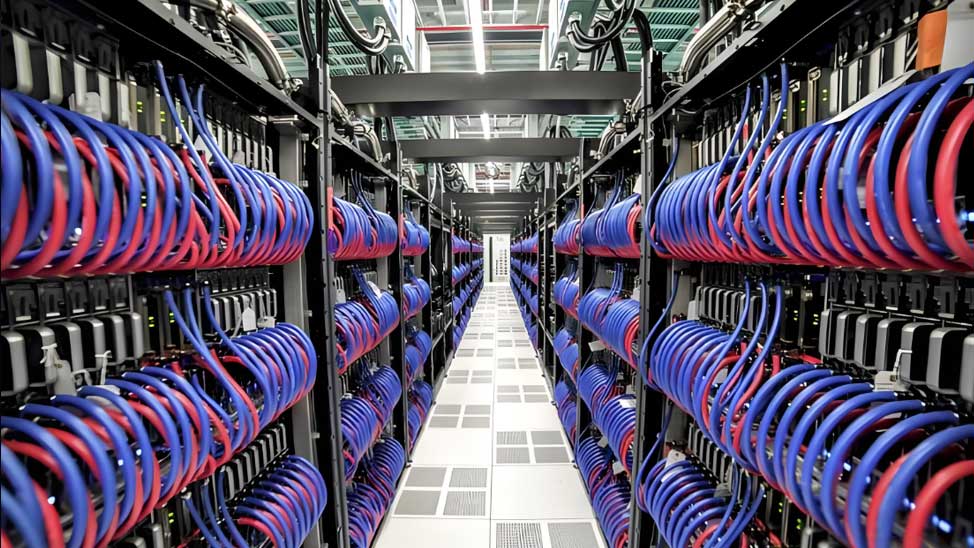
Inside the rack, copper's power and latency advantages remain decisive — active copper (AEC) extends that boundary to 5–7 m at 800G
❓ If copper is still fine in-rack, why is everyone talking about "copper running out"?
Because the share of links that fall within copper's reach is shrinking. A traditional data center rack might have 24–48 copper links, all under 5 meters. An NVL72-class AI rack can demand 500+ high-speed links, and while many are still under 2 meters, the row-to-row and spine connections — which didn't exist at this density before — are firmly in fiber territory. The absolute volume of copper isn't disappearing, but the percentage of the fabric that copper can serve is falling fast. That is what drives the narrative.
❓ Should I keep using Cat6A for management and PoE devices in an AI data center?
Absolutely. Cat6A remains the correct choice for management networks, BMC/IPMI access, IP cameras, Wi-Fi 7 access points, and building automation. These links run at 1G/10G and carry PoE/PoE++ power — none of which AI workloads change. The AI cabling pressure is entirely in the high-speed fabric tier (400G/800G/1.6T), not in the access and management tier.
Question 3: Where Copper Already Loses — Anything Beyond the Rack
The moment a link leaves the rack — crossing an aisle, reaching a spine switch, connecting to another row or hall — copper's advantages evaporate. This is the tier NVIDIA calls "scale-out", and it is where fiber is not just preferred but physically mandatory at AI speeds.
Why copper fails at row-level and beyond
- Reach: At 800G, passive DAC reaches 1–2 m. Even AEC tops out at ~7 m. Row-level links are typically 10–30 m, and spine connections can span 50–100 m+. Copper simply cannot carry 800G that far.
- Signal integrity: At 224G PAM4 (1.6T), copper channel loss becomes so severe that the equalization circuitry consumes more power than the data path itself. The industry calls this the "Copper Wall" — the frequency threshold where no amount of DSP can economically recover the signal.
- Cable bulk: High-speed copper bundles are thick, stiff, and heavy. In a dense AI hall with hundreds of 800G links per row, copper's physical mass becomes a cable management and airflow nightmare.
- EMI susceptibility: AI racks push 100–200 kW. The electromagnetic environment around power distribution, cooling systems, and thousands of GPUs makes copper's EMI vulnerability a real reliability risk at multi-meter distances.
- Heat: Copper cable resistance generates heat at the connector interface. In a rack already operating at 120+ kW, every watt of cable heat adds to an already stressed cooling system.
Where fiber is already the default
In every AI cluster AMPCOM engineers surveyed in 2026, the following link types were 100% fiber:
| Link Type | Typical Distance | Speed | Why Fiber Is Mandatory |
|---|---|---|---|
| Leaf-to-spine (in-row) | 10–20 m | 400G/800G | Beyond AEC reach; EMI and cable bulk |
| Spine-to-spine (cross-hall) | 30–100 m | 800G | Copper cannot carry 800G past ~7 m |
| Inter-building / DCI | 100 m – 10 km+ | 800G/1.6T | Only singlemode fiber reaches these distances |
| Breakout trunking | 5–50 m | 800G→2×400G | Density and flexibility; MPO fiber required |
The fiber choice for these links is almost always OS2 / G.657.A2 singlemode on MPO-16/MPO-24 trunking. Singlemode carries both 800G and 1.6T with no reach penalty, so the next generation becomes a transceiver swap rather than a recable. For shorter row-level links under 100 m, OM4/OM5 multimode is a cost-optimized alternative. Our guide to choosing the right fiber type: singlemode vs multimode explains the trade-off in depth.
When fiber wins — the 2026 rule
Choose fiber whenever a link must leave the rack, whenever you need breakout flexibility, or whenever you want a cabling plant that upgrades by swapping modules instead of re-cabling. It is the highest-cost, highest-power option per link — but across a whole AI facility it is usually the cheapest path to the next generation, which is the trade that matters. As we explain in our guide to 800G and 1.6T cabling trends, an OS2 singlemode plant installed today carries 400G, 800G, and 1.6T with only module changes.
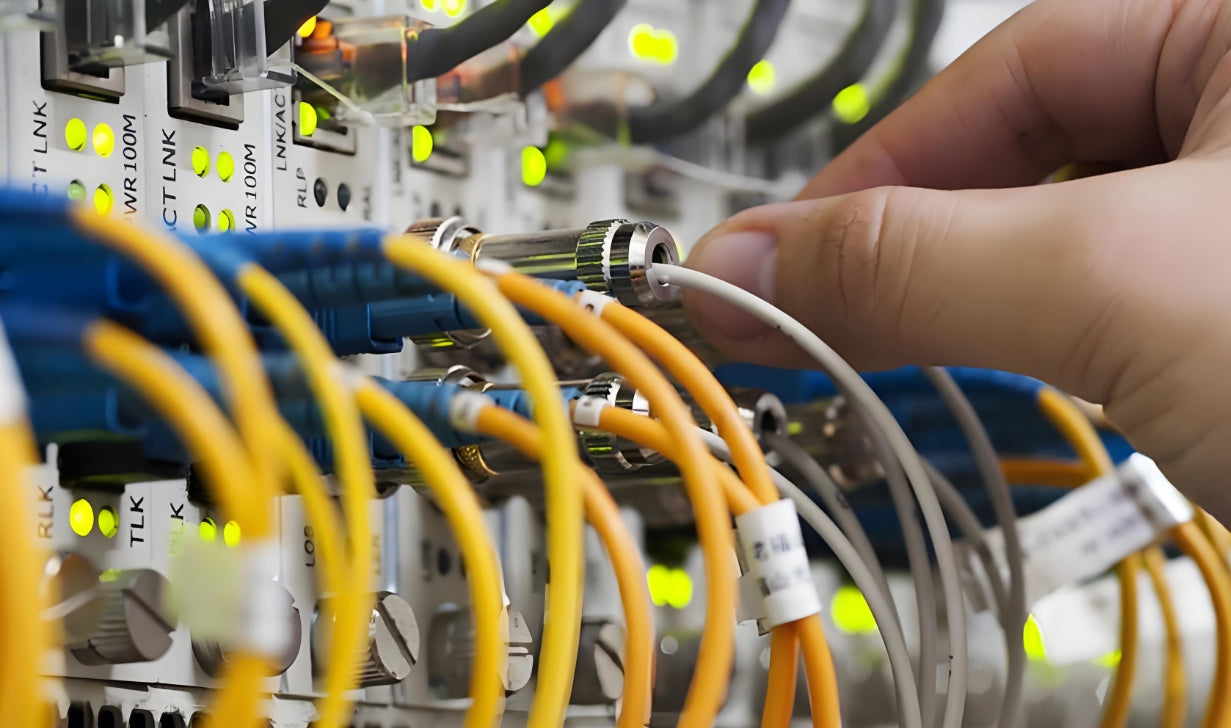
Once a link leaves the rack, fiber is the only option at AI speeds — and an OS2 singlemode plant carries multiple generations of optics
❓ What about AOC — isn't that a "fiber" option for shorter row-level links?
Yes — AOC is fiber, but in a sealed assembly with fixed optics at each end. It bridges the 3–30 m gap where passive DAC cannot reach and separate transceivers feel like overkill. AOC is lighter, thinner, and EMI-immune, making it ideal for row-level AI cluster links. The trade-off is that AOC is a single sealed unit — if it fails or you need to change speed, you replace the whole cable. For links where the layout may shift or speed may upgrade, prefer pluggable optics with separate fiber. Our DAC cable guide covers the full DAC/AOC/fiber decision in detail.
❓ How bad is the power difference between copper and fiber at scale?
It is significant. A passive DAC at 800G draws ~0.1 W per end; an 800G optical module draws 20–25 W per end. In a 48-port leaf switch, that is the difference between ~5 W (all DAC) and ~2,000 W (all optics) just in cable assemblies — before counting the switch itself. This is why engineers do not default everything to optics: the power and cooling cost of unnecessary optical modules in a dense AI rack is real money. The tiered approach — copper in-rack, fiber beyond — is not just about reach; it is about power economics.
Question 4: The Copper-to-Fiber Tipping Point — How to Audit Your Plant
So how do you decide which of your existing links to keep and which to replace? The answer is a link-by-link audit against three criteria: distance, speed, and upgrade horizon.
The three-question audit
For every high-speed link in your facility, ask:
- What is the actual physical distance? Measure it — do not estimate. Under 2 m at 800G: passive DAC. 2–7 m: AEC. 7–30 m: AOC. Beyond 30 m: pluggable optics + fiber.
- What speed will this link run at in 12–18 months? If 800G today and 1.6T planned, passive DAC's 1–2 m reach shrinks to ~1 m. AEC may become necessary even for in-rack links. Plan fiber for anything that might exceed copper's 1.6T envelope.
- Will this link need breakout or reconfiguration? If yes, choose pluggable optics + fiber — not AOC or DAC. The flexibility of separate modules and structured fiber pays for itself the first time a layout changes.
| Existing Copper Link | Current Speed | Distance | Verdict for AI Workloads |
|---|---|---|---|
| Cat5e horizontal | 1G | ≤100 m | Keep — fine for management/access; not in AI's path |
| Cat6A horizontal | 10G | ≤100 m | Keep — still the standard for PoE++ and Wi-Fi 7 |
| Cat8 short-link | 25G/40G | ≤30 m | Keep — adequate for non-AI interconnects |
| Passive DAC (25G/100G) | 25–100G | ≤3 m | Keep — still within copper's reach |
| Passive DAC (400G) | 400G | ≤2–3 m | Keep for now — plan AEC/AOC if upgrading to 800G |
| Passive DAC (800G) | 800G | ≤1–2 m | Keep only if ≤2 m — otherwise replace with AEC/AOC |
| Copper row-level links (>5 m) | 100G+ | 5–30 m | Replace with fiber — already past copper's reach at AI speeds |
| Copper inter-hall / DCI | Any | >30 m | Replace immediately — should have been fiber already |
Case study: A mid-tier enterprise data center audit
A 2,000-server enterprise facility preparing for AI inference workloads conducted a link-by-link audit with AMPCOM's engineering team. The findings:
- Access layer (Cat6A, 1G/10G): 1,200 links — all retained. No AI impact on management, PoE, or access-layer cabling.
- In-rack DAC (25G/100G): 480 links under 3 m — all retained. Will remain copper even at 400G upgrades.
- Row-level copper (100G, 8–15 m): 72 links — all replaced with AOC and pre-terminated OM4 MPO trunks. These were already marginal at 100G and would fail at 400G.
- Spine-to-spine (100G, 40–60 m): 24 links — replaced with OS2 singlemode MPO trunks and 400G pluggable optics. Future-proofed for 800G/1.6T.
- Result: ~85% of existing copper was retained; only 96 links (row-level and spine) required fiber migration. Total project cost was a fraction of a full recable, and the new fiber backbone is 1.6T-ready.
This audit mirrors what AI infrastructure is reshaping in data center cabling requirements — the pressure is concentrated in the fabric tier, not the access tier.
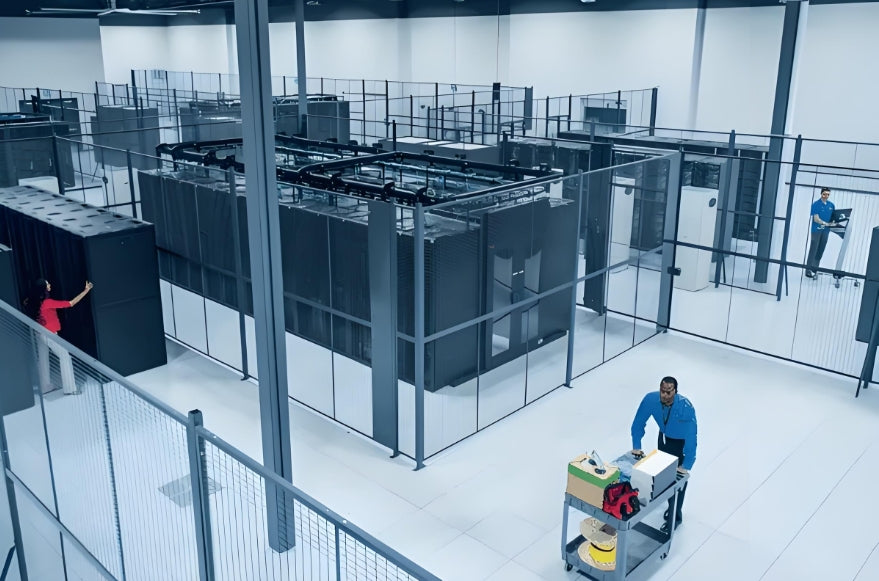
A link-by-link audit typically finds that 80–90% of copper is fine — only the high-speed fabric tier needs fiber migration
❓ How do I know if my copper links are already marginal at current speeds?
Look for three warning signs: (1) intermittent link drops that resolve on cable reseat — indicating connector insertion loss is near the limit; (2) higher-than-expected bit error rates (BER) on links that pass basic continuity testing; (3) links that work at full speed but fail when the rack temperature rises — a sign that thermal derating has eroded the signal margin. If any of these appear on links running at 100G or above, the link is likely at copper's edge and should be evaluated for AEC or fiber replacement.
❓ Should I just preemptively fiber everything to avoid future migration?
No — that is the other extreme. Over-fibering short in-rack links adds cost, power, and heat for no benefit. A passive DAC at 800G costs 2–5× less than an AOC and draws 1/50th the power. In a 48-port rack, defaulting everything to optics wastes hundreds of watts and thousands of dollars. The correct approach is tiered: copper in-rack, AOC/AEC row-level, fiber backbone — not fiber everywhere.
Question 5: The 5-Step Migration Plan — Keep What Works, Fiber What Doesn't
Based on hundreds of AMPCOM customer audits, here is the practical 5-step plan for preparing an existing cabling plant for AI workloads — without a full recable.
Step 1: Segment your links by tier
Map every high-speed link into three tiers: in-rack (≤5 m), row-level (5–30 m), and backbone/DCI (>30 m). This determines which medium each link should use. Document actual measured distances — not estimates.
Step 2: Retain copper where physics still favor it
Keep passive DAC for all in-rack links at 25G–400G under 3 meters. Keep Cat6A for all access-layer and PoE links. Keep Cat8 for short 25G/40G data center links. Do not touch what works — the goal is targeted migration, not blanket replacement.
Step 3: Migrate row-level copper to AEC or AOC
For links of 3–7 m at 400G/800G, replace passive DAC with AEC — active copper with retimers that extend reach to 5–7 m while staying cooler and cheaper than fiber. For links of 7–30 m, replace with AOC or pre-terminated OM4/OM5 MPO assemblies with pluggable optics.
Step 4: Build the backbone on OS2 singlemode MPO
All spine-to-spine, inter-hall, and DCI links should use OS2 / G.657.A2 singlemode fiber on MPO-16/MPO-24 trunking. This single fiber type carries 400G, 800G, and 1.6T with only module changes. Install spare dark fiber in every trunk — AI racks grow faster than anyone plans. As our guide to MPO fiber solutions explains, choosing the right fiber count upfront prevents costly retrofits.
Step 5: Document, test, and plan for the next generation
Document polarity, length, speed, and link type per port — using a TIA-606-style labeling system. Test every fiber link with OTDR and endface inspection before first power-on. Test every copper link with a Fluke DSX-class tester. And plan your 1.6T upgrade path now: identify which DAC links will need AEC at 1.6T, which AOC links will need pluggable optics, and which fiber trunks have enough dark fiber for the next expansion.
The five traps that cost AI teams the most
- ❌ Panicking and replacing all copper. The vast majority of access-layer and in-rack copper is fine. Targeted migration saves 70–90% vs full recable.
- ❌ Ignoring the 1.6T horizon. Passive DAC at 800G may not survive at 1.6T. Plan AEC or AOC for links near copper's reach limit.
- ❌ No spare dark fiber. AI clusters expand unpredictably. Every MPO trunk should have at least 30–50% spare fibers.
- ❌ Mixing polarity conventions within a tier. MPO Type B is the documented default for new parallel-optics installs. Mismatches create dark links.
- ❌ Skipping endface inspection. 80% of fiber link failures are dirty connectors. Inspect before you connect — every time.
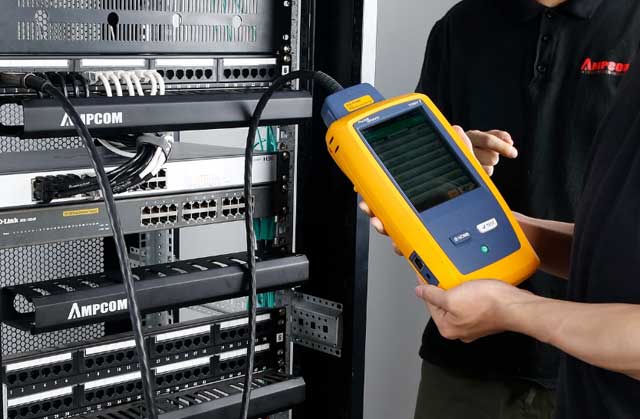
Whatever the link type — copper or fiber — certify it before first power-on and document every port for the next upgrade cycle
❓ How long will copper remain viable in-rack before CPO takes over?
NVIDIA's roadmap places CPO (Co-Packaged Optics) entering scale-up racks around 2027–2028 with the Rubin Ultra / Feynman architectures. Even then, copper will coexist — CPO handles the highest-density optical engine connections, while copper DAC/AEC continues to serve shorter in-rack hops. The industry consensus is that copper remains in-rack through at least 2030, with optics gradually moving closer to the silicon. For now, copper in-rack is not going away — it is the scale-out tier where fiber is already mandatory.
❓ What about LPO — does linear pluggable optics change the copper-versus-fiber math?
LPO removes the DSP from the optical module, cutting power by roughly 40–50% at 800G. This makes fiber more competitive on power — narrowing copper's advantage — but it does not extend copper's reach. LPO is an optical technology improvement, not a copper extension. It makes fiber more attractive for row-level links but does not change the in-rack copper verdict.
Key Takeaways
| Question | Bottom Line | AMPCOM Recommendation |
|---|---|---|
| Is all copper obsolete? | No — copper's territory is shrinking, not disappearing | Audit by link, not by facility |
| In-rack copper? | Still the best choice at ≤5–7 m for 800G | Keep passive DAC / AEC in-rack |
| Row-level copper? | Already past copper's reach at AI speeds | Migrate to AOC or OM4 MPO fiber |
| Backbone / DCI? | Fiber has been mandatory for years | OS2 singlemode MPO, 1.6T-ready |
| Access layer (Cat6A)? | AI does not affect 10G/PoE horizontal cabling | Keep — no action needed |
| 1.6T planning? | Passive copper reach drops to ~1 m; plan AEC/AOC | Build fiber-rich trunks now |
📌 AMPCOM's 5-Step Copper-to-Fiber Migration Quick Start
- Map every high-speed link by distance tier — in-rack, row-level, backbone — before deciding what to replace.
- Keep copper where physics still favor it — passive DAC in-rack, Cat6A access-layer, Cat8 short-link.
- Migrate row-level copper to AEC or AOC — 3–7 m: AEC; 7–30 m: AOC or OM4 MPO fiber.
- Standardize the backbone on OS2 singlemode MPO with 30–50% spare dark fiber.
- Document, test, and plan for 1.6T — label every port, inspect every endface, identify which links need AEC at 1.6T.

AMPCOM Technical Team
Industry experts with 17+ years in structured cabling, data center infrastructure, and fiber optic network design
Not sure which copper links to keep and which to replace?
AMPCOM supplies DAC/AEC/AOC assemblies, OS2/OM4 MPO trunking, and pluggable optics for AI infrastructure builds — all with factory test reports. Send us your rack diagram and our engineers will return a tiered migration plan.
Talk to Our Infrastructure Experts

