
Customer Asks: AI is Here, How Should Network Infrastructure Vendors Respond?
Published:Customer Question: "We hear AI is changing everything. As data center operators, what should we prepare for in terms of network infrastructure? What's your perspective as a supplier?"
This is the question we hear most frequently from customers lately. In this Ask AMPCOM feature, we address the four key concerns—bandwidth anxiety, power consumption, scaling confusion, and cost considerations—and provide actionable recommendations for navigating the AI era.
Quick Navigation
AI data centers demand a fundamental rethinking of network infrastructure design and deployment strategies
1. Customer Concerns: What's Driving the Questions
When we engage deeply with customers, we find their main concerns about network infrastructure in the AI era fall into four categories:
1. Bandwidth Anxiety
"Our AI training clusters need massive GPU interconnections. Can our existing network handle it?"
2. Power Panic
"We hear AI data centers have staggering power consumption. Will network equipment become a bottleneck?"
3. Scaling Confusion
"AI business is growing so fast. How should we plan our network architecture to keep up?"
4. Cost Concerns
"Network upgrades require significant investment. How do we calculate ROI?"
2. Bandwidth Requirements: The East-West Shift
2.1 Fundamental Traffic Pattern Change
The most significant change AI brings to data center networking is the shift from north-south to east-west traffic dominance:
| Metric | Traditional Data Center | AI Data Center |
|---|---|---|
| Traffic Pattern | North-south dominant (user access) | East-west dominant (GPU synchronization) |
| Per-node Bandwidth | 1G – 10G | 100G – 400G – 800G |
| Latency Requirements | Millisecond-level | Microsecond-level |
| Network Topology | Three-tier (core-agg-access) | Leaf-spine (flat, non-blocking) |
| Typical Link Type | 10G SFP+, 40G QSFP | 100G/400G/800G QSFP-DD |

AI training clusters require non-blocking network architectures with 400G/800G connectivity between GPU nodes
2.2 Recommendations for Bandwidth
Action Items
Upgrade backbone: Transition to 400G/800G fiber using OM4/OM5 multimode for SR4/SR8 links
Adopt leaf-spine: Implement non-blocking architecture with 1:1 oversubscription ratio
Select low-latency components: Choose switches and optical modules optimized for AI workloads
Plan for 1.6T: Design infrastructure to accommodate next-generation 1.6T links within 2-3 years
For more details on fiber selection, see our guide on choosing the right fiber type for AI data centers.
3. Power Consumption: Optimization Strategies
3.1 Network Power Impact
AI data center network power consumption is increasing, but there's significant room for optimization:
| Data Center Type | Network Power Share | Key Drivers |
|---|---|---|
| Traditional | 5% – 10% of total | Standard switching, 1G/10G links |
| AI-Optimized | 10% – 15% of total | High-speed optics, GPU NICs, RDMA |
3.2 Power Optimization Solutions
AMPCOM Solutions for Power Efficiency
1. High-Efficiency Optical Modules
- Silicon photonics technology: 30% power reduction vs. conventional optics
- PAM4 modulation: Doubles data rate per wavelength, reducing module count
- Coherent optics for longer reaches: Lower power per Gbps-km
2. Intelligent Management Systems
- Dynamic power adjustment based on real-time load
- Automatic port sleep when idle (significant for bursty AI workloads)
- Power monitoring and reporting for PUE optimization
3. Optimized Cabling Design
- Shorten cable distances: Reduces signal attenuation, allows lower-power optics
- Use active optical cables (AOCs) for high-bandwidth, short-reach connections
- Proper airflow design around cable pathways
Learn more about power considerations in our article on why power flexibility is becoming a core requirement for AI data centers.
4. Network Architecture: Modular Design
4.1 Leaf-Spine Architecture for AI
Modular design is the key to scaling AI infrastructure efficiently. The leaf-spine architecture provides the non-blocking connectivity AI workloads require:
AI Data Center Network Architecture (Leaf-Spine)
                    ┌─────────────┐
                    │  Spine Layer │  400G/800G
                    │(Core Switches)│
                    └──────┬──────┘
                           │
          ┌────────────────┼────────────────┐
          │                │                │
    ┌─────┴─────┐    ┌─────┴─────┐    ┌─────┴─────┐
    │ Leaf Layer │    │ Leaf Layer │    │ Leaf Layer │
    │(Aggregation)│   │(Aggregation)│   │(Aggregation)│
    └─────┬─────┘    └─────┬─────┘    └─────┬─────┘
          │                │                │
    ┌─────┴─────┐    ┌─────┴─────┐    ┌─────┴─────┐
    │ GPU Cluster│   │ GPU Cluster│   │ GPU Cluster│
    │  (PoD 1)   │    │  (PoD 2)   │    │  (PoD 3)   │
    └───────────┘    └───────────┘    └───────────┘

    Each PoD (Point of Delivery) scales independently
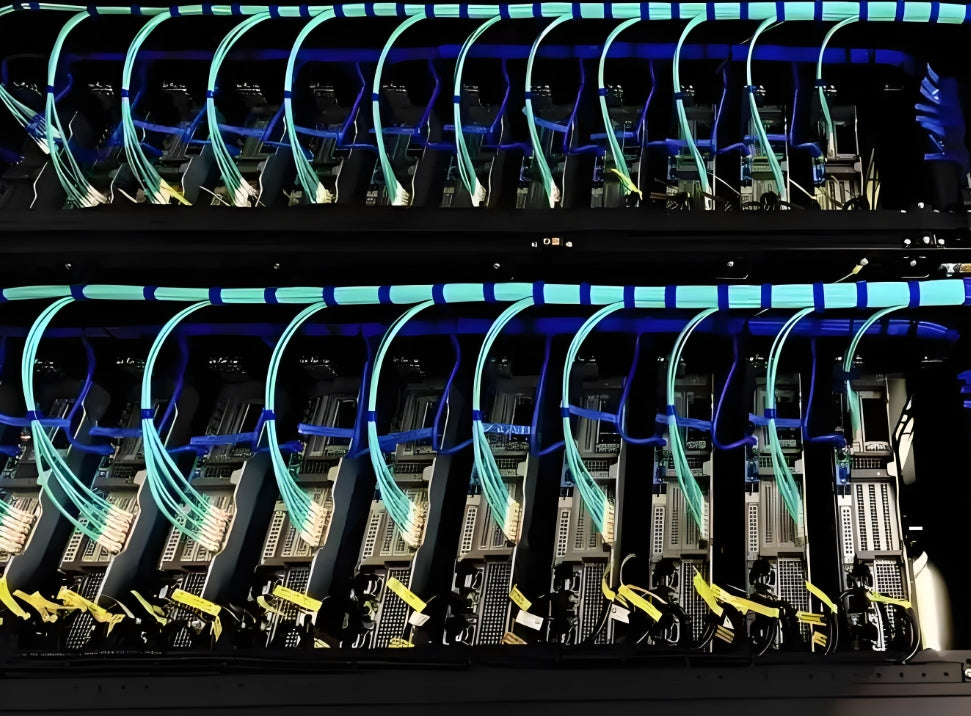
Modular PoD design enables independent scaling and reduces blast radius for failures
4.2 Planning Considerations
- Independent PoDs: Each Point of Delivery can be added on demand without affecting others
- Spine expansion: Reserve expansion slots in spine layer for future growth
- Port redundancy: Design cabling with 20%-30% spare ports per PoD
- Pre-terminated systems: Use factory-terminated solutions for rapid deployment
For structured cabling guidance, see what's changing in structured cabling for AI data centers.
5. ROI Analysis: Investment Justification
5.1 TCO Comparison Model
AI-optimized networks require higher initial investment but deliver superior long-term returns:
| Item | Traditional Solution | AI-Optimized Solution | Difference |
|---|---|---|---|
| Initial Investment | $1M (baseline) | $1.5M | +50% |
| Cost per Gbps | $100/G | $60/G | -40% |
| Annual O&M Cost | $100K | $80K | -20% |
| AI Training Efficiency | Baseline | +30% | Business value-add |
| 3-Year ROI | Baseline | +25% | Superior |
5.2 Key Takeaways
ROI Analysis Summary
Lower unit cost: AI-optimized networks deliver lower cost per Gbps despite higher initial investment
Business value: AI training efficiency gains generate value far exceeding network investment
Reduced O&M: Modern architectures require less manual intervention, lowering operational costs
Future-proofing: Investment in 400G/800G infrastructure avoids costly forklift upgrades
6. AMPCOM's Response Strategy
As a network infrastructure supplier, we're addressing AI-era challenges across multiple dimensions:
6.1 Product Innovation
AI-Ready Product Lines
High-Speed Fiber Systems: 400G/800G cabling solutions with OM4/OM5 multimode and OS2 single-mode options
High-Density MPO Solutions: 12/16/24/32-fiber MPO configurations for maximum port density
Low-Loss Pre-terminated Cables: Factory-tested fiber assemblies with guaranteed performance
Thermally Optimized Cabinets: Network cabinets designed for high-density, high-power environments
6.2 Technical Services
- Consultation: AI data center network planning and architecture design
- Site Services: Site survey, solution design, and installation supervision
- Testing: Professional installation and test certification services
- Support: 24/7 technical support for mission-critical infrastructure
6.3 Turnkey Solutions
We provide complete AI data center network infrastructure solutions:
- End-to-end delivery from products to services
- Compatibility certification with major network equipment vendors (Cisco, Arista, NVIDIA, Juniper)
- Single point of accountability for the entire infrastructure
7. Customer Recommendations
7.1 Short-term (0-6 months)
Immediate Actions
1. Assess Current State: Conduct thorough audit of existing network bottlenecks
2. Small-scale Pilot: Select one PoD or zone for AI-optimized upgrade pilot
3. Establish Baseline: Test and document current network performance metrics
4. Skill Development: Begin training operations team on AI networking concepts
7.2 Mid-term (6-18 months)
Scaling Phase
1. Gradual Upgrade: Expand AI-optimized PoDs based on business growth
2. Team Training: Complete advanced training for operations team
3. Automate Operations: Implement automated O&M systems for scale
4. Document Lessons: Capture and share learnings from initial deployments
7.3 Long-term (18 months+)
Strategic Evolution
1. Architecture Evolution: Plan transition to 800G/1.6T network infrastructure
2. Intelligent Operations: Introduce AI-assisted network management and optimization
3. Sustainability: Continuously optimize PUE and energy efficiency
4. Vendor Partnerships: Develop strategic relationships with infrastructure vendors
Final Thought
The AI era presents higher demands on network infrastructure but also creates new opportunities. As a network infrastructure supplier, we're not just product providers—we're customer partners, helping clients navigate the AI wave with confidence.
Related Articles
- 800G Is Not Just a Speed Upgrade — It Changes Which Fiber Designs Remain Manageable — Understanding the implications of 800G on cabling design
- AI Data Center Cabling Is Getting Harder to Manage — What Actually Breaks First? — Real-world challenges in AI infrastructure
- Nvidia's 2026 Data Center Roadmap: What Faster Hardware Cycles Mean for Network Infrastructure — Preparing for accelerated hardware evolution
- How AI Infrastructure Is Reshaping Data Center Cabling Requirements — The fundamental shifts in cabling requirements

AMPCOM Technical Team
Industry experts with 15+ years in enterprise network infrastructure
Need a Custom Cabling Solution?
Our technical team provides free site surveys and customized pre-terminated cabling designs.
Get Free Consultation

