
Structured Cabling Standards: TIA-568 vs ISO/IEC 11801
Published:Structured cabling standards are the invisible backbone of every enterprise network. Pick the wrong one for your region, and you're looking at failed inspections, warranty voids, and a six-figure remediation bill.
If you've ever stared at a specification sheet wondering whether to follow TIA-568 or ISO/IEC 11801 — or whether it even matters — you are not alone. Network engineers, project managers, and procurement teams run into this question on nearly every international project. This guide gives you the straight answer: what each standard covers, where they diverge, who needs which, and how to avoid the most expensive mistakes that come from guessing wrong.
Quick Navigation
- 1 What Are Structured Cabling Standards and Why They Matter
- 2 TIA-568 Deep Dive: The North American Powerhouse
- 3 ISO/IEC 11801 Deep Dive: The Global Framework
- 4 Head-to-Head: TIA-568 vs ISO/IEC 11801 Compared
- 5 Category vs Class: Decoding the Naming System
- 6 T568A vs T568B: The Termination Standard Within the Standard
- 7 Regional Adoption and Compliance Reality
- 8 How to Choose the Right Standard for Your Project
- 9 AMPCOM's Dual-Compliance Product Strategy
- 10 Key Questions About Structured Cabling Standards

Properly executed structured cabling following recognized standards ensures decades of reliable network performance and simplifies future upgrades
1. What Are Structured Cabling Standards and Why They Matter
Walk into any commercial building, hospital, university campus, or data center, and behind every wall plate and patch panel is a structured cabling system — a standardized, hierarchical wiring infrastructure designed to carry voice, data, and video across an organization. These systems are not improvised. They follow precise engineering specifications that dictate everything from the copper wire gauge inside a Cat6A cable to the maximum insertion loss allowed at a fiber connector.
Structured cabling standards exist for one reason: interoperability without guesswork. When a facility is built to a recognized standard, you can plug in equipment from any compliant manufacturer and know it will work. The alternative — proprietary, ad-hoc cabling — creates vendor lock-in, makes troubleshooting a nightmare, and turns every network expansion into a custom engineering project.
1.1 The Three Pillars of Any Cabling Standard
Whether you're looking at TIA-568, ISO/IEC 11801, or the European equivalent EN 50173, every recognized structured cabling standard defines three core things:
- Topology: The physical layout — entrance facility, equipment room, backbone cabling (vertical), horizontal cabling, work area, and telecommunications rooms. Standards define maximum distances, cross-connect rules, and hierarchical structure.
- Performance: For every cable category or fiber type, the standard sets electrical and optical parameters: bandwidth, insertion loss, crosstalk limits, return loss, propagation delay, and more.
- Testing Methodology: How you verify that an installation actually meets the standard — field testers, certification procedures, pass/fail thresholds, and documentation requirements.
Without all three, you have components that might work today but degrade unpredictably under real-world conditions. That is exactly what standards are designed to prevent.
2. TIA-568 Deep Dive: The North American Powerhouse
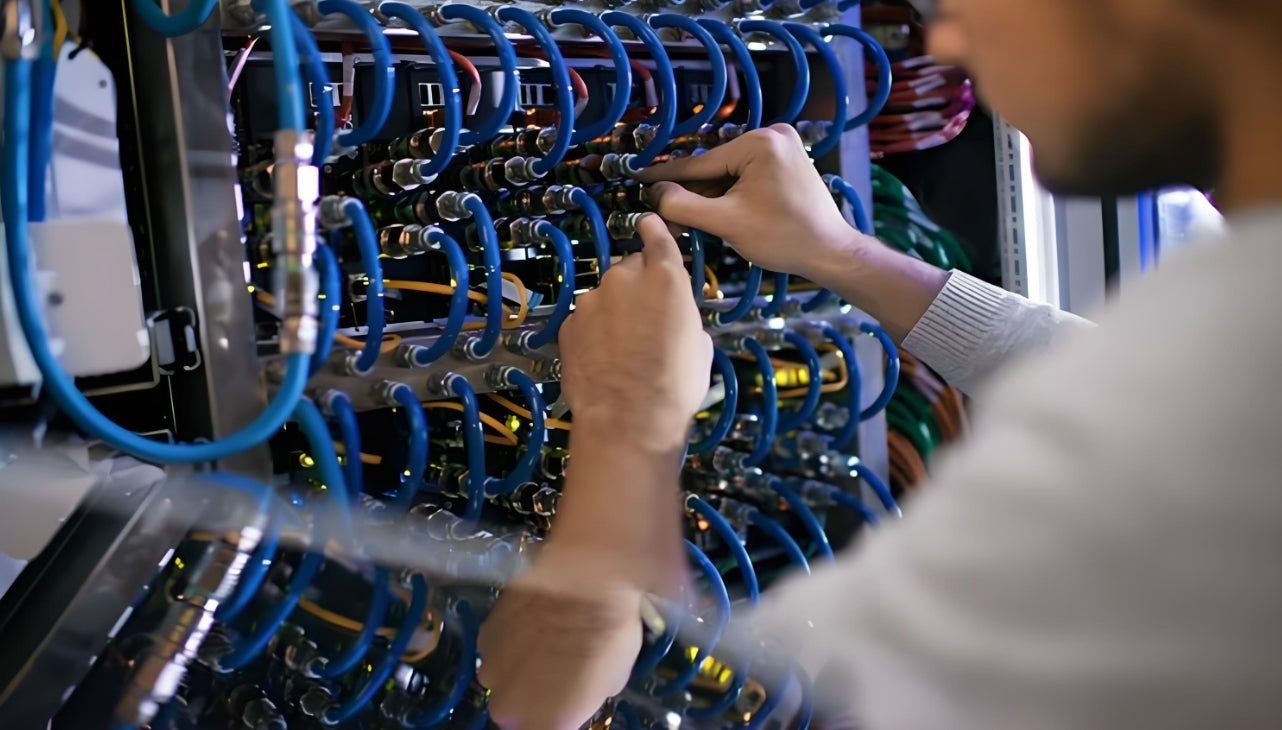
A properly executed TIA-568-compliant installation uses consistent labeling, organized pathways, and certified components throughout
2.1 What TIA-568 Actually Covers
The TIA-568 series is maintained by the Telecommunications Industry Association and serves as the dominant structured cabling reference across the United States, Canada, and much of Latin America. It is not a single document — it is a family of standards that has evolved through multiple revisions:
| Document | Scope | Key Content |
|---|---|---|
| TIA-568.0-D | Generic Telecommunications Cabling | Topology, architecture, and general requirements for customer premises cabling |
| TIA-568.1-E | Commercial Building Cabling | Pathways, spaces, and installation practices for office and commercial environments |
| TIA-568.2-D | Balanced Twisted-Pair Copper | Performance specifications for Cat3 through Cat8 components and links |
| TIA-568.3-E | Optical Fiber Cabling | Fiber types, connector standards, polarity, and testing for OM1 through OM5 and OS1/OS2 |
| TIA-568.4-E | Broadband Coaxial Cabling | Coax specifications for CATV and broadband distribution |
| TIA-568.5-1 | Single-Pair Ethernet (SPE) | Emerging standard for IoT, building automation, and industrial cabling |
2.2 The Evolution: From 568-A to 568-E
TIA-568 has been through five major iterations since its introduction in 1991 鈥?each aligned with the IEEE 802.3 Ethernet speeds of its era. Understanding this history matters because facilities built under older revisions still exist, and backward compatibility is a core design principle of the standard:
- TIA-568-A (1995): The original widely adopted version. Defined Cat3, Cat4, Cat5. T568A pinout was the default. Many government buildings and older commercial properties still reference this as their baseline.
- TIA-568-B (2001): Switched the default pinout to T568B to align with AT&T's widely deployed 258A wiring scheme. Added Cat5e. This is the version most field technicians memorized.
- TIA-568-C (2009): Major restructuring — split into multiple sub-standards (568-C.0 through 568-C.4). Introduced Cat6A specifications and updated fiber guidelines for OM3/OM4. Recognized augmented Category 6 for 10GBASE-T at full 100-meter channels.
- TIA-568-D (2015): Incremental update. Refined alien crosstalk requirements for Cat6A, added MPO connector guidelines for high-density fiber deployments.
- TIA-568-E (current): The latest revision. Expanded coverage for single-pair Ethernet to support IoT and building automation. Updated nomenclature. Addresses 25GBASE-T and 40GBASE-T over Cat8 copper for data center top-of-rack and end-of-row switching.
3. ISO/IEC 11801 Deep Dive: The Global Framework
3.1 What Sets ISO/IEC 11801 Apart
ISO/IEC 11801 is the international structured cabling standard developed jointly by the International Organization for Standardization and the International Electrotechnical Commission. Unlike TIA-568, which was built around the North American commercial office environment, ISO/IEC 11801 was designed from the ground up as a global standard covering a much broader range of deployment environments.
This broader scope is not a minor detail — it fundamentally changes the standard's structure. ISO/IEC 11801 is organized by environment type, each with its own performance and installation requirements:
| ISO/IEC 11801 Part | Environment | Typical Applications |
|---|---|---|
| 11801-1 | Generic Cabling (General Requirements) | Core topology, channel classes, reference implementations shared across all environments |
| 11801-2 | Office Premises | Corporate headquarters, branch offices, open-plan workspaces with flexible furniture configurations |
| 11801-3 | Industrial Premises | Manufacturing floors, process automation, environments with vibration, dust, oil, temperature extremes, and EMI |
| 11801-4 | Single-Tenant Homes | Residential structured wiring for smart home, entertainment, and home office applications |
| 11801-5 | Data Centers | Hyperscale, colocation, and enterprise data centers with high-density fiber and copper requirements |
| 11801-6 | Distributed Building Services | Building automation, HVAC control, access control, lighting — increasingly using single-pair Ethernet |
3.2 Stricter Performance Requirements
One of the most consequential differences between the two standards is that ISO/IEC 11801 generally imposes tighter performance requirements than TIA-568 for equivalent levels of cabling. This is not marketing — it shows up in specific electrical parameters:
- Insertion Loss: ISO Class EA channel insertion loss limits are typically 0.2-0.5 dB tighter than TIA Cat6A at frequencies above 250 MHz.
- Alien Crosstalk: ISO requirements for PS ANEXT (Power Sum Alien Near-End Crosstalk) in bundled cable configurations apply more conservative margins, which matters in high-density patching fields where dozens of cables run parallel.
- Return Loss: ISO Class FA (equivalent to Cat7A) specifies return loss performance at frequencies up to 1,000 MHz — well beyond what TIA currently addresses for twisted-pair copper.
For network designers, this means that a cabling system certified to ISO/IEC 11801 will almost always pass TIA-568 testing, but the reverse is not guaranteed — especially for installations pushing the limits of channel length or operating in electrically noisy environments.
Real-World Impact: The Industrial Facility That Got It Wrong
A European automotive parts manufacturer built a new production monitoring network using TIA-568-spec components sourced from a North American distributor — because the purchasing team found a price advantage. During commissioning, 11% of links failed ISO/IEC 11801 certification testing required by the facility's insurance underwriter. The root cause: the UTP cabling met TIA Cat6 alien crosstalk limits but exceeded ISO Class E PS ANEXT thresholds when 48 cables were bundled in a single tray above the production line. Remediation required replacing all horizontal runs with S/FTP cables rated for Class EA — at triple the labor cost of doing it right the first time.
4. Head-to-Head: TIA-568 vs ISO/IEC 11801 Compared
| Comparison Dimension | TIA-568 | ISO/IEC 11801 |
|---|---|---|
| Governing Body | Telecommunications Industry Association (TIA), ANSI-accredited | ISO and IEC — international standards bodies with member national committees from 165+ countries |
| Primary Geography | North America (U.S., Canada, Mexico); also used in parts of Latin America, Middle East, and Asia-Pacific where U.S. consultants influence projects | Global. Default in Europe, Middle East, Africa, Asia-Pacific. Required by most international tender documents and multinational corporate standards |
| Environment Coverage | Primarily commercial office buildings. Data centers addressed through companion standard TIA-942. Industrial and residential environments are outside TIA-568 scope. | Six distinct environment types: generic, office, industrial, residential, data center, and distributed building services. Each has environment-specific MICE (Mechanical, Ingress, Climatic, Electromagnetic) classifications. |
| Copper Naming | Category-based: Cat5e, Cat6, Cat6A, Cat8 | Class-based: Class D, Class E, Class EA, Class F, Class FA, Class I, Class II |
| Fiber Naming | OM1, OM2, OM3, OM4, OM5 (multimode); OS1, OS2 (single-mode) | Same OM/OS naming adopted, plus additional longer-reach optical classes (e.g., OF-300, OF-500, OF-2000 for channel-length-based classification) |
| Highest Copper Spec | Cat8 (2 GHz, 40GBASE-T up to 30m) | Class II (2 GHz, equivalent to Cat8.2); also recognizes Class FA (1 GHz, Cat7A) |
| Connector Standards | RJ45 for copper; LC and SC for fiber | RJ45 and non-RJ45 (GG45, ARJ45, TERA) recognized for Class F/FA; LC, SC, and MPO for fiber |
| Shielding Requirements | Both UTP and shielded recognized. Shielded gaining traction for Cat6A and Cat8 in data centers, but UTP still dominant in commercial office horizontal cabling. | Shielded (F/UTP, S/FTP) is the default recommendation for Class EA and above. European installations overwhelmingly use shielded systems due to stricter EMC regulations. |
| Performance Stringency | Slightly more lenient insertion loss and crosstalk margins for some categories | Tighter specifications — a system that passes ISO will pass TIA, but the reverse is not guaranteed |
| Channel Definition | Permanent link: 90m max. Channel: 100m max (including patch cords) | Same distance limits. ISO adds MICE environmental classification that may derate channel length in harsh conditions. |
TIA-568 Best For
- Commercial office buildings in the U.S. and Canada
- Projects where local inspectors reference TIA specifically
- Environments where UTP has proven sufficient
- Federal government contracts (often mandate TIA)
- Retail, healthcare, and education campuses in North America
ISO/IEC 11801 Best For
- Multinational corporate deployments
- Any project in the European Union
- Industrial and manufacturing environments
- Data centers requiring third-party certification
- Projects where future-proofing is a key requirement
5. Category vs Class: Decoding the Naming System

Understanding the relationship between TIA Categories and ISO Classes eliminates confusion during procurement and testing
If there is one thing that trips up even experienced network engineers on international projects, it is the naming mismatch between TIA-568's Category system and ISO/IEC 11801's Class system. They describe the same physical reality — but use different labels to do it. Here is the direct mapping:
| ISO/IEC 11801 Class | TIA-568 Category | Max Bandwidth | Typical Application | Max Channel Distance |
|---|---|---|---|---|
| Class D | Cat5e | 100 MHz | 1GBASE-T (Gigabit Ethernet), 1000BASE-T | 100 m |
| Class E | Cat6 | 250 MHz | 1GBASE-T, 10GBASE-T (up to 55 m for UTP, longer for shielded) | 100 m (1G); 55 m (10G UTP) |
| Class EA | Cat6A | 500 MHz | 10GBASE-T (full 100 m), 2.5GBASE-T, 5GBASE-T | 100 m |
| Class F | Cat7* | 600 MHz | 10GBASE-T; also supports non-Ethernet applications like broadband video | 100 m |
| Class FA | Cat7A* | 1,000 MHz | 10GBASE-T, 25GBASE-T, 40GBASE-T; CATV/broadband up to 862 MHz | 100 m |
| Class I | Cat8.1 | 2,000 MHz | 25GBASE-T, 40GBASE-T (data center, 30 m max) | 30 m |
| Class II | Cat8.2 | 2,000 MHz | 25GBASE-T, 40GBASE-T (data center, 30 m max) | 30 m |
*Note: Cat7 and Cat7A are recognized by ISO/IEC 11801 but not by TIA-568, which skipped from Cat6A to Cat8. Cat7/7A uses non-RJ45 connectors (GG45, TERA) by default, though RJ45-compatible variants exist. This is why you rarely see Cat7 specified in North American projects.
6. T568A vs T568B: The Termination Standard Within the Standard
Within TIA-568 (and adopted by ISO/IEC 11801), there is a second decision that every installer must make: T568A or T568B pinout. These two wiring schemes use the same eight conductors inside the cable but swap the positions of the green and orange pairs at the RJ45 connector.

RJ45 pinout wiring diagram comparing PoE power delivery modes Mode A on data pairs pins 1-2 and 3-6, Mode B on spare pairs pins 4-5 and 7-8
| Pin | T568A Wire Color | T568B Wire Color | Pair Assignment |
|---|---|---|---|
| 1 | White/Green | White/Orange | (T568A: Pair 3; T568B: Pair 2) |
| 2 | Green | Orange | Same as above |
| 3 | White/Orange | White/Green | (T568A: Pair 2; T568B: Pair 3) |
| 4 | Blue | Blue | Pair 1 (identical in both) |
| 5 | White/Blue | White/Blue | Pair 1 (identical in both) |
| 6 | Orange | Green | (T568A: Pair 2; T568B: Pair 3) |
| 7 | White/Brown | White/Brown | Pair 4 (identical in both) |
| 8 | Brown | Brown | Pair 4 (identical in both) |
6.1 Which One Should You Use?
The short answer: it does not matter for performance — but it matters enormously for consistency. Here is the practical guidance:
- T568B is the de facto standard in U.S. commercial installations. If you walk into any random office building in Dallas or Chicago, the patch panels are almost certainly punched down to T568B. AT&T's 258A wiring scheme (which T568B mirrors) was deployed so widely in the 1980s and '90s that the industry simply followed the installed base.
- T568A is required by U.S. federal government contracts and is more common in Canadian projects. It is also the default in many residential structured wiring guidelines.
- ISO/IEC 11801 recognizes both but does not mandate either. European installations tend to follow whatever the local market prefers — which in practice means T568B in most countries, though you will find regional variation.
The $47,000 Patch Panel Mistake
During a 12-floor office retrofit in Chicago, a contractor's crew terminated half a floor's patch panels to T568A while the rest of the building used T568B. Nobody caught it during installation because the cable jackets were the same color and the labels were on the patch panels, not the individual ports. The result: intermittent connectivity on 34% of workstations, five days of re-termination, and a $47,000 change order. The fix was straightforward — re-terminate the non-conforming panels — but the downtime during business hours was not. One standard per facility. Always.
7. Regional Adoption and Compliance Reality
Here is something the standards documents themselves will not tell you: what actually happens in the field. The theoretical dividing line between TIA-568 and ISO/IEC 11801 territory is real, but it is messier than a clean map would suggest.
7.1 Where Each Standard Dominates
| Region | Dominant Standard | Notes |
|---|---|---|
| United States | TIA-568 | Near-universal. Building codes, BICSI training, and AHJ (Authority Having Jurisdiction) inspections all reference TIA. ISO exists in multinational corporate standards but is rarely the default. |
| Canada | TIA-568 (with CSA adoption) | CSA (Canadian Standards Association) adopts TIA-568 with Canadian-specific amendments. Some federal projects trend toward ISO. |
| European Union | ISO/IEC 11801 (with EN 50173) | EN 50173 is the CENELEC adoption of ISO/IEC 11801 for the European market. For all practical purposes, ISO/IEC 11801 and EN 50173 are identical in technical content — the difference is legal standing within the EU regulatory framework. |
| United Kingdom | BS EN 50173 (ISO/IEC 11801) | Post-Brexit, the UK continues to use EN 50173 as a BS (British Standard) adoption. No practical change for installers. |
| Middle East | Mixed — ISO/IEC 11801 trending | Historically TIA-influenced due to U.S. consulting firms. Recent mega-projects (NEOM, Lusail, Expo sites) have shifted toward ISO as the baseline for international competitive bidding. |
| Asia-Pacific | Mixed — ISO/IEC 11801 gaining | China, Japan, and Korea maintain national variants. Singapore and Australia default to ISO/IEC 11801. India is split — TIA-568 in IT parks built by U.S.-based developers, ISO in government and telecom projects. |
| Latin America | TIA-568 | Strong U.S. influence. Brazil's ABNT standards reference TIA-568. Mexico follows TIA closely. Only large multinationals operating in the region specify ISO. |
7.2 The Certification Gap
One of the least-discussed but most important differences is in third-party certification. In North America, a "certified" cabling system typically means it has been tested with a field certifier (Fluke, Viavi, Softing) against the TIA-568 limits embedded in the tester's firmware. This is a field verification — it confirms that a specific installation passes, but it does not independently validate the components themselves.
In Europe, "certified" more often means the components (cable, connectors, patch panels) have been tested by an independent laboratory — such as GHMT, 3P, or Delta — against the full ISO/IEC 11801 performance specification. This third-party component certification is separate from field testing and is increasingly required in tender documents for public-sector and infrastructure projects.
8. How to Choose the Right Standard for Your Project
With all the technical details laid out, the decision framework comes down to five questions. Answer them in order:
Decision Framework: TIA-568 or ISO/IEC 11801?
Q1: Where is the project located? If you are in the U.S. or Canada, start with TIA-568 unless a multinational corporate standard overrides it. If you are in the EU, start with ISO/IEC 11801. In mixed regions, proceed to Q2.
Q2: What does the client or tender document specify? This trumps geography. If the RFP says ISO/IEC 11801, build to ISO/IEC 11801 — even if the building is in Dallas. Do not try to "educate" the client into switching standards; it rarely ends well.
Q3: What will the local AHJ (Authority Having Jurisdiction) accept? In some jurisdictions, the building inspector or fire marshal may only recognize one standard. Check before you design. Getting a Certificate of Occupancy held up because the cabling standard does not match the filed plan is a project delay nobody needs.
Q4: What environment are you cabling? If it is an industrial floor, a manufacturing plant, or an outdoor cabinet — ISO/IEC 11801-3 provides environment-specific guidance that TIA-568 simply does not have. In these cases, ISO is the objectively better choice regardless of geography.
Q5: What is the performance requirement? For standard office networking (1G/10G over Cat6A), either standard works. For high-frequency applications beyond 500 MHz, or if you need the headroom that ISO's tighter specifications provide, lean toward ISO/IEC 11801-certified components — even in North America.
A systematic decision process eliminates guesswork and ensures your cabling specification aligns with project requirements from day one
9. AMPCOM's Dual-Compliance Product Strategy
At AMPCOM, we recognized years ago that serving a global customer base meant designing products that satisfy both standards simultaneously. Dual-compliance is not a marketing checkbox — it is an engineering decision that affects cable construction, connector design, and every step of the manufacturing process.
9.1 What Dual-Compliance Means at the Component Level
A cable that is genuinely dual-compliant (TIA-568 and ISO/IEC 11801) is not just tested twice. It is engineered from the start to meet the tighter of the two standards for every electrical parameter. For example:
- Cat6A / Class EA patch cords: Our shielded S/FTP construction meets ISO Class EA insertion loss margins while maintaining TIA Cat6A alien crosstalk requirements. The same cable ships with test reports referencing both standards.
- Keystone jacks: AMPCOM's shielded tool-less keystone jacks are tested to 500 MHz per both ANSI/TIA-568.2-D and ISO/IEC 11801 Class EA. They accept T568A and T568B wiring with color-coded termination guides for both.
- Fiber patch cords: Our OM4 and OM5 multimode fiber assemblies meet TIA-568.3-E insertion loss limits (0.35 dB max per connector) and ISO/IEC 11801 channel attenuation requirements.
- Patch panels: Designed with a fully enclosed metal housing to satisfy ISO shielding continuity requirements while maintaining the 110/Krone dual IDC compatibility expected in TIA markets.
9.2 The Certification Documentation Question
One of the most frequent requests our team receives from integrators and consultants: "Can you provide ISO/IEC 11801 test reports for your Cat6A products?" The answer is yes — and this should be a question you ask every supplier before specifying their products on an ISO-governed project. A surprising number of manufacturers claim "ISO-compatible" on their datasheets but cannot produce lab reports from an ISO 17025-accredited facility that actually test to ISO/IEC 11801 parameters.
What to Look for in Dual-Compliance Documentation
Component-level certification: Test reports for the cable, connector, and patch panel individually — not just an assembled channel.
Third-party lab accreditation: The testing lab should be ISO 17025-accredited. GHMT, 3P, Intertek, and UL are all recognized.
Frequency range: Reports should cover the full frequency range of the category or class — not just a subset. A Cat6A cable tested only to 250 MHz is not Cat6A-certified no matter what the datasheet says.
Both standards referenced: The test report should explicitly list the standards and parameters tested. "Meets or exceeds" language without specific pass/fail values is a red flag.
10. Key Questions About Structured Cabling Standards
- What is the main difference between TIA-568 and ISO/IEC 11801?
- TIA-568 is a North American structured cabling standard developed by the Telecommunications Industry Association, focusing primarily on commercial office buildings, while ISO/IEC 11801 is an international standard that covers six distinct environments — from offices and data centers to industrial facilities and smart homes. The most immediately visible difference is terminology: TIA-568 uses Category (Cat5e, Cat6, Cat6A, Cat8), while ISO/IEC 11801 uses Class (Class D, E, EA, F, FA, I, II). Beyond naming, ISO/IEC 11801 generally imposes tighter performance requirements, particularly for alien crosstalk and insertion loss at higher frequencies. On a practical level, the choice between them is usually dictated by geography — North America defaults to TIA-568; the rest of the world trends toward ISO/IEC 11801.
- Is T568A or T568B the better termination standard?
- Neither is electrically superior — they perform identically. The only thing that matters is consistency within a facility. T568B is the dominant pinout in U.S. commercial installations because it is compatible with AT&T's legacy 258A wiring, which was so widely deployed that the industry never switched. T568A is required by U.S. federal government contracts and is more common in Canadian and some international projects. The single most expensive mistake you can make with these pinouts is mixing both in the same building: it creates unintentional crossover conditions that cause days of troubleshooting. Pick one. Document which one. Enforce it on every termination.
- Does Cat6A equal Class EA?
- Functionally, yes — both support 10GBASE-T at 100 meters over 500 MHz bandwidth. Technically, Class EA has marginally tighter performance requirements for certain parameters (particularly PS ANEXT in high-density bundle configurations). In practice, a well-manufactured Cat6A cable that passes ANSI/TIA-568.2-D certification will almost always pass Class EA testing. The important nuance is documentation: if your project requires ISO certification paperwork, you need test reports that explicitly reference ISO/IEC 11801 parameters — not every Cat6A cable manufacturer provides these.
- Can certified components from both standards work together in the same installation?
- Yes — the physical layer is mechanically and electrically compatible between the two standards. An RJ45 plug is an RJ45 plug whether it was tested to TIA-568 or ISO/IEC 11801. LC and SC fiber connectors, copper cable categories, and patch panel form factors are physically identical across both standards. The differences exist in the testing methodology and performance thresholds, not in the hardware interface. However, mixing standards creates a documentation and warranty headache. If your permanent link uses TIA-certified cable and ISO-certified connectors, which standard does the completed channel meet? Usually neither — because the certification was never performed on the combined assembly. For mission-critical installations, specify a single standard for the entire channel and insist on end-to-end certification to that standard.
- What is EN 50173 and how does it relate to ISO/IEC 11801?
- EN 50173 is the European adoption of ISO/IEC 11801 published by CENELEC. In technical content, they are identical — EN 50173 mirrors ISO/IEC 11801 with European-specific annexes for regulatory alignment. The practical difference is legal: EN 50173 carries formal standing under EU harmonization directives, meaning it can be referenced in EU regulations, building codes, and public procurement requirements. If you see "EN 50173" on a tender document in Europe, treat it as ISO/IEC 11801 for all technical purposes.
- Are Cat7 and Cat7A cables worth considering?
- It depends entirely on your standard and your application. Cat7 (600 MHz, Class F) and Cat7A (1,000 MHz, Class FA) are recognized by ISO/IEC 11801 but not by TIA-568 — the North American standard skipped from Cat6A directly to Cat8. Cat7/7A cables require non-RJ45 connectors (GG45, ARJ45, or TERA) to achieve their rated performance, which limits compatibility with standard networking equipment. Their real value proposition is in applications that need bandwidth beyond 500 MHz but do not require the 2 GHz and 40 Gbps that Cat8 targets — such as broadband CATV distribution or high-frequency video. For standard Ethernet networking in North America, Cat7/7A is not recognized and offers no practical advantage over Cat6A. In Europe, it has niche adoption in broadcast and telecommunications infrastructure. For most enterprise network projects, Cat6A / Class EA remains the sweet spot.
Related Articles
- How AI Infrastructure Is Reshaping Data Center Cabling Requirements — The unique cabling demands of 400G/800G AI clusters and why conventional designs fall short
- Structured Cabling for AI Data Centers: What Is Changing — From leaf-spine topologies to MPO-16/MPO-24, the cabling shift AI workloads demand
- How to Choose the Right Fiber Type: Singlemode vs Multimode — OM4, OM5, or OS2? Matching fiber to link speed, distance, and budget

AMPCOM Technical Team
17 years of structured cabling expertise. Serving 50,000+ enterprise customers across 100+ countries with TIA-568 and ISO/IEC 11801 dual-certified copper and fiber solutions.
Need dual-compliant cabling for a multinational project?
AMPCOM's structured cabling products are engineered and third-party certified to both TIA-568 and ISO/IEC 11801. From Cat6A shielded patch cords to MPO fiber trunks, we provide complete test documentation so your installation passes inspection — wherever the project is.
Get a Project Consultation

