
Installing at Gigawatt Pace: Cable Installation Workflows for Fast-Track AI Data Center Builds
Published:Executive Summary: Meta's Kuna campus just went live with a $1.2 billion first phase. Cerebras broke ground on a 165 MW facility in Finland. NEOM Oxagon is pushing 1.5 GW of power infrastructure. These are not hyperscale data centers as we knew them five years ago — they are gigawatt-scale industrial projects with timelines that make traditional cable installation workflows obsolete. This guide breaks down the installation methods that compress months of field work into weeks: pre-terminated fiber, modular prefabrication, and factory-assembled rack packages — and exactly where each fits in an AI data center build.
Quick Navigation
- 1 Why Traditional Installation Workflows Cannot Keep Up
- 2 The Three Speed Levers: Prefabrication, Modularization, Pre-Termination
- 3 Pre-Terminated Fiber: MPO/MTP Solutions for AI Cabling
- 4 Factory Prefabrication: Rack-Level Assemblies
- 5 Copper Cabling for AI Racks: Cat8 with Factory-Terminated Links
- 6 Site Workflow: Sequencing for Speed Without Cutting Corners
- 7 Testing & Commissioning: The Parallel Workflow
- 8 Real Project Comparison: Traditional vs Fast-Track Timeline
- 9 Key Takeaways
- 10 Frequently Asked Questions

High-density AI data center builds demand installation workflows built for speed — pre-terminated trunk cables and modular assemblies replace field splicing on-site
Chapter 1: Why Traditional Installation Workflows Cannot Keep Up With AI Data Center Timelines
The problem is not technical complexity — it is time. A conventional enterprise data center with 5,000 to 10,000 fiber ports might take 18 to 24 weeks from cable pull to final commissioning. That timeline was acceptable when a data center was a building project first and a network project second.
AI data centers have inverted that equation. GPU clusters need to be online and revenue-generating — or contractually penalty-clocked — as quickly as possible. The build timeline is set not by the cable contractor but by the hardware delivery schedule of NVIDIA and the power utility. Against a 12-to-16-week window, traditional field-termination workflows are not just slow. They are showstoppers.
The three main sources of delay in traditional workflows are: on-site termination labor (splicing and connectorization that requires skilled technicians at height, in racks), sequential commissioning (testing cannot begin until installation is complete), and unpredictable field conditions ( conduit congestion, incorrect cable routing, and measurement errors that only surface during pull). Each of these has a direct solution in the prefab/modular toolkit.
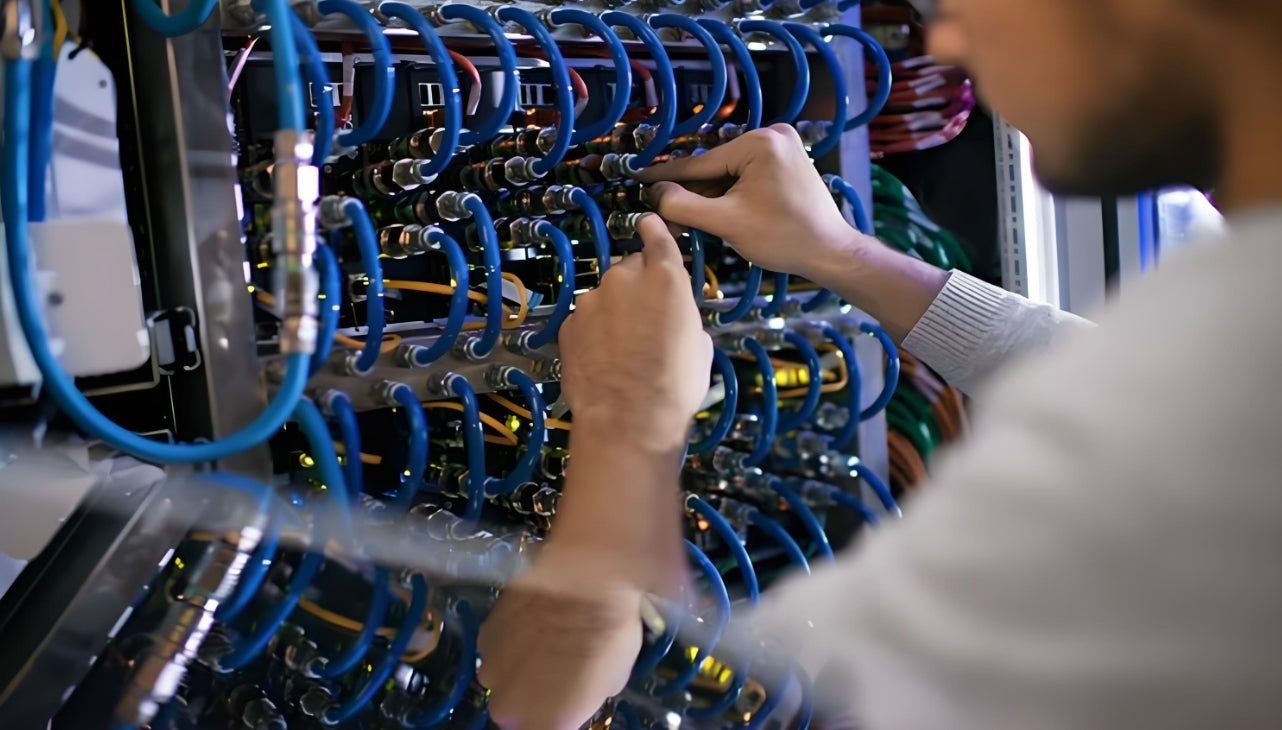
Commissioning and testing must run in parallel with installation — not after — to keep gigawatt-scale projects on schedule
Chapter 2: The Three Speed Levers — Prefabrication, Modularization, and Pre-Termination
Every fast-track installation workflow for AI data centers draws on the same three levers. Used individually, each saves time on one bottleneck. Used together in a coordinated workflow, they can cut total installation duration by 40 to 60 percent.
⚡ Pre-Termination
- Connectors assembled in factory at controlled temperature/humidity
- MPO/MTP on fiber; factory-cat6a/8 on copper
- Zero field splice; eliminates weather/environment risk
- Typical yield: 99.5%+ first-pass on first install
🏗️ Prefabrication
- Rack-level cable assemblies built and tested before site delivery
- Patch panels, trunk cables, and label sets pre-loaded
- Factory QA sign-off replaces on-site QC delays
- Reduces on-site skilled-labor dependency significantly
🔧 Modularization
- Break build into independent modular sections
- Each module tested and commissioned independently
- Fault isolation to one module, not whole system
- Enables parallel workstreams, not sequential phases
📐 Structured Planning
- 3D BIM models for cable routing before site work begins
- Bill of materials locked before factory order placed
- Parallel testing from first cable run
- Reduces change orders — the #1 killer of fast-track schedules
Chapter 3: Pre-Terminated Fiber — MPO/MTP Solutions for AI Cabling Density
Modern AI data centers are fiber-dense by necessity. A single NVIDIA GB300 cluster requires MPO-based high-density fiber infrastructure at every scale-up and scale-out link. Pre-terminated MPO trunk cables — factory-terminated to IEC 61754-7 standards — eliminate the single most time-consuming field task in fiber installation: fusion splicing.
A single qualified fusion splicer can complete roughly 12 to 20 fiber terminations per shift. An MPO-24 trunk carrying 24 fibers in one pull replaces that entire day's work with a single 10-minute plug-in. For a 10,000-port AI data center, this is not an incremental improvement — it is a paradigm shift.

MPO-based trunk cables carrying 12, 24, or 48 fibers per assembly dramatically reduce the number of cable runs needed to connect dense AI server racks
3.1 MPO Polarity: Getting It Right Before the Factory Order
The most common MPO installation failure is not a factory defect — it is a polarity error. MPO polarity methods Type A, Type B, and Type C must be specified at order time and locked into the infrastructure documentation. Mixing methods within a single link segment breaks the channel completely with no intermediate test point to isolate the fault.
| MPO Type | Fiber Count | Best Use Case | Polarity Risk |
|---|---|---|---|
| MPO-12 | 12 fibers | QSFP-DD 400G SR4 links, 12-fiber base-12 systems | Low — straightforward key-up/key-up |
| MPO-24 | 24 fibers | Dual 400G QSFP-DD (2×12f), AI scale-up trunks | Medium — verify Type A or B at order |
| MPO-16 | 16 fibers | OSFP 800G SR8, emerging 1.6T form factors | High — check vendor spec compatibility |
| MPO-8 | 8 fibers | Single QSFP-DD 400G SR4 (4×4f lane mapping) | Medium — lane-to-fiber mapping critical |
3.2 Singlemode vs Multimode for AI Interconnect
AI scale-up networks inside the cluster — NVLink and InfiniBand fabric — almost universally use multimode OM4 or OM5 for distances under 100 meters. Long-reach DCI (Data Center Interconnect) segments beyond 500 meters use singlemode OS2 with LC or SC connectors behind the MPO trunk interface. Specifying the wrong fiber type at order time creates a change order that can cost weeks.
💡 Planning tip: Design your fiber infrastructure in two layers: an intra-rack layer (multimode MPO to LC breakouts, short-reach AI fabric) and an inter-facility layer (singlemode OS2 for DCI and upstream connectivity). Specify each layer independently and ensure the MPO trunk polarity method is documented in both the factory order and the as-built drawings.
Chapter 4: Factory Prefabrication — Rack-Level Assemblies
The highest-impact time saver in fast-track AI data center builds is the pre-built, pre-tested rack assembly. In this workflow, the factory builds the entire copper and fiber patching infrastructure for a rack — including patch panels, trunk cables, cable management, and label sets — ships it to site as a single crane-lift unit, and the on-site team simply drops it into position and connects the server pigtails.
The time comparison is stark:
✅ Prefab Rack Assembly
- Factory build + test: 5–7 days per rack
- On-site install: 1 day per rack (drop & connect)
- First-pass yield: 95–99% (factory tested)
- Labor: semi-skilled on-site; skilled in factory
- Change orders caught before shipping
❌ Traditional Field Build
- On-site build: 3–5 days per rack (skilled crew)
- Termination: 1–2 additional days per rack
- First-pass yield: 70–85% (environment variables)
- Labor: scarce skilled technicians on-site
- Field errors found after all racks installed
The prefab approach does require upfront investment in detailed design documentation. TIA-606-B compliant labeling must be fully specified and locked before the factory order is placed — every label, every port, every cable length. This upfront engineering cost pays back tenfold in reduced on-site rework.

Well-structured rack cabling with pre-loaded patch panels and pre-tested trunk assemblies dramatically reduces on-site installation time and skilled labor dependency
Chapter 5: Copper Cabling for AI Racks — Cat8 with Factory-Terminated Links
AI data center servers still use copper for short-reach server-to-switch connections (top-of-rack and end-of-row), and Cat8 direct-attached copper (DAC) and Cat8.2 shielded assemblies are the dominant choice for 400G and 800G top-of-rack connectivity.
For the structured copper cabling layer — the horizontal and inter-rack links — pre-terminated Cat6A or Cat8 assemblies eliminate the field termination bottleneck. Factory-terminated and tested patch cords with configurable lengths (typically 1m, 2m, 3m, 5m) arrive on-site labeled and ready to route.
💡 Copper length planning tip: Use a structured length matrix for your copper patch cord inventory — 1U cable managers can accommodate a specific slack loop radius. Over-long patch cords are the leading cause of bend radius violations in high-density racks, which degrade PoE and signal integrity simultaneously. Order in 0.5m increments for AI server racks where space is at a premium.
Chapter 6: Site Workflow — Sequencing for Speed Without Cutting Corners
A fast-track installation sequence is fundamentally different from a traditional sequential workflow. The goal is to establish parallel workstreams from day one and to achieve partial commissioning on the first installed section — not to wait until the entire build is complete before turning on any test equipment.
📋 Fast-Track Installation Sequence (Week-by-Week)
| Phase | Week 1–2 | Week 3–4 | Week 5–6 | Week 7–8 |
|---|---|---|---|---|
| Design & BOM | 3D BIM routing, BOM lock, factory orders placed | — | — | — |
| Fabrication | Factory build of rack assemblies begins | Factory QC and factory test runs | — | — |
| Infrastructure Prep | Conduit, cable tray, grounding infrastructure | Parallel — in separate zone from fiber | Parallel — next zone | Parallel — final zones |
| Trunk Cable Pull | — | MPO trunk pull (Zone 1) | MPO trunk pull (Zones 2–N) | — |
| Rack Drop-In | — | Prefabricated racks (Zone 1) | Prefabricated racks (Zones 2–N) | Final alignment |
| Commissioning | — | Zone 1 OTDR + insertion loss test | Zone 1 fiber channel test; Zone 2 OTDR | Full system test, Fluke certification |
The critical discipline in this workflow is zone-based commissioning: each zone is tested and accepted independently before the next zone's cables are pulled. This isolates faults to one zone, prevents a single error from cascading into a full re-test of the entire build, and gives the project manager verifiable acceptance milestones to report to stakeholders.
Chapter 7: Testing & Commissioning — The Parallel Workflow
Commissioning in a fast-track workflow is not the final step — it is a continuous parallel track that starts the moment the first trunk cable is pulled. The testing methodology for AI data center fiber infrastructure follows a tiered approach:
Tier 1: Factory Test (Tier 1 — mandatory for all prefab assemblies)
Every pre-terminated MPO trunk and rack assembly undergoes factory OTDR (Optical Time Domain Reflectometry) and insertion loss testing to IEC 61300-3-4 before shipping. Results are delivered as a PDF test report linked to the serial number of each assembly. Reading these test reports before accepting delivery catches factory defects before they become on-site delays.
Tier 2: Site Acceptance Test (Tier 2 — on every installed link)
On-site testing with an MPO OLTS (Optical Loss Test Set) or OTDR validates that no damage occurred during shipping or pull-in. Test results are recorded per port and compared against the factory baseline. For AI data centers running 400G+ links, insertion loss budgets are tighter than legacy 10G infrastructure — a 0.5 dB excess loss that would be invisible at 10G becomes a showstopper at 400G SR4.
💡 Loss budget tip: At 400G SR4 (PSM4, 500m reach), the total channel loss budget is approximately 2.9 dB for OM4. At 800G SR8, the budget tightens further. Use an OLTS (two-point loss measurement) rather than an OTDR for final acceptance — OTDR traces are harder to interpret for channel-level pass/fail against the standard's loss limits.
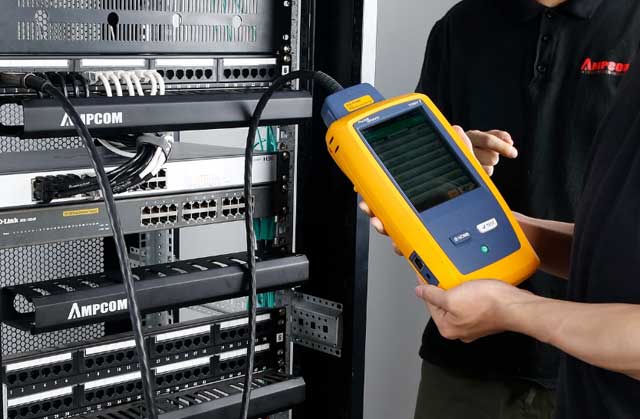
Fluke certification testing — every link in an AI data center must be verified against its specific loss budget before serving 400G+ workloads
Tier 3: System-Level Test (Tier 3 — with live traffic)
Once all zones pass Tier 2, the complete channel is tested end-to-end with live traffic or a BERT (Bit Error Rate Tester) to validate the full link under load. This is where DAC cable performance — latency, jitter, and bit error rate — is verified against the AI workload requirements for the specific cluster type.
Chapter 8: Real Project Comparison — Traditional vs Fast-Track Timeline
How significant is the workflow difference in practice? Consider a representative 10,000-port AI data center build (roughly equivalent to a 64-GPU cluster installation) comparing a traditional field-terminated approach against a fully prefabricated fast-track approach:
| Work Item | Traditional Workflow | Fast-Track Workflow | Time Saved |
|---|---|---|---|
| Design & BOM | 6 weeks (iterative field measurement) | 3 weeks (3D BIM, factory BOM review) | 3 weeks |
| Fiber termination (field splice) | 10,000 fusions × 18/day = ~14 weeks | 0 (pre-terminated MPO) | 14 weeks |
| Copper termination | 2,000 ports × 40/day = ~12 days | 0 (factory Cat8 assemblies) | 12 days |
| Rack build & cable dress | 4 days per rack × 100 racks = ~14 weeks | 1 day per rack × 100 racks = ~3.5 weeks | 10.5 weeks |
| Testing & commissioning | 8 weeks (sequential, full build first) | 4 weeks (parallel, zone-by-zone) | 4 weeks |
| Total Project Duration | ~24–26 weeks | ~9–11 weeks | ~13–17 weeks |
📍 Case Study: Meta Kuna Campus Cabling Approach
The Meta Kuna facility in Ohio exemplifies the gigawatt-pace build model. Reports from the construction phase indicate the data center design incorporated modular power and network zones — each certified and commissioned independently — allowing GPU cluster deployment to begin in the first certified zone while subsequent zones were still being cabled. This parallelization approach compressed what would traditionally be a sequential 18-month project into a 9-month first-phase deployment.
The cable infrastructure strategy relied heavily on pre-terminated MPO-24 trunk assemblies and factory-built rack packages, with fiber testing running in parallel with server hardware installation — not after it.
Chapter 9: Key Takeaways
📌 Five things to remember from this guide:
1. Pre-termination is non-negotiable for any AI data center with more than 2,000 ports — field fusion splicing cannot scale to gigawatt-pace timelines.
2. Lock the BOM before the factory order — prefab is only fast if the design is frozen. Change orders on prefab assemblies cost 3–5× more than field changes.
3. Parallel commissioning starts on day one, not after the last cable is pulled. Zone-based acceptance gives you verifiable milestones throughout the build.
4. Tighten your loss budgets for 400G/800G — what passed at 10G will fail at 400G. Test every link with calibrated OLTS before servers go live.
5. Modularize the build into independent zones — this is what allows multiple workstreams to run simultaneously without blocking each other.
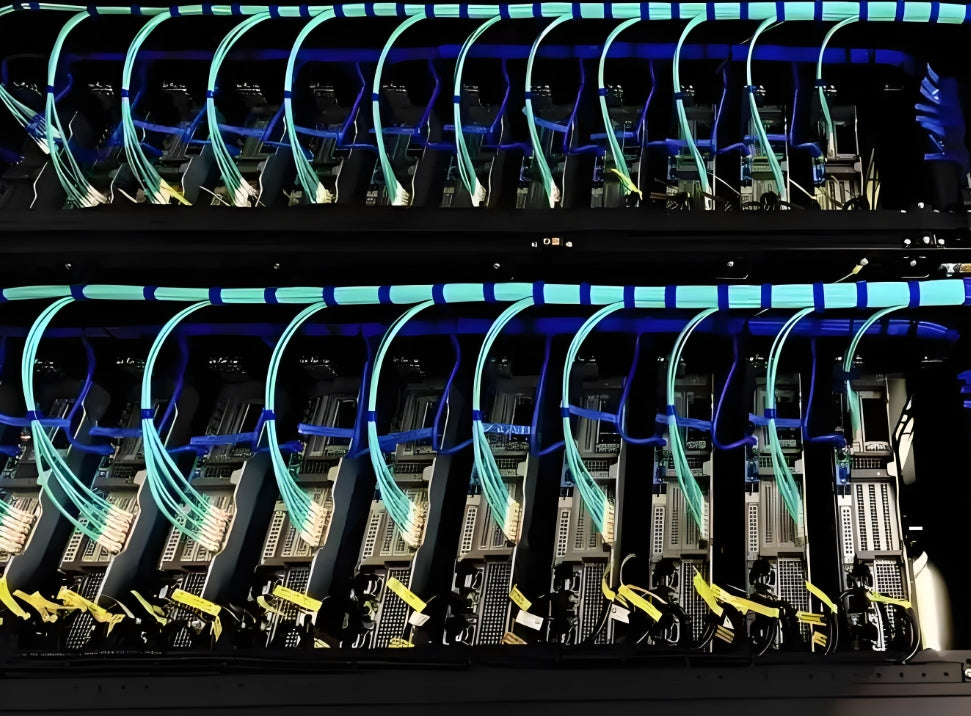
Factory-pre-terminated fiber assemblies with MPO interfaces are the foundation of any fast-track AI data center cable installation workflow
Chapter 10: Frequently Asked Questions
Q: Can pre-terminated MPO assemblies be re-used if a rack layout changes after installation?
A: Yes — MPO trunk assemblies are designed for multiple mating cycles (typically rated to 200–500 mate/de-mate cycles per IEC 61300-2-46). However, the cable routing and length planning must account for the re-patching configuration. If the layout change requires significantly different cable paths, a new trunk assembly with the correct length may be needed. This is why detailed BIM routing before ordering is essential — it reduces the likelihood of needing to re-order due to layout changes.
Q: What happens if a pre-terminated MPO assembly fails factory test?
A: Factory test failures are caught before shipping — the assembly is replaced under the manufacturer's defect warranty. This is why factory test reports should be requested with every order. A field failure of a pre-terminated assembly (e.g., damaged during shipping) can be addressed by swapping the affected assembly — the modular design makes this straightforward. With field-spliced fiber, a single failed splice requires a full re-splice in the field, which can take days to schedule and execute.
Q: Does prefabrication increase upfront cost?
A: Prefab assemblies typically carry a 15–25% cost premium over equivalent field-terminated components. However, when you factor in reduced on-site skilled labor costs, faster project completion (which reduces the total cost of the overall project), fewer change orders, and faster time-to-revenue for the AI cluster, the total cost of ownership for a fast-track workflow is generally 10–20% lower than a traditional field-based approach on projects exceeding 5,000 ports.
Q: How do I manage MPO polarity across a multi-vendor installation?
A: Specify a single polarity method (Type A or Type B) in the project specification and require all vendors to comply. The most common approach for AI data centers is Type A (key-up to key-up throughout), which is straightforward to implement and audit. Document the polarity method in the as-built drawings and verify with an MPO polarity checker (a simple visual or LED polarity tester) before commissioning any zone. Mixing polarity methods within a channel is the single most common cause of dark links in MPO deployments.
Q: Should I use OM4 or OM5 multimode fiber for an AI scale-up network?
A: For intra-cluster AI fabric (NVLink, InfiniBand) at distances under 100 meters, OM4 is the industry standard and the most cost-effective choice. OM5 (with SWDM wideband multimode capability) is relevant for long-reach 40G/100G over 200–300m spans where OM4 begins to show modal dispersion penalties. For any link exceeding 100 meters within the cluster, consult your switch vendor's fiber reach specifications — newer 800G optics may have different reach specifications than legacy 400G modules.
Ready to Plan Your Fast-Track AI Cabling Infrastructure?
AMPCOM supplies pre-terminated MPO fiber assemblies, factory-built rack packages, and Cat8 copper solutions engineered for gigawatt-scale AI data center builds. Get a custom BOM and lead time quote for your next project.
Contact AMPCOM for a Custom Quote →

