
From "Building from Parts" to Turnkey: Construction Practice of Data Center Prefab Modular Solutions
Published:Executive Summary: The traditional "assemble-it-yourself" data center procurement model — where owners separately source power systems, cooling infrastructure, network cabling, and servers — is increasingly failing to meet the demands of AI-scale workloads. Prefab modular construction is not just a trend; it is rapidly becoming the default delivery model for AI data centers in 2026. This article breaks down what prefab modular actually means in practice, how power-cooling-cabling integration works on-site, and what project managers need to watch out for during delivery.
Quick Navigation
1. Why the Old Model Is Breaking Down
The conventional data center delivery model treats each subsystem as an independent workstream: the general contractor handles the building shell, a separate MEP firm handles electrical and mechanical, a cabling contractor handles structured cabling, and a separate IT team handles server racking. In an era where a single AI training cluster can consume 10–40 MW of power and generate heat densities of 50–100 kW per rack, this siloed approach creates three categories of failure:
1.1 Interface Gaps Between Subsystems
The most common problem: the power contractor specifies PDUs with a certain amperage, the cooling contractor specifies chillers with a certain capacity, and the cabling contractor wires up the racks — but nobody owns the integration point where these three systems meet. On-site change orders to fix interface mismatches routinely add 15–25% to project cost and 3–6 months to timeline.
1.2 Speed vs. Quality Trade-off
AI infrastructure buyers cannot afford to wait 18–24 months for a traditionally procured data center. IDC's revised 2026 forecast now projects $497 billion USD in AI infrastructure spending, up 56% year-over-year. Every month of delay translates to lost inference revenue, delayed model training, and competitive disadvantage. But speed achieved by cutting corners on cabling infrastructure — using undersized conduits, skipping burn-in tests, or using non-standard fiber — creates operational nightmares that cost far more to fix post-commissioning.
1.3 The 800G and GPU Cluster Cabling Load
Modern AI clusters require massive intra-rack and inter-rack fiber connectivity: NVLink, InfiniBand, and RoCE networks operating at 400G and 800G per link. A single DGX GB200 rack contains 72 GPUs, each requiring multiple high-speed connections. The cabling density inside these racks — sometimes exceeding 500 fiber connections per rack — demands engineering-grade pre-planning that traditional on-site coordination cannot provide fast enough.

Figure 1: High-density AI rack with complex intra-rack fiber routing — a scenario that demands pre-engineered prefab solutions rather than on-site improvisation
2. What "Prefab Modular" Actually Means
The term "prefabricated" in data centers spans a wide spectrum. Not all modular solutions are created equal — and conflating them leads to poor procurement decisions.
2.1 The Prefab Spectrum
| Delivery Model | What's Pre-built | What's Built On-site | Best For |
|---|---|---|---|
| Traditional Stick-Built | Nothing — all systems assembled on-site | 100% of structure, MEP, cabling, IT | Custom large-scale projects, non-standard sites |
| Containerized Modular | Complete IT + power + cooling modules in ISO containers | Site preparation, interconnection, commissioning | Edge sites, remote locations, rapid deployment |
| Row/Rack Modular | Pre-configured rack rows with integrated power + cooling | Building shell, utility connections, cabling between rows | Mid-size AI clusters, colocation build-outs |
| Block Modular | Pre-engineered structural blocks with all MEP systems pre-wired | Block stacking, external utility tie-in, IT commissioning | Large hyperscale campuses, time-critical AI builds |
| Turnkey Full-Package | End-to-end from shell to commissioned facility | Land acquisition, permits — sometimes even handled | Enterprises wanting zero operational involvement |
2.2 What Makes a Solution "Integrated" vs. Just "Modular"
The critical distinction: integration means the subsystems are engineered together as a system, not just assembled from pre-made parts. True integrated prefab solutions feature:
- Co-engineered power and cooling: PDU capacity matched to chiller capacity, matched to rack heat load simulation
- Pre-terminated cabling infrastructure: fiber and copper pathways designed with the rack layout from day one
- Single point of commissioning: one vendor or integrator owns the whole system's performance, not four separate contractors pointing fingers
- Digital twin documentation: as-built drawings and cabling schedules delivered as a complete digital package

Figure 2: Modern AI data center interior — integrated power, cooling, and cabling infrastructure designed as one system
3. The Three-Layer Integration: Power, Cooling, Cabling
The most technically complex part of prefab modular delivery is ensuring that the three core infrastructure layers — power, cooling, and cabling — are co-engineered rather than co-located. Here is how that integration works in practice.
3.1 Power + Cooling Co-Engineering
In traditional builds, power engineers and cooling engineers work in separate teams with separate budgets and separate timelines. In a prefab modular project, they share a single thermal-electrical simulation model. The output of this model determines:
- PDU capacity and distribution topology — matched to each rack's GPU power draw, not an average
- Chiller and CRAH/CDU sizing — matched to the actual heat density of each rack type (compute vs. storage racks have very different profiles)
- Power chain redundancy design — N+1 vs. 2N for UPS and generator systems, driven by the customer's SLA requirements
3.2 Cabling Integration: The System That Bridges Everything
Network cabling is unique among infrastructure subsystems because it is the last system installed and the first system that fails when things go wrong. In a prefab context, cabling integration means:
Cabinet-Level Pre-Termination
Rather than field-terminating Cat6A or MPO fiber inside the rack on delivery day, integrated prefab solutions deliver racks with pre-terminated patch panels and pre-installed fiber harness assemblies. This brings several benefits:
- Factory termination quality: controlled environment, calibrated tooling, 100% factory test
- Predictable labeling: every port labeled according to the customer's naming convention before delivery
- Faster commissioning: network team connects servers, not terminates cables — commissioning time cut by 40–60%
- Reduced on-site skilled labor dependency: the bottleneck in most data center builds is certified cable installers
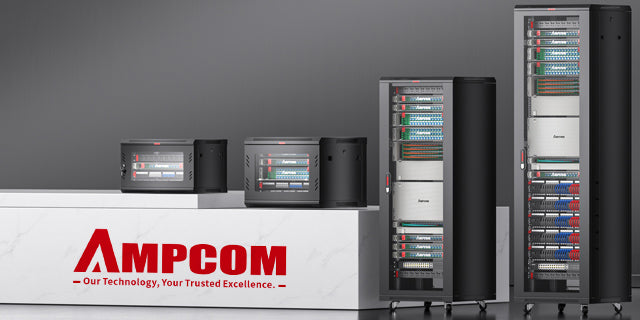
Figure 3: Pre-configured server rack with integrated patch panels and structured cabling — the foundation of a prefab modular delivery
3.3 The Role of Structured Cabling in Power-Cooling Co-Design
Few people realize that structured cabling design actually impacts cooling performance. The volume of cables in a rack affects airflow obstruction — a heavily cabled rack can reduce cooling efficiency by 15–25% compared to a lightly cabled rack with the same heat load. Integrated prefab designers account for this in two ways:
- Cable containment sizing: Over-sizing cable trays and conduits by 30–40% to maintain airflow pathways
- Patch cord management zones: Keeping high-volume patch cord bundles in dedicated vertical managers, away from server intake zones
- Fiber vs. copper density planning: Prioritizing fiber to reduce cable bundle thickness — fiber cables carry far more bandwidth per unit cross-section than copper
4. On-Site Construction Workflow: Step by Step
Understanding the on-site workflow helps project managers coordinate the various trades and avoid the "herding cats" problem that plagues traditional data center builds.
4.1 Phase 1: Site Preparation and Utility Tie-In (Weeks 1–6)
Even the most sophisticated prefab solution still requires a prepared site. This phase involves:
- Ground preparation and structural reinforcement (for floor loading of 15–25 kN/m² for heavy AI racks)
- Utility power connection to the site utility entry point
- Cooling tower or dry cooler positioning and connection
- Fiber optic entry conduit installation from the carrier meet-me room
4.2 Phase 2: Modular Unit Placement and Interconnection (Weeks 7–10)
This is where the prefab model demonstrates its speed advantage. Pre-built modules arrive on-site and are positioned using cranes or heavy equipment. The key activities:
- Rack module placement per the pre-engineered layout drawing
- Inter-row power busway or cable tray connection
- Cooling pipe interconnection between CDU/rack cooling units
- MPO trunk fiber connection between row-terminated fiber panels
4.3 Phase 3: Structured Cabling Completion and IT Commissioning (Weeks 11–14)
With the infrastructure shell complete, the focus shifts to network connectivity:
- Horizontal Cat6A cabling from patch panels to server ports (if not pre-terminated)
- MPO trunk fiber patching between leaf switches and spine
- Fluke certification testing of all copper and fiber links
- Server and GPU cluster racking and power-on
- Network switch configuration and SAN connectivity

Figure 4: Inter-row structured cabling in a high-performance computing facility — pre-engineered routing minimizes on-site rework
4.4 Phase 4: Burn-In, Optimization, and Handover (Weeks 15–18)
The final phase validates that the as-built system performs to specification under real load:
- Load bank testing at 50%, 75%, and 100% of design capacity
- Thermal imaging of rack power and fiber connections under load
- PAM4 signal testing for 800G fiber links (using Fluke CertiFiber Pro or similar testers)
- Network performance validation at full cluster scale
- As-built documentation handover including cabling schedules and ODF records
5. Cabling-Specific Challenges in Prefab Delivery
Even with the best pre-engineering, there are cabling challenges unique to modular delivery that practitioners need to manage proactively.
5.1 The Length Calibration Problem
Pre-terminated assemblies are manufactured to exact lengths specified in the design drawings. But if the actual site dimensions vary even slightly from the design — a few centimeters off in a row pitch, for example — the pre-made cables may be too short. The solution: tolerance budgeting at the design stage, and always ordering a 5–10% spare of each cable assembly type.
5.2 MPO Polarity in High-Density Inter-Row Cabling
As inter-row fiber counts grow with 800G architectures, MPO polarity errors become a significant commissioning delay. In a prefab context where hundreds of MPO connections are pre-terminated in the factory, a polarity mistake in the design stage is expensive to fix on-site. Using Type-B polarity MPO trunk cables consistently throughout the design eliminates this class of error.
5.3 Labeling Consistency Across Factory and Field Teams
One of the most underestimated challenges in prefab delivery: the labeling scheme used in the factory must match what the on-site commissioning team expects. This requires a unified labeling standard agreed upon during design, covering:
- Rack naming convention (row-letter + rack-number)
- Patch panel port numbering (1–24 or U-based referencing)
- Fiber strand labeling (position number in MPO connector)
- Switch port labeling and VLAN assignment documentation
5.4 Managing Cable Slack in Pre-Engineered Routes
Pre-engineered cable routes are designed for efficiency, but they can become problematic when future moves-adds-changes (MACs) require new cables to be pulled through the same pathways. Designing dedicated maintenance loops — small service coils at each rack end — allows future cable additions without disrupting existing connections.
6. Real Project Case: 10MW AIDC in Southeast Asia
Project Profile
A tier-1 hyperscaler commissioned a 10MW AI data center in a Southeast Asian market, targeting a 9-month delivery from ground-breaking to live. The traditional stick-built approach would have taken an estimated 20 months.
Delivery Approach
The project used a block modular + full cabling integration model:
- Structural blocks pre-built in China with integrated power busways and cooling pipework
- Racks pre-configured with AMPCOM pre-terminated Cat6A patch panels and MPO-24 trunk assemblies
- All fiber labeling generated from the project's digital twin and applied at factory before shipment
- On-site phase: block placement → utility tie-in → fiber interconnection → commissioning
Results
| Metric | Traditional Estimate | Actual (Prefab) |
|---|---|---|
| Total delivery time | 18–20 months | 8.5 months |
| On-site cabling installation time | 12–16 weeks | 4 weeks |
| Commissioning failures due to cabling | ~8–12 incidents | 1 incident (MPO polarity, fixed in 2 hours) |
| Fluke certification pass rate (first attempt) | ~88% | 99.2% |
Key Lessons
- Pre-terminated cabling was the single biggest time-saver — eliminated 8 weeks of field termination and re-test cycles
- Digital twin labeling prevented commissioning delays — the network team could trace every cable from the first day of commissioning, not after a manual documentation exercise
- Factory QA reduced on-site rework to near zero — the only field issue was a single MPO polarity mismatch, caught in first-pass testing
7. Key Takeaways and Q&A
Key Points Summary
| # | Takeaway | Practical Implication |
|---|---|---|
| 1 | Prefab modular is the new default for AI-scale builds | Evaluate prefab integrators alongside traditional EPCs for any project over 5MW |
| 2 | Integration, not just modularization, is what delivers value | Demand proof of co-engineered power-cooling-cabling from your vendor |
| 3 | Pre-terminated cabling cuts commissioning time by 40–60% | Include pre-terminated assemblies in your prefab package specification |
| 4 | Labeling and documentation must be agreed at design stage | Create a unified labeling standard document before manufacturing begins |
| 5 | Tolerance budgeting prevents field cable shortages | Order 5–10% spare of each cable assembly type for contingency |
| 6 | MPO polarity discipline prevents expensive on-site rework | Lock in a single polarity type (Type-B recommended) across the entire design |
Frequently Asked Questions
Q: Is prefab modular more expensive than traditional construction?
A: Upfront unit costs for prefab modules are typically 10–20% higher than equivalent stick-built components. However, when you factor in the reduction in on-site labor, faster time-to-revenue, lower change-order exposure, and reduced commissioning failures, the total cost of ownership (TCO) is 10–25% lower for AI-scale projects. The faster delivery also means earlier revenue generation — a critical factor for commercial AI operations.
Q: Can prefab modular work for retrofits and expansions of existing data centers?
A: Yes, row-modular and rack-modular approaches work well for brownfield expansions. The key constraint is physical compatibility: the new modular units must fit the existing floor grid, power entry points, and cooling infrastructure. A thorough site survey and structural assessment is essential before specifying a modular expansion.
Q: How do we handle MACs (moves, adds, changes) in a prefab-built data center?
A: MACs are handled the same way as in traditional builds, but the documentation quality from day one makes them much easier to execute. The pre-engineered cable routes, service loops, and labeling schemes built into the original design create predictable pathways for future changes. For large-scale MACs, pre-order additional cable assemblies matching the original factory specs to maintain consistency.
Q: What fiber types should we specify for a prefab AI data center?
A: For AI intra-cluster connectivity, OM4 or OM5 multimode fiber for short-reach 400G/800G links (under 100m), and OS2 singlemode for longer inter-row or inter-building links. Using MPO-12 or MPO-24 pre-terminated trunks throughout minimizes field termination complexity. Ensure your fiber type selection aligns with your switch and transceiver selection — mixing fiber types is a common and costly mistake.

AMPCOM Technical Team
Infrastructure specialists covering data center cabling design, testing, and deployment for AI-scale facilities across Asia-Pacific.
Ready to Specify Your Next Data Center Cabling Project?
AMPCOM provides pre-terminated cabling assemblies, MPO fiber solutions, and Cat6A/Cat8 patch panel systems designed for modular and traditional AI data center deployments. Contact our team for project consultation and custom solution design.
Get in Touch →

