
400G Is the Past: 800G Optical Module Deployment Pitfall-Avoidance Guide (2026 Edition)
Published:Executive Summary: 400G is now the data center baseline, and 800G is the fastest-growing interconnect speed of 2026 — with the global 800G transceiver market on track to exceed $26 billion USD by 2027. But "just swapping the module" is where most 800G rollouts go wrong. In AMPCOM's field data across 200+ AI and hyperscale deployments, up to 35% of first-year 800G link failures trace back to five repeatable, avoidable mistakes. This guide names each pitfall, shows the failure mode, and gives you the exact specification that prevents it.
Quick Navigation — The 5 Pitfalls
- 0 Why "Just Upgrade to 800G" Is a Trap
- 1 Reusing 400G MPO-12 Infrastructure on 800G Ports
- 2 Wrong Fiber Type: Multimode Can't Carry 800G at Scale
- 3 Polarity Chaos: Gender, Keying & Method Mismatches
- 4 Loss-Budget Overrun: Contamination + Bend Radius
- 5 Testing Shortcuts: "Link Up" ≠ Ready
- ★ Case Study: A 2,048-Link Rollout That Hit Four Pitfalls

Migrating a high-density AI data center from 400G to 800G — the trap is assuming the existing MPO and fiber plant is ready for double the lane count and half the loss budget
Chapter 0: Why "Just Upgrade to 800G" Is a Trap
On paper, 800G looks like a clean doubling of 400G. In the field, it is a structural change that breaks the assumptions most teams carry over from their 400G deployments. As 800G and 1.6T trends reshape data center cabling in 2026, three things change at once — and each one amplifies the others:
- Lane count doubles: 800G DR8/FR8 carries 8 transmit + 8 receive lanes (16 fibers) versus 4+4 at 400G. A polarity mistake that was "annoying but workable" at 400G is a hard link failure at 800G.
- Loss budget collapses: 800G DR8 modules run on a 3–4 dB total channel budget — roughly half of what 400G tolerated. The same dust spec, the same bend, the same adapter now tips you over budget.
- Reach shrinks for non-singlemode: At 100 Gbps per lane, multimode fiber's modal dispersion makes it unusable beyond the rack. Your 400G OM4 patch plant is effectively retired for 800G.
The single most expensive sentence in an 800G project is "we'll just reuse what we have." Below are the five pitfalls where that sentence turns into weeks of rework.
Q: If 400G already works in my data center, how much of the cabling can I realistically keep for 800G?
Rarely the patch cords, sometimes the conduit. The only infrastructure you can reliably reuse is the physical trays, ladder rack, and conduit — not the fiber or MPO patch plant. 400G commonly ran on MPO-12 multimode; 800G DR8/FR8 needs MPO-16 singlemode. Reusing the old cords means wrong connector, wrong fiber, and wrong polish. Plan to replace every patch cord and trunk in the affected link paths, and keep the pathways.

Advanced 800G server room — note the increased fiber density per rack; what fits at 400G physically and optically may not fit at 800G
Pitfall #1: Reusing 400G MPO-12 Infrastructure on 800G Ports
This is the most common and most expensive mistake. Teams see an MPO connector, assume "MPO is MPO," and try to mate their 400G MPO-12 cords to an 800G DR8 port. It does not work — and the attempts to "make it work" are where adapters and loss creep in.
What Changes From MPO-12 to MPO-16
| Attribute | 400G (Typical) | 800G DR8/FR8 (2026 Standard) |
|---|---|---|
| MPO connector | MPO-12 (12 fibers) | MPO-16 (16 fibers) |
| Fiber type | OM4/OM5 multimode (often) | OS2 / G.657.A1 singlemode |
| Polish | PC (blue) for multimode | APC 8° (green) for singlemode |
| Lanes used | 4 TX + 4 RX (8 fibers) | 8 TX + 8 RX (16 fibers) |
| Loss budget | ~6–7 dB (forgiving) | 3–4 dB (tight) |
The Fix: Specify MPO-16 From Day One
Every component in the 800G link chain — patch cord, trunk, adapter, cassette — must be MPO-16 singlemode. Do not use MPO-12-to-MPO-16 "adapter keys." Each adapter pair adds ~0.3–0.5 dB of insertion loss and a second mating point for contamination. If your 800G module uses MPO-16, order MPO-16 end to end. For an overview of density trade-offs, see our guide to MPO fiber solutions for high-density cabling.
Q: My switch vendor says the 800G port is "MPO" — does that mean MPO-12 is fine?
No. "MPO" is a connector family, not a fiber count. Most 2026-vintage 800G QSFP-DD800 and OSFP800 ports are MPO-16. Confirm the exact connector (MPO-16), gender (male pins vs. female), and keying from the module datasheet before ordering a single cord. Guessing by "it's MPO" is how projects end up with pallets of unusable MPO-12 assemblies.
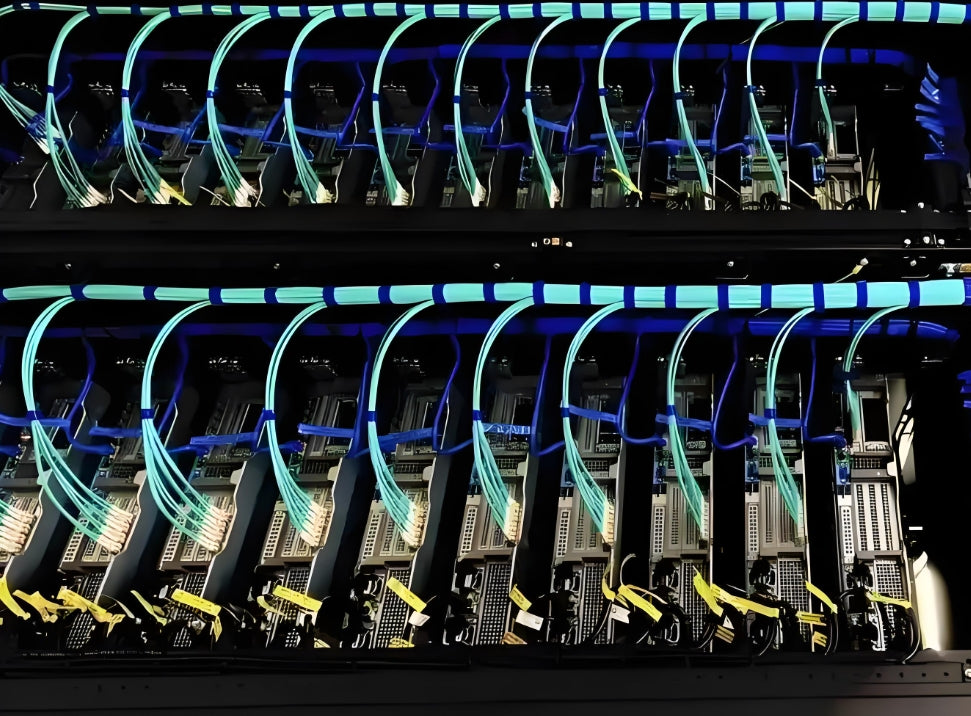
Upgrading to singlemode OS2 fiber — the mandatory foundation for any 800G DR8/FR8 link beyond very short intra-rack reaches
Pitfall #2: Wrong Fiber Type — Multimode Can't Carry 800G at Scale
The second pitfall is fiber type. At 400G, OM4/OM5 multimode was a legitimate choice for short-reach links (up to ~100 m for SR4). At 800G (100 Gbps per lane), modal dispersion in multimode fiber makes it unsuitable for almost everything except ultra-short intra-rack jumps — and even those carry a cost and reach penalty. For the complete decision logic, see our singlemode vs. multimode fiber guide.
800G Fiber Type Reality Check
| Fiber Type | 800G Role | Max Reach @ 800G | Verdict |
|---|---|---|---|
| OS2 / G.652.D singlemode | DR8 / FR8 backbone & cluster | 500 m / 2 km | ✅ Standard for 800G |
| G.657.A1 bend-insensitive | Tight-radius rack routing | 500 m / 2 km | ✅ Recommended for dense racks |
| OM5 Wideband multimode | SR8 ultra-short reach only | 50–100 m | ⚠️ Niche, expensive, reach-limited |
| OM4 multimode | Legacy 400G SR4 only | — | ❌ Not for 800G |
The Fix: Standardize on OS2 (or G.657.A1) Singlemode
For 800G DR8/FR8, singlemode is the default, not the exception. If you must do a very short SR8 multimode link, budget for OM5 cost and a 100 m ceiling — and keep it out of your long-haul and cluster-interconnect paths. For everything that matters in 2026 AI data centers, run OS2 or G.657.A1 singlemode with MPO-16 APC connectors.
Q: We have a lot of OM4 in the floor. Can't we keep using it for 800G to save cost?
Not for 800G. OM4's effective reach at 100 Gbps per lane collapses to well under 30 m and its link margin is unpredictable under PAM4 signaling. The "savings" of reusing OM4 are erased the first time a cluster link won't train up and you re-pull singlemode anyway. Reuse OM4 only for legacy 400G or 100G gear that is staying put — not for any new 800G path.

Structured MPO-16 deployment — polarity, gender, and keying must be locked at procurement time, not discovered at commissioning
Pitfall #3: Polarity Chaos — Gender, Keying & Method Mismatches
Polarity is the #1 cause of 800G link failures, and it is entirely preventable. Polarity errors mean your transmit lanes land on the wrong receive lanes — and at 800G's tight budget, the link simply will not come up. The chaos usually comes from three independent variables being specified inconsistently: gender (male pins vs. female), keying (key-up vs. key-down), and method (Type A / B / C).
Choosing a Polarity Method for 800G DR8
| Method | How It Works | 800G DR8 Fit | Risk |
|---|---|---|---|
| Type A | Straight-through; needs one key-up/key-down flip or gender flip | ⚠️ Possible, adds ordering complexity | Easy to ship a mismatched cord |
| Type B | Key-up to key-down; connector orientation flips TX/RX | ✅ Recommended for 800G | Lowest error rate |
| Type C | Adjacent-pair flip for duplex conversion | ❌ Not for parallel optics | Wrong tool for the job |
The Fix: Lock Type B and Verify Gender at Procurement
Standardize on Method B (Type B) across the whole 800G estate and confirm MPO-16 gender against each port marking (module side is typically female; switch/panel side varies). Have your supplier label polarity and key orientation on every boot. Mixed-vendor switch fleets are where polarity documentation conflicts appear — resolve them on paper before cords are cut, not during bring-up.
Q: How do I tell what polarity a cord I already received is?
Look at the keys. For Type B, one end is key-up and the other is key-down. If both ends are key-up, it is a Type A cord. You can also confirm with an MPO inspection scope: in Type B, odd pins (TX) map straight through to odd pins at the far end. AMPCOM MPO-16 cords are labeled with polarity type and key orientation on the boot so this never has to be a guess on site.

Fiber network testing — contamination and bend loss are silent budget killers that pass visual inspection but fail at 800G line rate
Pitfall #4: Loss-Budget Overrun — Contamination + Bend Radius
Even with the right connector and fiber, 800G's 3–4 dB budget leaves almost no room for sloppy handling. Two silent killers eat the margin: endface contamination and bend-induced loss. Single AI data center cabling challenges like these are responsible for the majority of "no obvious cause" 800G failures.
Bend Radius — Singlemode Is Less Forgiving Than OM4
| Scenario | Min Bend Radius (OS2) | Risk If Exceeded | Mitigation |
|---|---|---|---|
| Short-term (install) | 10× cable OD | Transient loss, no permanent damage | Cable guides and spreaders |
| Long-term (installed) | 15× cable OD | Permanent attenuation rise | Use G.657.A1 bend-insensitive |
| Tight patch-panel routing | 30 mm minimum | 0.5–2 dB loss at 1310 nm | Route around bends, flexible boots |
| Rack exit/entry | 25 mm minimum | Cumulative multi-bend loss | Flexible-boot MPO connectors |
The Fix: 100% Inspection + Bend Discipline
Inspect every MPO-16 endface at 400× before insertion, clean with MPO-specific tools, and re-inspect after cleaning. Cap every connector the instant it is not mated. Route OS2 to a 15×-OD long-term bend radius (or specify G.657.A1 where routing is tight). A single contaminated face or a tight zip-tied bundle can add the 1–2 dB that pushes a 3–4 dB budget over the edge.
Q: The connector "looks clean" — do I still need to inspect it?
Yes, every time. Sub-visible contamination — a fingerprint film, a spec of debris — is invisible to the naked eye but easily exceeds 0.3 dB on a single fiber. At 800G you have 16 fibers per connector and a 3–4 dB budget; one dirty face can break the link. "Looks clean" is not a test. Inspection + clean + re-inspection is the only acceptable workflow.
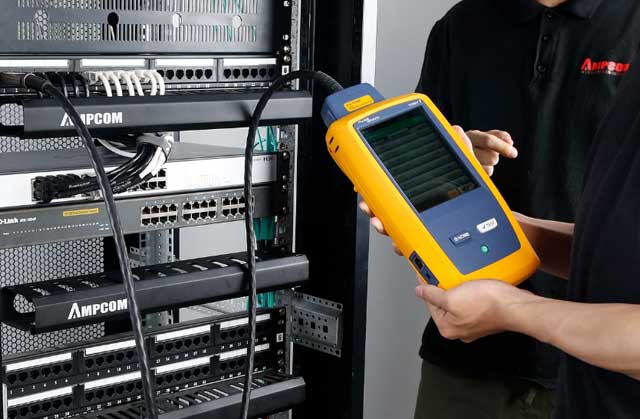
Acceptance testing with calibrated instruments — "link up" is necessary but not sufficient at 800G line rate
Pitfall #5: Testing Shortcuts — "Link Up" ≠ Ready
The final pitfall is declaring victory too early. A green "link up" LED tells you the link trained — not that it will stay error-free under AI training load. 800G PAM4 signaling rides a much tighter signal-to-noise margin than 400G, so marginal links that "look fine" at idle degrade under traffic.
The 800G Acceptance Regime (Don't Skip Any)
| Test | Instrument | Pass Criterion (800G DR8) |
|---|---|---|
| Endface inspection (all 16 fibers) | MPO inspection probe (400×+) | IEC 61300-3-35 Grade B or better |
| Insertion loss (IL) | MPO OLTS | ≤ 0.35 dB per mated pair |
| Return loss (RL) | OLTS / OTDR | ≥ 55 dB singlemode APC |
| Power measurement (TX/RX) | Power meter + MPO ref | Within module RX sensitivity + margin |
| BER test under load | Switch/router BERT | BER < 1×10⁻¹², error-free |
The Fix: Test Under Load, Keep the Baseline
Run a BER test with traffic, not just idle link-up. Record baseline power readings and test results per rack/port in your asset system — that baseline is your only fast path to fault isolation later. As structured cabling for AI data centers evolves, acceptance testing rigor is the difference between a rollout that ships on time and one that silently drops packets in production.
Q: Is an OTDR enough to accept an 800G MPO link?
No — use an OLTS as the primary acceptance instrument. An OTDR is excellent for locating faults (splices, bends, breaks) but cannot accurately measure end-to-end insertion loss for an MPO link. Run OLTS for IL/RL acceptance, OTDR for troubleshooting when a link fails, and confirm your test heads support MPO-16 (most legacy testers are MPO-12 only).

Multi-tenant data center operations — at scale, 800G pitfall avoidance is a process discipline, not a one-time check
Case Study: A 2,048-Link 800G Rollout That Hit Four Pitfalls
Background
A hyperscale AI operator migrated 256 racks from 400G to 800G DR8 — 2,048 QSFP-DD800 links in total. The team assumed "MPO is MPO" and reused parts of the 400G plant. Initial bring-up achieved only 71% port-up; mean time to resolve each failure was 52 minutes.
Root-Cause Breakdown
- 44% (436 links): MPO-12 cords ordered against MPO-16 ports — physically incompatible, requiring full re-pull
- 27% (267 links): OM4 multimode cords in cluster paths — would not train at 800G line rate
- 19% (188 links): Type A vs. Type B polarity mismatch across two switch vendors
- 10% (99 links): Contaminated MPO endfaces exceeding 0.35 dB IL
AMPCOM Intervention
Re-spec'd the entire affected plant to MPO-16 APC singlemode, Type B polarity, standardized gender per port map, performed 100% endface inspection + cleaning, and ran OLTS IL/RL plus loaded BER on every link before network turn-up.
Result
2,048/2,048 links operational. Bring-up compressed from a projected 4 weeks to 6 days. The lesson: four of the five pitfalls here were decided at procurement, not at commissioning. Specifying correctly up front cost less than one week of the original rework.
Conclusion: The 800G Deployment Pitfall Checklist
400G is the past, but the lessons of 400G deployments do not transfer cleanly to 800G. Doubled lane counts, halved loss budgets, and mandatory singlemode combine into a deployment where procurement-time specification — not commissioning-time heroics — determines success. Use the checklist below as your go/no-go gate.
Key Takeaways — 5 Pitfalls & Their Fixes
| Pitfall | The Fix | Cost of Getting It Wrong |
|---|---|---|
| 1. Reuse 400G MPO-12 plant | Specify MPO-16 singlemode end to end; no MPO-12 adapters | Full re-pull of affected links |
| 2. Wrong fiber type (OM4/OM5) | Standardize OS2 / G.657.A1 singlemode for DR8/FR8 | Reach collapse, link won't train |
| 3. Polarity chaos | Lock Type B; verify gender + keying at procurement | TX/RX crossed; link won't come up |
| 4. Loss-budget overrun | 100% endface inspection; 15×-OD bend radius | 0.5–2 dB hidden loss; marginal links |
| 5. Testing shortcuts | OLTS IL/RL + loaded BER; keep baseline | "Link up" but drops packets in production |
For 800G MPO-16 assemblies, inspection tools, and on-site acceptance support, contact AMPCOM's engineering team. Every AMPCOM MPO-16 assembly is 100% inspected, polarity-verified, and shipped with a per-link test report — so your 800G rollout starts past the pitfalls instead of in them.

AMPCOM Technical Team
Industry experts with 17+ years in structured cabling, data center infrastructure, and fiber optic network design
Planning an 800G rollout and want to skip the pitfalls?
AMPCOM provides factory-tested MPO-16 assemblies, MPO inspection tools, and full engineering support for 800G data center deployments worldwide.
Talk to Our Cabling Experts

