
How to Choose the Right Patch Cable Length
Published:Executive Summary: Patch cable length is the most overlooked variable in structured cabling design -- and the one that causes the most avoidable failures. A cable that's 30 cm too short creates connector tension that triggers intermittent 10G link flaps. One that's 2 m too long coils into a bend-radius violation that silently eats 3 dB of margin. Copper or fiber, Cat5e or OS2 singlemode, the physics doesn't care about your deadline.
This guide maps every standard patch cable length to its real-world deployment scenario, walks through the copper-vs-fiber distance equation, and gives you a repeatable measurement framework that eliminates the guesswork -- whether you're populating a single IDF closet or 200 racks in a hyperscale data center.
Quick Navigation
- 1 Why Patch Cable Length Is a Performance Parameter
- 2 Standard Copper Patch Cable Lengths: Complete Reference
- 3 Standard Fiber Patch Cord Lengths: Complete Reference
- 4 Copper vs Fiber: How Distance Shapes Your Cable Choice
- 5 Bend Radius: The Silent Length Multiplier
- 6 How to Measure for Patch Cable Length: A Repeatable Method
- 7 Standard vs Custom Lengths: When the Premium Pays Off
- 8 PoE, Heat, and Length: The Bundle Effect
- 9 Decision Framework: Pick the Right Length in 5 Minutes
- 10 Key Questions Answered (FAQ)

Properly sized patch cables eliminate excess slack, preserve bend radius, and maintain clean airflow paths through high-density data center racks
Why Patch Cable Length Is a Performance Parameter
Most network engineers treat patch cable length as a logistics variable -- "grab whatever reaches." That mindset is expensive. Length directly controls three physical-layer parameters that determine whether your link passes certification or fails intermittently at 2 AM.
The Three Failure Modes Caused by Wrong Length
| Failure Mode | Root Cause | Symptoms | Typical dB Loss |
|---|---|---|---|
| Connector Tension (Too Short) | Lateral pull on RJ45/LC ferrule prevents full insertion | Intermittent link flaps, CRC errors, auto-negotiation to lower speed | 0.5 - 2.0 dB (fiber); 1 - 3 dB (copper) |
| Bend-Radius Violation (Too Long, Coiled) | Excess cable coiled tighter than minimum bend radius | Increased attenuation at specific wavelengths, BER spikes under traffic load | 0.5 - 1.5 dB per tight bend (fiber); 0.2 - 0.8 dB (copper) |
| Cable-Management Overload (Too Long, Unmanaged) | Patch cord spaghetti blocks airflow, combs against neighboring cables | Alien crosstalk (AXT) in copper, connector contamination in fiber, thermal throttling | Variable; AXT can degrade SNR by 3-6 dB |
Real-World Case: The $11,000 Length Mistake
A colocation provider in Northern Virginia deployed 48 racks with Cat6A patch cords ordered at 14 ft (4.3 m) "to be safe." The racks had 42U of equipment with top-of-rack switches and servers in the same cabinet -- requiring at most 5 ft (1.5 m). The excess 9 ft of cable per connection (768 total patch cords) created 6,912 ft of unnecessary copper coiled inside vertical cable managers. Within six months, alien crosstalk at the bundle center degraded 17 of 48 links below the 10GBASE-T signal-to-noise threshold. The remediation required replacing all 768 patch cords at $11,000 in materials alone, plus three days of downtime-window labor.
Length in the Channel Budget
The ANSI/TIA-568.2-D channel model allocates 100 m total, broken into:
Channel Length Budget Breakdown
Horizontal cable (solid conductor): Maximum 90 m (295 ft)
Equipment cord (patch panel to switch): Maximum 5 m (16 ft)
Work-area cord (outlet to device): Maximum 5 m (16 ft)
Total channel: 100 m (328 ft) including all patch cords and horizontal cable
10GBASE-T over Cat6: Channel limited to 55 m (180 ft) total, making patch cord discipline even more critical
Every meter of unnecessary patch cable burns channel budget that could have been allocated to horizontal reach. In borderline installations where the horizontal run is already at 85-88 m, a pair of 7 ft patch cords instead of 3 ft cords can push the channel past 100 m -- and past certification.
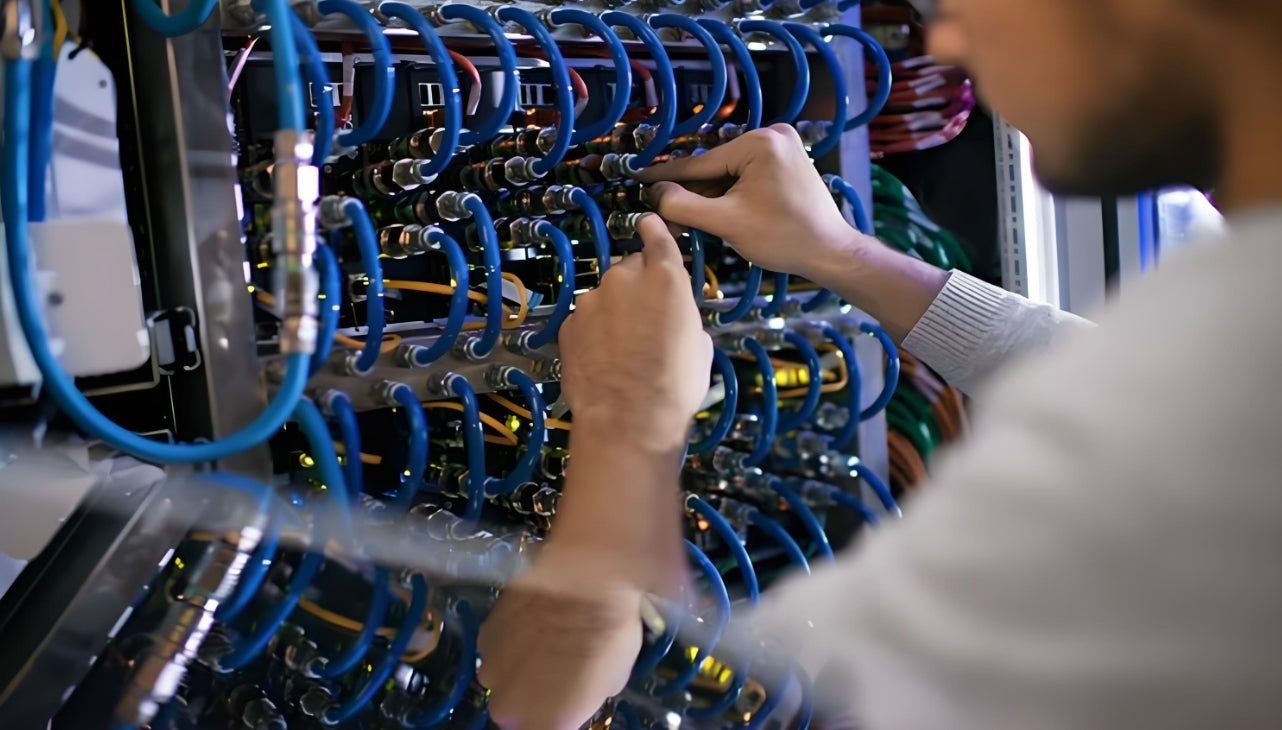
Measuring actual routing distance -- not straight-line distance -- is the difference between a clean installation and a patch cord graveyard
Standard Copper Patch Cable Lengths: Complete Reference
Industry-Standard Lengths (Imperial & Metric)
Copper patch cables -- covering Cat5e, Cat6, Cat6a, Cat7, and Cat8 -- are manufactured in standardized lengths that align with common rack dimensions and deployment scenarios. These are not arbitrary: each length maps to a specific physical layout.
| Standard Length | Metric Equivalent | Best-Fit Deployment Scenario | Typical Use |
|---|---|---|---|
| 1 ft | 0.3 m | Adjacent ports on same patch panel or switch | Intra-panel patching, stacked switches |
| 3 ft | 1 m | Server to top-of-rack switch (same cabinet, 1U-20U distance) | Most common data center length |
| 5 ft | 1.5 m | Server to top-of-rack switch (42U cabinet, bottom-to-top) | Full-cabinet vertical runs |
| 7 ft | 2 m | Adjacent cabinet in same row, switch-to-switch | Inter-cabinet stacking links |
| 10 ft | 3 m | End-of-row switch to cabinet (within row) | EoR architecture, IDF patching |
| 14 ft | 4.3 m | Cross-row patching, raised-floor traverse | MDA-to-HDA connections |
| 25 ft | 7.6 m | IDF closet to work area outlet | Enterprise desktop patching |
| 50 ft | 15.2 m | Long horizontal reach within large telecom rooms | Cross-connect fields, demarc extensions |
| 100 ft | 30.5 m | Maximum practical pre-made patch cord | Temporary links, event networking |
Category-Specific Length Constraints
Higher cable categories impose tighter length limits because they operate at higher frequencies where attenuation per meter increases dramatically:
| Category | Max Frequency | Max Channel Length | Max Patch Cord per End | Key Limitation |
|---|---|---|---|---|
| Cat5e | 100 MHz | 100 m | 5 m | Gigabit Ethernet; most forgiving category |
| Cat6 | 250 MHz | 100 m (1G); 55 m (10G) | 5 m | 10GBASE-T limited to 55 m channel |
| Cat6A | 500 MHz | 100 m | 5 m | Alien crosstalk; shielding recommended for bundles > 24 |
| Cat7 | 600 MHz | 100 m | 5 m | S/FTP mandatory; GG45/TERA connectors |
| Cat8 | 2,000 MHz | 30 m | 3 m | 25G/40GBASE-T; data center only, not for horizontal |
The Cat8 30 m channel limit fundamentally changes the patch cable equation: with only 30 m of total budget and 24 m of horizontal cable, you have just 6 m of combined patch cord length. A pair of 5 m standard patch cords already exceeds the budget. For Cat8 deployments, 1-3 m patch cords are not a preference -- they're a hard requirement.
Standard Fiber Patch Cord Lengths: Complete Reference
Fiber Length Standards by Application
Fiber patch cords follow a different length logic than copper. Because fiber attenuation at data center distances is negligible (0.003 dB/m for OM4 at 850 nm vs 0.2 dB/m for Cat6A at 500 MHz), the length decision is dominated by cable management, bend radius, and connector accessibility -- not signal integrity.
| Standard Length | Metric | Application Scenario | Fiber Type |
|---|---|---|---|
| 0.5 m | 1.6 ft | Adjacent ports on same fiber patch panel or stacked switches | OM3/OM4/OS2 LC-LC |
| 1 m | 3.3 ft | Server to top-of-rack fiber switch (same cabinet) | OM4 LC-LC duplex |
| 2 m | 6.6 ft | Most common data center fiber length; intra-cabinet with managed slack | OM4/OS2 LC-LC, MPO-12 |
| 3 m | 10 ft | Adjacent cabinet in same row; through-cabinet-side routing | OM4/OM5 LC-LC, MPO-12/MPO-24 |
| 5 m | 16 ft | Cross-row within same pod; overhead tray routing | OM4/OS2, MPO trunk extensions |
| 7 m | 23 ft | Inter-pod connections within same data hall | OS2 LC-LC, MPO-24 |
| 10 m | 33 ft | MDA-to-HDA backbone within same floor | OS2 LC-LC/SC, MPO-24 trunk |
| 15 m | 49 ft | Inter-floor riser connections; HDA-to-ZDA | OS2 singlemode |
| 20 m+ | 66 ft+ | Building-to-building within campus; custom | OS2 singlemode armored |
Fiber-Specific Consideration: The MPO Trunk Length Trap
MPO/MTP trunk cables (12-fiber or 24-fiber) are typically factory-terminated at fixed lengths: 2 m, 5 m, 10 m, 15 m, 20 m, 30 m, 50 m, and 100 m. The mistake that costs data center operators thousands is ordering trunk cables based on the straight-line distance between cabinets. A 10 m straight-line distance between MDA and HDA actually requires a 15-18 m trunk cable once you account for vertical rise (2.5 m per floor), horizontal tray offset (1-2 m per turn), and service loops (1 m per end). The rule: measure the actual cable pathway, not the floor-plan distance, and add 15% for slack.

Fiber patch cords at 2-3 m standard lengths provide enough slack for safe bend-radius routing without creating unmanageable cable mass in vertical managers
Copper vs Fiber: How Distance Shapes Your Cable Choice
The Distance Decision Matrix
Patch cable length is not an isolated decision -- it interacts with the fundamental copper-vs-fiber choice. The table below maps each deployment scenario to the correct medium and the resulting patch cord length range.
| Scenario | Typical Reach | Recommended Medium | Patch Cord Length Range | Why |
|---|---|---|---|---|
| Intra-rack (ToR switch to server) | 0.5 - 2 m | Copper (Cat6A DAC or Cat6A patch) | 1 - 5 ft (0.3 - 1.5 m) | Lowest cost, lowest latency; no optics required |
| Adjacent rack (same row) | 2 - 5 m | Copper DAC or Cat6A patch | 7 - 14 ft (2 - 4.3 m) | Still within copper's economic sweet spot |
| End-of-row to rack (EoR) | 5 - 15 m | Fiber (OM4/OM5 MMF) | 5 - 15 m (fiber) | Copper 10G runs out of guaranteed reach beyond 15 m Cat6A in high-EMI environments |
| Cross-row (within data hall) | 15 - 30 m | Fiber (OM4/OM5 or OS2) | 15 - 30 m (fiber) | Copper Cat8 limited to 30 m total channel; fiber has no practical length penalty |
| MDA to HDA (backbone) | 30 - 100 m | Fiber (OS2 singlemode) | 30 - 100 m (fiber trunk) | OS2 handles 100 m at 400G with zero distance degradation |
| Inter-building (campus) | 100 m - 2 km | Fiber (OS2 singlemode) | Custom trunk assemblies | Copper is physically incapable beyond 100 m |
The Attenuation Reality Check
Here's the math that makes fiber the default choice beyond 15 m, rendered in plain dB:
Attenuation per Meter: Copper vs Fiber
Cat6A copper at 500 MHz: ~0.2 dB/m → 15 m cable = 3.0 dB of insertion loss, plus connector loss
OM4 multimode fiber at 850 nm: ~0.003 dB/m → 30 m cable = 0.09 dB of attenuation, plus connector loss
OS2 singlemode fiber at 1310 nm: ~0.0004 dB/m → 100 m cable = 0.04 dB of attenuation, plus connector loss
Bottom line: A 30 m Cat6A patch cord burns over 6 dB of your insertion loss budget. A 30 m OM4 fiber patch cord burns less than 0.1 dB. For any run where the patch cord alone exceeds 10 m, fiber is the technically correct answer.
Bend Radius: The Silent Length Multiplier
Minimum Bend Radius Specifications
Bend radius directly controls how much "extra" length you actually need. A cable that requires a 30 mm bend radius cannot make a tight 90-degree turn inside a 40 mm cable manager without violating its mechanical spec. That means you need more cable length to route the curve properly.
| Cable Type | Min Bend Radius (No Load) | Min Bend Radius (Under Tension) | Practical Turn Diameter |
|---|---|---|---|
| Cat5e UTP (5.5 mm OD) | 22 mm (4x OD) | 44 mm (8x OD) | ~50 mm |
| Cat6 UTP (6.0 mm OD) | 24 mm (4x OD) | 48 mm (8x OD) | ~50 mm |
| Cat6A S/FTP (7.5 mm OD) | 30 mm (4x OD) | 60 mm (8x OD) | ~70 mm |
| Cat7 S/FTP (8.0 mm OD) | 32 mm (4x OD) | 64 mm (8x OD) | ~75 mm |
| Cat8 S/FTP (8.5 mm OD) | 34 mm (4x OD) | 68 mm (8x OD) | ~80 mm |
| Fiber 1.6 mm simplex | 16 mm (10x OD) | 24 mm (15x OD) | ~40 mm |
| Fiber 2.0 mm duplex | 20 mm (10x OD) | 30 mm (15x OD) | ~50 mm |
| Fiber 3.0 mm distribution | 30 mm (10x OD) | 45 mm (15x OD) | ~70 mm |
| MPO-12 trunk (4.5 mm) | 45 mm (10x OD) | 68 mm (15x OD) | ~100 mm |
The Bend Radius-to-Length Equation
Here's the practical consequence: every time your patch cable makes a 90-degree turn around a cable manager, it consumes a length of cable equal to approximately 1.57 times the bend radius of that turn. For a Cat6A S/FTP cable turning around a 70 mm-radius manager, that's 110 mm per turn -- per cable. In a 42U rack with 48 patch cords each making three turns, the bend-radius compliance alone consumes 15.8 m of total cable length that a "straight-line" measurement misses.
Case: The 42U Rack That Failed Thermal Audit
An enterprise customer deployed Cat6A S/FTP patch cords at 3 ft (1 m) throughout a 42U cabinet. The cables reached their destinations -- but only by being pulled straight across the rack rails, making 120-degree bends around equipment ears. A thermal audit six months later found that the crushed cable bundles at the rail edges blocked 38% of the designed front-to-back airflow through that rack zone. The server inlet temperature exceeded ASHRAE A3 limits by 4°C during peak load. The fix: replacing all 48 patch cords with 5 ft (1.5 m) cables and routing them through vertical cable managers with compliant bend radii. Cost: $620 in cables. Avoided cost: one rack of throttled servers and a potential thermal shutdown event.
How to Measure for Patch Cable Length: A Repeatable Method
The Route-First Measurement Protocol
Stop measuring straight-line distance. It produces cables that are too short 80% of the time in structured cabling environments. Use this five-step method instead:
Five-Step Patch Cable Measurement Method
Step 1 -- Identify the cable pathway: Determine whether the cable routes through horizontal managers (front-to-side), vertical managers (up/down the rack), or overhead trays. Never assume a direct diagonal path.
Step 2 -- Measure the routed path: Use a flexible measuring tape or pull-string to trace the actual cable route through all managers, turns, and transitions. Record the measurement in meters.
Step 3 -- Add bend-radius allowance: For each 90-degree turn, add 1.57 x minimum bend radius. For copper, that's roughly 50-110 mm per turn depending on category. For fiber, 40-100 mm per turn depending on diameter.
Step 4 -- Add service-loop slack: Add 30-50 cm (12-20 in) at each end for re-termination allowance and device-swap flexibility. Do not add more than 50 cm per end: excess slack creates cable management problems.
Step 5 -- Round up to the next standard length: After calculating your total, select the next available standard length. If your calculation says 1.8 m, buy 2 m cables -- not 1.5 m. The cost difference is negligible compared to a failed installation.
Common Measurement Scenarios with Worked Examples
| Scenario | Routed Path | + Bend Turns | + Service Loops | = Total | Buy |
|---|---|---|---|---|---|
| Server U20 to ToR switch U42 | 1.0 m vertical + 0.3 m horizontal | 2 turns x 70 mm = 0.14 m | 2 x 0.4 m = 0.8 m | 2.24 m | 2 m / 7 ft |
| Patch panel port 1 to switch port 48 | 0.4 m horizontal through manager | 2 turns x 50 mm = 0.10 m | 2 x 0.3 m = 0.6 m | 1.10 m | 1 m / 3 ft |
| EoR switch to cabinet 8 (same row) | 8.5 m through overhead tray | 4 turns x 100 mm = 0.40 m | 2 x 0.5 m = 1.0 m | 9.90 m | 10 m fiber |
| Fiber patch: MDA panel to HDA panel, cross-row | 18 m through tray | 6 turns x 70 mm = 0.42 m | 2 x 0.5 m = 1.0 m | 19.42 m | 20 m OS2 |
Standard vs Custom Lengths: When the Premium Pays Off
The Economics of Standard Lengths
Standard-length patch cables benefit from mass production: automated cutting, automated RJ45 crimping, factory certification testing, and bulk packaging. The cost premium of custom lengths (typically 30-60% more per cable) is only justified under specific conditions.
| Factor | Standard Lengths | Custom Lengths |
|---|---|---|
| Cost per Cat6 patch cord | $2 - $8 | $5 - $15 |
| Lead time | In stock | 3-14 days |
| Factory certification | Batch-tested, full test report | Available but adds cost |
| Cable management outcome | Good when length is correctly matched | Excellent when manufactured to exact pathway measurement |
| Best for | Deployments under 10 racks, mixed layouts | 10+ racks with identical architecture |
Five Triggers for Ordering Custom Lengths
Custom patch cable lengths are not a luxury -- they are an operational necessity when any of these five conditions apply:
When Custom Lengths Are Worth the Cost
1. Identical rack architecture across 10+ cabinets: The volume justifies the per-cable premium. Order one length per port type (e.g., 1.35 m for servers U2-U21 to ToR U42, 2.10 m for U22-U41).
2. The gap between two standard lengths is a genuine problem: When a 3 ft cable is too short (creates tension) but a 5 ft cable creates unmanageable slack loops, a custom 4 ft (1.2 m) cable is the correct answer.
3. MPO/MTP trunk cables in a defined architecture: Trunk cable length errors cascade to every channel in the trunk. A 2 m measurement error on a 24-fiber trunk creates 48 incorrect channel lengths. Custom trunks measured to the actual pathway are mandatory.
4. High-density fiber panels with port-to-port variability: In a 1U 72-fiber LC panel, ports 1-36 on the left side and ports 37-72 on the right side require different patch cord lengths to reach the same switch. Mixing two custom lengths per panel eliminates the "all cables too long for half the ports" problem.
5. Cat8 25G/40GBASE-T deployments: The 30 m channel budget is so tight that every centimeter of excess patch cord matters. Custom lengths are not optional here -- they are the difference between a certified link and a failed one.
PoE, Heat, and Length: The Bundle Effect
Voltage Drop Over Patch Cords
Power over Ethernet (PoE) turns patch cable length from a signal-integrity concern into a power-delivery one. The DC resistance of copper conductors creates a voltage drop proportional to length that can starve powered devices.
| PoE Standard | Max Power at PSE | Min Power at PD | Budget for Loss | Voltage Drop per 10 m of 24 AWG |
|---|---|---|---|---|
| 802.3af (PoE) | 15.4 W | 12.95 W | 2.45 W | ~0.4 V (manageable) |
| 802.3at (PoE+) | 30 W | 25.5 W | 4.5 W | ~0.6 V (manageable) |
| 802.3bt Type 3 (PoE++) | 60 W | 51 W | 9 W | ~1.0 V (use 23 AWG) |
| 802.3bt Type 4 (PoE++) | 90 W | 71.3 W | 18.7 W | ~1.5 V (23 AWG minimum; keep patch cords under 5 m) |
For PoE++ Type 4 at 90 W, a pair of unnecessarily long 7 ft patch cords instead of 3 ft cords adds over 2 m of conductor length, consuming an extra 0.3-0.4 V of an already tight voltage budget. In a deployment with marginal horizontal cable (85 m+, 24 AWG), that 0.3 V is the difference between a camera that boots and one that browns out.
Bundle Heating and Derating
The TIA TSB-184-A guideline for PoE cable bundles states that the temperature rise inside a bundle must not exceed 15°C above ambient. Longer patch cables in a bundle increase thermal mass and reduce heat dissipation surface area per unit length. In practice, this means:
- Bundles of 24+ Cat6A cables carrying PoE++ should use the shortest patch cords the rack layout permits -- ideally 1-3 ft in the patching zone
- Avoid coiling excess PoE patch cord length inside vertical cable managers; the coil acts as a thermal insulator
- For PoE++ Type 4, specify 23 AWG conductors for patch cords over 5 ft; the larger conductor reduces DC resistance from 0.084 to 0.067 Ω/m
Decision Framework: Pick the Right Length in 5 Minutes
Run every patch cable decision through this six-question framework. It catches the edge cases that trip up even experienced cabling teams.
Patch Cable Length Decision Framework
Question 1 -- What is the routed distance? Measure the actual cable pathway through all managers and trays. Not the straight-line distance. Not the "looks about right" distance.
Question 2 -- Copper or fiber? Under 10 m routed path: copper is cost-effective. Over 10 m: fiber is technically correct. Over 15 m copper: you are burning more than 3 dB of insertion loss margin.
Question 3 -- How many turns? Count the 90-degree turns in your pathway and add 1.57x the minimum bend radius per turn to your total length.
Question 4 -- Is PoE involved? If yes, keep patch cord length to the minimum the layout allows. Never add "extra for flexibility." Use 23 AWG for PoE++ patch cords over 5 ft.
Question 5 -- Standard or custom? Standard unless you have 10+ identical racks, MPO trunks with defined pathways, a genuine gap between two standard sizes, or a Cat8 deployment.
Question 6 -- Did you add service loops? 30-50 cm per end. No more, no less. This is not a negotiation.
Decision Framework Applied: A 12-Rack EoR Deployment
A customer is designing a 12-rack pod with end-of-row switching. The farthest cabinet is 9 m from the EoR switch along the overhead tray pathway. Applying the framework:
Q1: Routed distance = 9.0 m (tray) + 2.5 m (vertical riser in rack) + 1.5 m (horizontal at each end) = 13.0 m
Q2: Copper or fiber? = 13 m routed path, over 10 m threshold → fiber (OM4 LC-LC duplex)
Q3: Turns = 6 x 90° turns x 70 mm fiber bend radius x 1.57 = 0.66 m added
Q4: PoE? = No (switch-to-switch uplinks)
Q5: Standard or custom? = Standard 15 m OM4 LC-LC (total = 13.0 + 0.66 + 1.0 service loops = 14.66 m; rounds up to 15 m standard)
Result: Order 15 m OM4 LC-LC duplex fiber patch cords. Copper is technically possible at 13 m of Cat6A but leaves only 1 dB of insertion loss margin -- not worth the certification risk.

The difference between a maintainable deployment and a troubleshooting nightmare is patch cables cut to the right length -- measured by pathway, not by eye
Key Questions Answered
What is the most common patch cable length for data centers?
For intra-rack connections, 1 ft (0.3 m) and 3 ft (1 m) are the most common copper patch cable lengths. For inter-rack connections within the same row, 7 ft (2 m) to 10 ft (3 m) predominate. For fiber patch cords, 2 m and 3 m are the most widely deployed lengths because they provide sufficient slack without excess cable mass in vertical managers.
Does a longer patch cable affect network speed?
Yes, through three mechanisms. Copper: longer cables increase insertion loss and near-end crosstalk; Cat6's 10GBASE-T range drops from 55 m to 37 m at elevated temperatures. Fiber: each meter adds negligible attenuation at data center distances (0.003 dB/m for OM4). Both: the dominant concern for lengths under 30 m is not bandwidth but cable management -- excess slack creates bend-radius violations that cause micro-bends and intermittent packet loss.
Can I use a custom-length patch cable instead of standard sizes?
Yes, when one of these triggers is met: (1) 10+ racks with identical architecture, (2) a genuine gap between two standard lengths where one is too short and the next creates dangerous slack, (3) MPO/MTP trunk cables in a defined pathway, (4) high-density fiber panels with port-to-port length variability, or (5) Cat8 deployments where the 30 m channel budget demands millimeter-level precision.
What happens if a patch cable is too short?
A cable that's too short creates lateral tension on the connector. For copper, this pulls the RJ45 plug out of full insertion, degrading contact resistance and causing intermittent link flaps at 1G and 10G. For fiber, tension on the LC/SC ferrule creates micro-gaps at the end-face interface, adding 0.5-2.0 dB of insertion loss -- enough to push a marginal link below the receiver sensitivity threshold.
What is the maximum length for a Cat6 patch cable?
Per ANSI/TIA-568.2-D, each individual patch cord should not exceed 5 m (16 ft) within the telecommunications room or work area. The total channel is 100 m, with a maximum of 10 m of combined patch cord length. For 10GBASE-T over Cat6, the total channel is further limited to 55 m, making patch cord length discipline even more critical. Pre-made Cat6 patch cables are commonly available at 1 ft, 3 ft, 5 ft, 7 ft, 10 ft, 14 ft, 25 ft, 50 ft, and 100 ft.
Are fiber patch cord length rules different from copper?
Yes. Bend radius: fiber requires 10x cable diameter minimum (vs 4x for copper), so a 2 mm fiber cord needs a 20 mm turn radius. Attenuation: fiber loss per meter is negligible -- 0.003 dB/m for OM4 vs 0.2 dB/m for Cat6A -- so fiber length selection is dominated by cable management, not signal integrity. Trunking: MPO/MTP trunks at 5-100 m must be measured by pathway, not straight-line distance, because measurement errors cascade to every channel in the trunk.
How does PoE affect patch cable length selection?
PoE introduces DC voltage drop proportional to cable length. For PoE++ Type 4 (90 W), a pair of unnecessarily long 7 ft patch cords instead of 3 ft cords wastes 0.3-0.4 V of a tight voltage budget. Additionally, longer PoE patch cords in bundles retain more heat; the TIA TSB-184-A guideline limits bundle temperature rise to 15°C above ambient. Best practice: keep PoE patch cords as short as the rack layout allows and specify 23 AWG conductors for runs over 5 ft.
Related Articles
- Cat6 Patch Cable: Everything You Need to Know — Complete specifications, UTP vs STP, jacket types, and deployment best practices for the most widely deployed copper patch cable category
- Component vs Channel vs Permanent Link Testing: Specs, Limits & Certification Guide — How cable length interacts with testing methodologies and pass/fail thresholds across TIA and ISO standards
- AMPCOM Multimode Patch Cables: Empowering Next-Gen Digital Infrastructure — OM3/OM4/OM5 fiber patch cord specifications and deployment strategies for data center environments
- AI Frontend vs Backend Networks: Key Design Differences in Data Center Architecture — How network topology dictates copper vs fiber choices and the patch cord length implications of each design

AMPCOM Technical Team
Industry experts with 17+ years in enterprise network infrastructure
Planning a large-scale data center deployment?
Our team offers free consultation and customized cabling solutions for hyperscale and enterprise data centers.
Get Free Consultation

